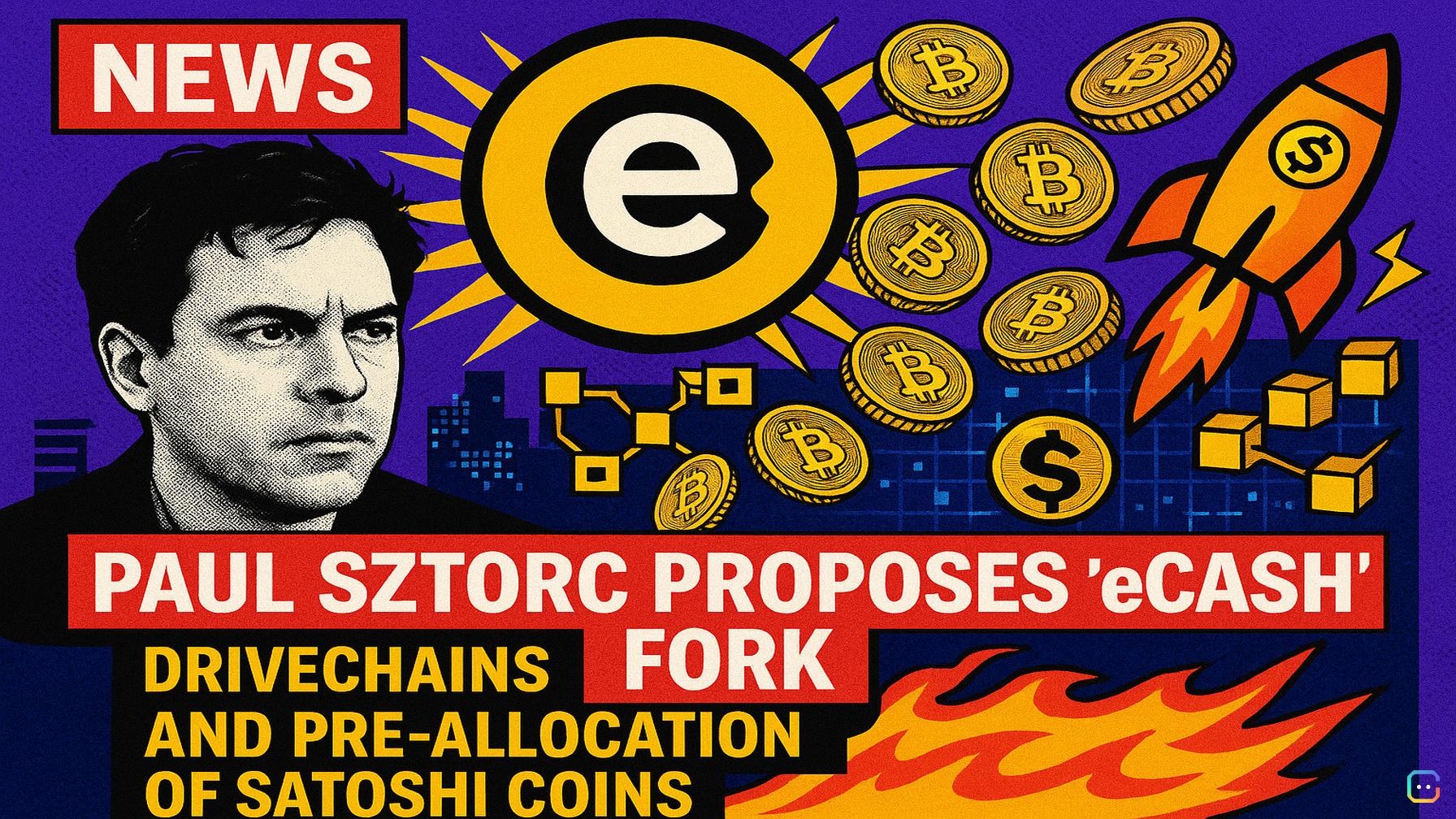
Long-time Bitcoin developer Paul Sztorc has escalated a years‑long push to change Bitcoin’s architecture by proposing a contentious hard fork that would spin the ledger into a new chain called eCash — and hand out free tokens to current BTC holders. The plan, announced on X, has reignited old debates about forks, incentives and the ethics of touching coins tied to Bitcoin’s pseudonymous creator, Satoshi Nakamoto.
What Sztorc is proposing
- The fork would copy Bitcoin’s entire history and launch a separate network at Bitcoin block height 964,000, currently targeted for August 2026. At the moment of the split, every BTC balance would be mirrored as an equivalent eCash balance — “Hold 4.19 BTC at the time of the fork, get 4.19 eCash,” Sztorc wrote.
- A coin‑splitter tool would be released to help holders separate their original BTC from newly minted eCash tokens.
- The new chain is largely a near‑copy of Bitcoin but adds Drivechains, a sidechain architecture Sztorc first proposed in 2015 and formalized as BIP300 (2017) and BIP301 (2019). Drivechains let assets move between the main chain and sidechains so developers can run experiments (privacy, DEXes, prediction markets, quantum resistance, etc.) without changing Bitcoin’s base rules.
Drivechains: what they aim to do
Sztorc compares Drivechains to service roads next to a highway: they don’t change the main route but let traffic divert to different lanes with different rules when needed. He says seven Drivechains are already in development for the eCash chain, including a Zcash‑style privacy chain, a prediction market called Truthcoin, a decentralized exchange named CoinShift, and a quantum‑resistant chain dubbed Photon.
The flashpoint: Satoshi’s coins
The most controversial element of the proposal is how Sztorc plans to finance early development and attract collaborators: by assigning a portion of the eCash tokens that would correspond to addresses believed to belong to Satoshi Nakamoto to investors before the fork. Because a full ledger copy would recreate balances for every wallet — including the roughly 1.1 million BTC historically attributed to Satoshi’s untouched addresses — those balances would appear on eCash as well.
According to Sztorc, fewer than half of the Satoshi‑equivalent eCash coins would be pre‑allocated to investors now as an incentive to finish work ahead of launch. The exact mechanism for this pre‑assignment remains unclear and, since eCash does not yet exist, would effectively be a promised credit contingent on a successful fork.
Community backlash
That financing choice has drawn sharp condemnation from parts of the Bitcoin community. “Taking Satoshi coins is theft and disrespectful,” Bitcoin advocate Peter McCormack wrote on X, adding that the name eCash is already in use in projects like Cashu and Fediverse Lightning integrations — choices he called poor. Josh Ellithorpe, CTO at Pixelated Ink, warned that the precedent could be dangerous: “Now it's Satoshi, but it could be anyone later,” he said, adding concerns about misrepresenting the BCH fork, borrowing another project’s name, and the lack of replay protection.
Why Sztorc says it’s needed
Sztorc argues the pre‑allocation is pragmatic: it creates a tangible early incentive to recruit developers and keep the project from becoming a “zombie” that dies unfinished or — worse from his perspective — becomes controlled by a small, centralized group of contributors. He frames the move as essential to building momentum and completing the technical work before launch.
Context and implications
Hard forks are not new: in 2017 a dispute over Bitcoin’s block size limit resulted in a split that created Bitcoin Cash (BCH). Forks copy transaction history up to the split and then diverge, producing new rules, features and tokens. But the eCash plan highlights modern tensions around protocol governance, developer funding, and the ethics of reassigning balances that are effectively dormant but culturally and symbolically significant.
If the proposal proceeds, it will test how much of the Bitcoin community is willing to accept a fork that borrows the ledger and modifies who controls which tokens before a chain begins. The debate touches both technical tradeoffs — whether Drivechains are the right scaling path — and broader norms: who has the right to redistribute balances that were never spent on the original chain.
Next steps
Sztorc has publicized the timeline and some technical details on X; the fork remains a proposal and will require adoption by enough users, developers and miners of the new chain to go forward. Expect intense discussion in the months ahead as stakeholders weigh the design, the Drivechains roadmap, and the political and legal optics of reallocating Satoshi‑linked balances.
Read more AI-generated news on: undefined/news