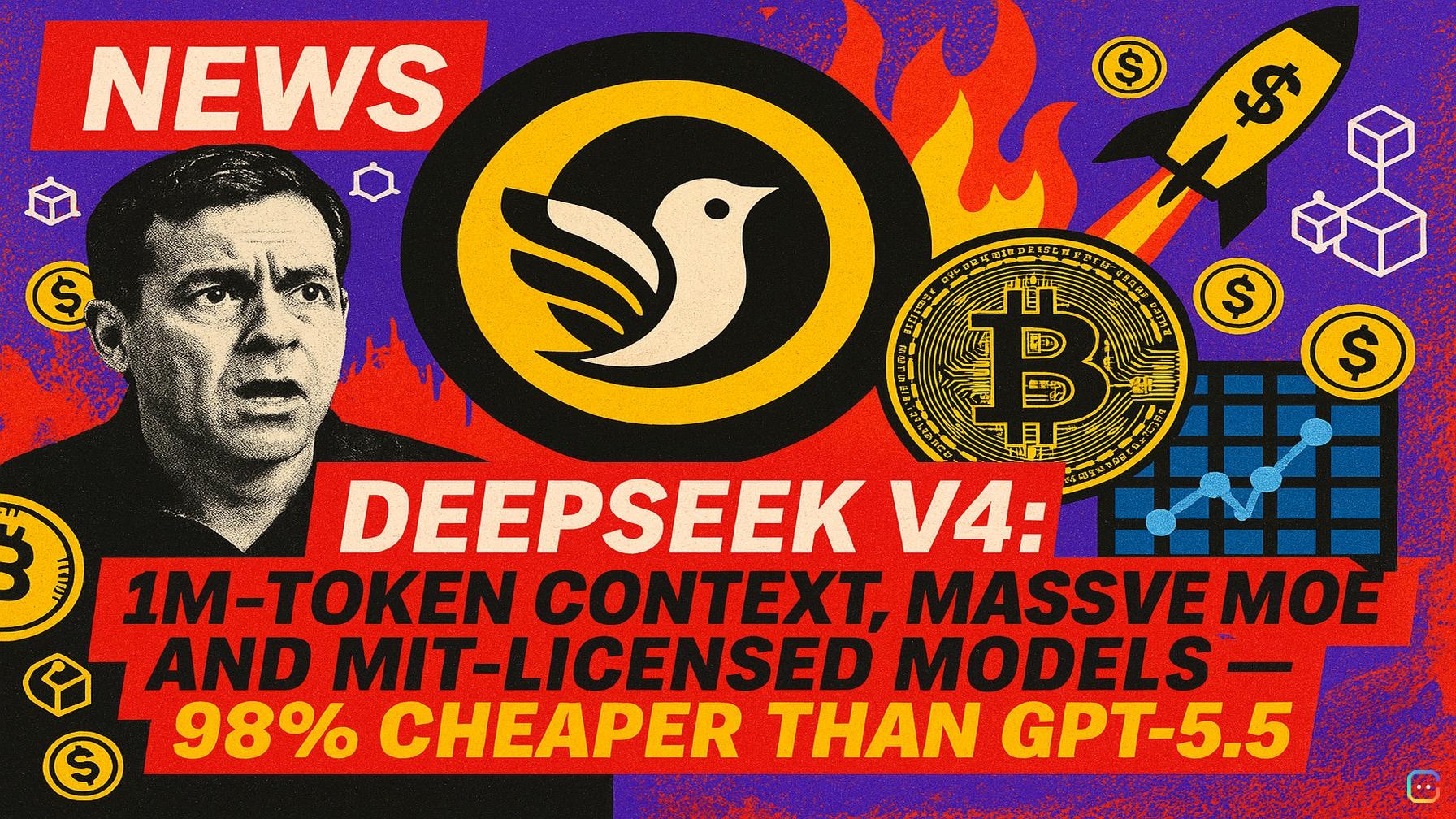
Headline: DeepSeek V4 Arrives — One-Million-Token Context, Massive MoE Model, and Pro Pricing That Undercuts GPT-5.5 by 98%
DeepSeek dropped V4 just hours after OpenAI unveiled GPT‑5.5 — a timing that smells intentional for a Hangzhou lab racing around U.S. chip export restrictions. The new family ships two open-weight models today: DeepSeek‑V4‑Pro and DeepSeek‑V4‑Flash. Both support a 1,000,000‑token context window (roughly 750,000 words — the Lord of the Rings trilogy and then some), are free to run locally, and come with price points that sharply undercut Western closed‑source alternatives.
Why crypto builders should care: longer context, far lower token costs, and the ability to run and adapt the models locally can dramatically cut the bill for tasks that dominate crypto projects — smart‑contract audits, on‑chain data analysis, DAO governance document review, full‑codebase reasoning, and agentic bots that chain multiple calls together.
Key specs and pricing
- DeepSeek‑V4‑Pro: 1.6 trillion total parameters; Mixture‑of‑Experts activates 49 billion parameters per inference. Price: $1.74 per million input tokens, $3.48 per million output tokens.
- DeepSeek‑V4‑Flash: 284 billion total parameters; 13 billion active. Price: $0.14 per million input, $0.28 per million output.
- Context: 1,000,000 tokens standard for both models (no premium tier).
- License & availability: MIT license, models on Hugging Face, free to run locally; old deepseek-chat and deepseek-reasoner endpoints retire July 24, 2026.
What’s new under the hood
DeepSeek keeps the full technical picture public (paper on GitHub) and leaned hard into efficiency. The headline trick is a refined Mixture‑of‑Experts (MoE): the huge model footprint stores more knowledge, but only a relevant slice (49B for Pro, 13B for Flash) wakes for each request — more knowledge, same compute.
To handle one‑million‑token attention without bankrupting users, DeepSeek invented two attention schemes:
- Compressed Sparse Attention: compress token groups (e.g., 4 tokens → 1 entry), then use a “Lightning Indexer” to pick the most relevant chunks for a query. Think: a librarian who skips irrelevant books and goes straight to the right shelf.
- Heavily Compressed Attention: aggressive compression (e.g., 128 tokens → 1 entry) to create a cheap global view. The model alternates layers of both approaches to retain both detail and overview.
Performance and efficiency gains
- At one million tokens, V4‑Pro uses 27% of the compute V3.2 needed; KV cache drops to 10% of V3.2.
- V4‑Flash uses 10% of V3.2’s compute and 7% of the memory.
Those savings let DeepSeek offer much lower costs per token than comparable offerings.
Benchmarks — where it shines and where it trails
DeepSeek published full comparisons and didn’t hide gaps:
Wins and standout results:
- Codeforces (competitive programming): V4‑Pro scored 3,206, roughly 23rd among human contest participants.
- Apex Shortlist (hard math/STEM): V4‑Pro 90.2% vs Opus 4.6 85.9% and GPT‑5.4 78.1%.
- SWE‑Verified (real GitHub issue resolution): 80.6%, matching Claude Opus 4.6.
- Agentic, real‑world work (GDPval‑AA by Artificial Analysis): V4‑Pro‑Max 1,554 Elo, ahead of GLM‑5.1 (1,535) and MiniMax M2.7 (1,514); Claude Opus 4.6 still leads at 1,619.
Where it lags:
- MMLU‑Pro multitasking: V4‑Pro 87.5% vs Gemini‑3.1‑Pro 91.0%.
- GPQA Diamond expert knowledge: V4‑Pro 90.1% vs Gemini 94.3%.
- Humanity’s Last Exam (graduate‑level test): V4‑Pro 37.7% vs Gemini‑3.1‑Pro 44.4%.
- Long‑context needle retrieval: V4‑Pro beats Gemini‑3.1‑Pro on CorpusQA but loses to Claude Opus 4.6 on MRCR.
Agentic developer relevance
Two agent features matter for product builders:
- Interleaved thinking: V4 retains chain‑of‑thought across multi‑step tool calls (web search → code → search), avoiding the “amnesia” that forces a model to rebuild its mental state between steps.
- Tool integration and developer feedback: V4‑Pro plugs into Claude Code, OpenCode, and other coding tools. In a survey of 85 developers using V4‑Pro as their primary coding agent, 52% said it was ready as their default, 39% leaned yes, and fewer than 9% said no.
Market context and competitive landscape
DeepSeek’s V4 arrives in a fast‑moving field:
- OpenAI launched GPT‑5.5 with Pro pricing at $30 per million input and $180 per million output; GPT‑5.5 (non‑Pro) listed $5 input / $30 output per million tokens. GPT‑5.5 outperforms V4 on Terminal Bench 2.0 (82.7% vs 70.0%) but costs far more for many tasks.
- Anthropic rolled out Claude Opus 4.7 (April 16) and has other variant work in progress (e.g., Claude Mythos). Xiaomi released MiMo V2.5 Pro (April 22) at $1 input/$3 output per million tokens, and Tencent released Hy3.
- DeepSeek’s last headline moment — the R1 release in January 2025 — triggered sharp market reactions (reportedly removing $600 billion from Nvidia’s market cap that day). This V4 release is quieter and focused on efficiency and developer economics.
Real dollar impact example
DeepSeek’s low costs aren’t hypothetical: an industry tweet noted that if Uber had used DeepSeek instead of another model for its 2026 AI needs, what would have been four months of usage could have lasted seven years at DeepSeek prices.
What this means for crypto projects
- Lower token costs and one‑million‑token contexts let crypto teams analyze entire codebases, run long forensic analyses on on‑chain history, and maintain richer dialogue histories for agents and governance bots without constant chunking.
- Open weights and MIT licensing mean firms can host models on private infrastructure, customize them for smart‑contract semantics, and avoid costly per‑token cloud bills.
- Interleaved thinking helps multi‑step automated agents (audit pipelines, bots that fetch on‑chain data then run simulations then propose transactions) maintain context across tool calls.
Limitations and what’s next
- Models are text‑only for now; multimodal work is promised but not released, meaning labs with early multimodal wins (Xiaomi, OpenAI) still have an edge in image/audio/video tasks.
- DeepSeek is transparent about gaps versus leading closed models; for scenarios where absolute top reasoning is critical, premium closed models still pull ahead.
Bottom line
DeepSeek V4 is a major efficiency play: giant open‑weight models with Mixture‑of‑Experts, new compressed attention methods, and a one‑million‑token context delivered at dramatically lower prices. For builders in crypto — where large documents, entire codebases, and complex agentic flows are common — V4 could cut costs and simplify architectures. The models are MIT‑licensed and on Hugging Face now, with enterprise and developer implications likely to unfold quickly as teams benchmark real workloads.
Links and practical notes
- Models and paper: available on Hugging Face and GitHub (DeepSeek published full technical details).
- Old endpoints (deepseek-chat and deepseek-reasoner) retire July 24, 2026.
Read more AI-generated news on: undefined/news