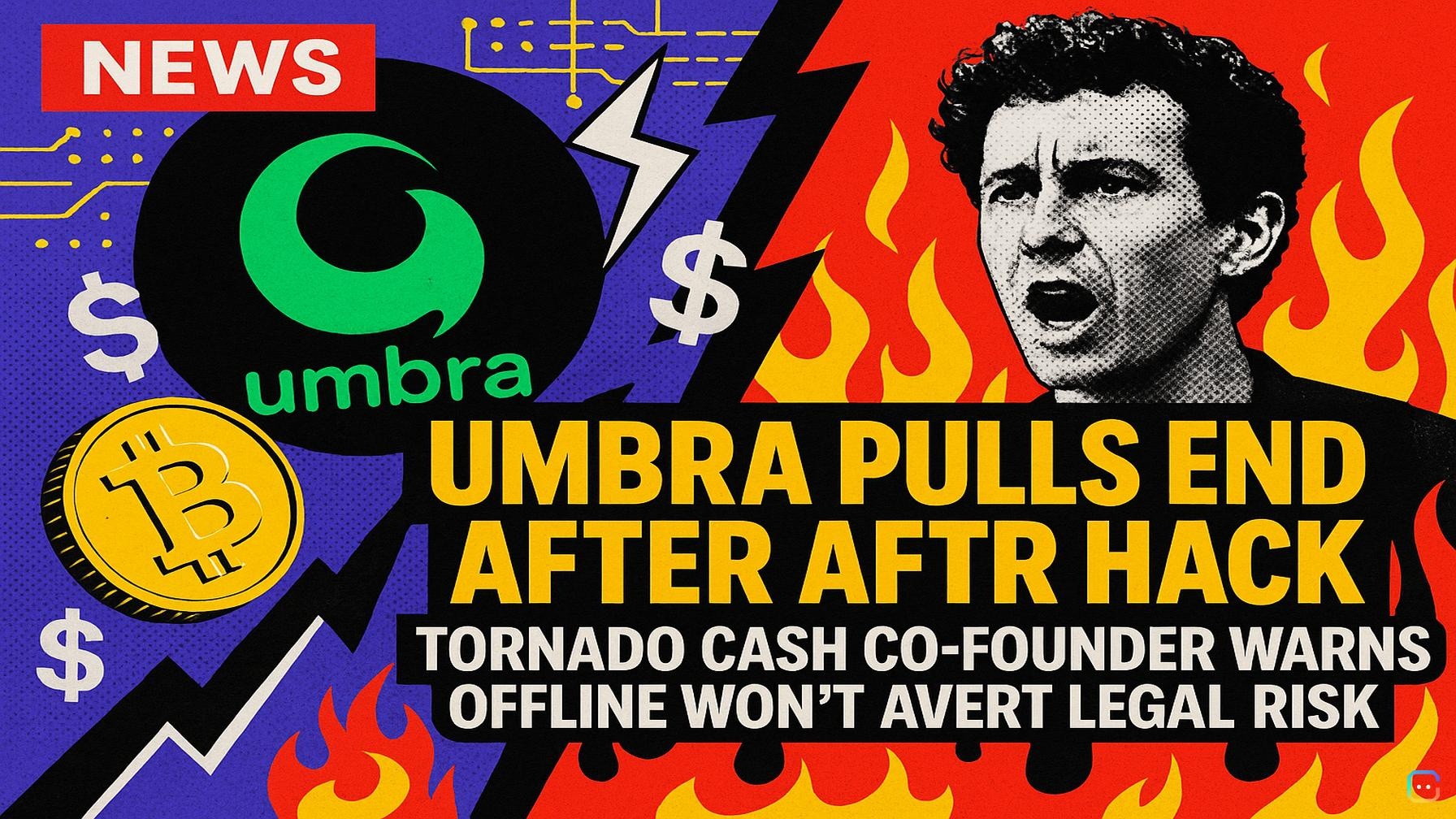
Privacy tool Umbra temporarily pulled its hosted website after reports that hackers used the protocol to move stolen funds — and Tornado Cash co‑founder Roman Storm warns that simply taking a front end offline may not protect a protocol from legal scrutiny.
What happened
- Umbra announced Tuesday it removed its hosted front end after blockchain analysis tied roughly 349 ETH (about $800,000) of stolen assets to transactions that passed through the protocol. The team said the takedown was intended to avoid creating obstacles for recovery and that the site would return once investigators gave the all‑clear. Umbra also pushed back on media reports that inflated the amount, saying the higher figures were inaccurate.
- The stolen funds were linked to a much larger exploit of the Kelp protocol, a breach security researchers estimate at more than $280 million. After that exploit, blockchain security firm PeckShield flagged Umbra as one of several protocols used by the attackers to shift funds from Ether toward Bitcoin.
Why this matters
- The attackers are believed to be linked to North Korean hacking groups, entities already subject to heavy U.S. sanctions. That has led exchanges and service providers to freeze or otherwise disrupt suspected laundering attempts.
- Umbra’s team made clear that taking down a hosted website only stops casual users: its smart contracts remain on‑chain and can be interacted with directly, and users can run self‑hosted copies of the open‑source front end. In short, the removal limits convenience, not functionality.
Roman Storm’s warning
- Roman Storm, a Tornado Cash co‑founder who was convicted last August on charges related to operating an unlicensed money‑transmitting business (he was acquitted of conspiring to violate U.S. sanctions), says past prosecutions show authorities may view a front‑end shutdown as evidence of operator control.
- “If you can make changes to the user interface, including further updates through new builds on IPFS, then you are in full control,” Storm said, arguing that such demonstrations of control were used by prosecutors in his case.
- That perspective raises a legal paradox for privacy projects: acting to curb abuse can be framed as proof of governance or control — and therefore responsibility — while failing to act can be criticized as enabling illicit use.
Broader implications
- Umbra’s takedown underscores the tension at the heart of blockchain privacy tools: protecting user privacy and resisting censorship versus the risk of being implicated in money‑laundering investigations when bad actors exploit those tools.
- For now, Umbra awaits direction from investigators and says it will restore its hosted front end once given the all‑clear. The episode is likely to intensify debate among regulators, security teams and privacy advocates over where responsibility lies for open‑source, permissionless protocols used by both legitimate users and criminals.
Read more AI-generated news on: undefined/news