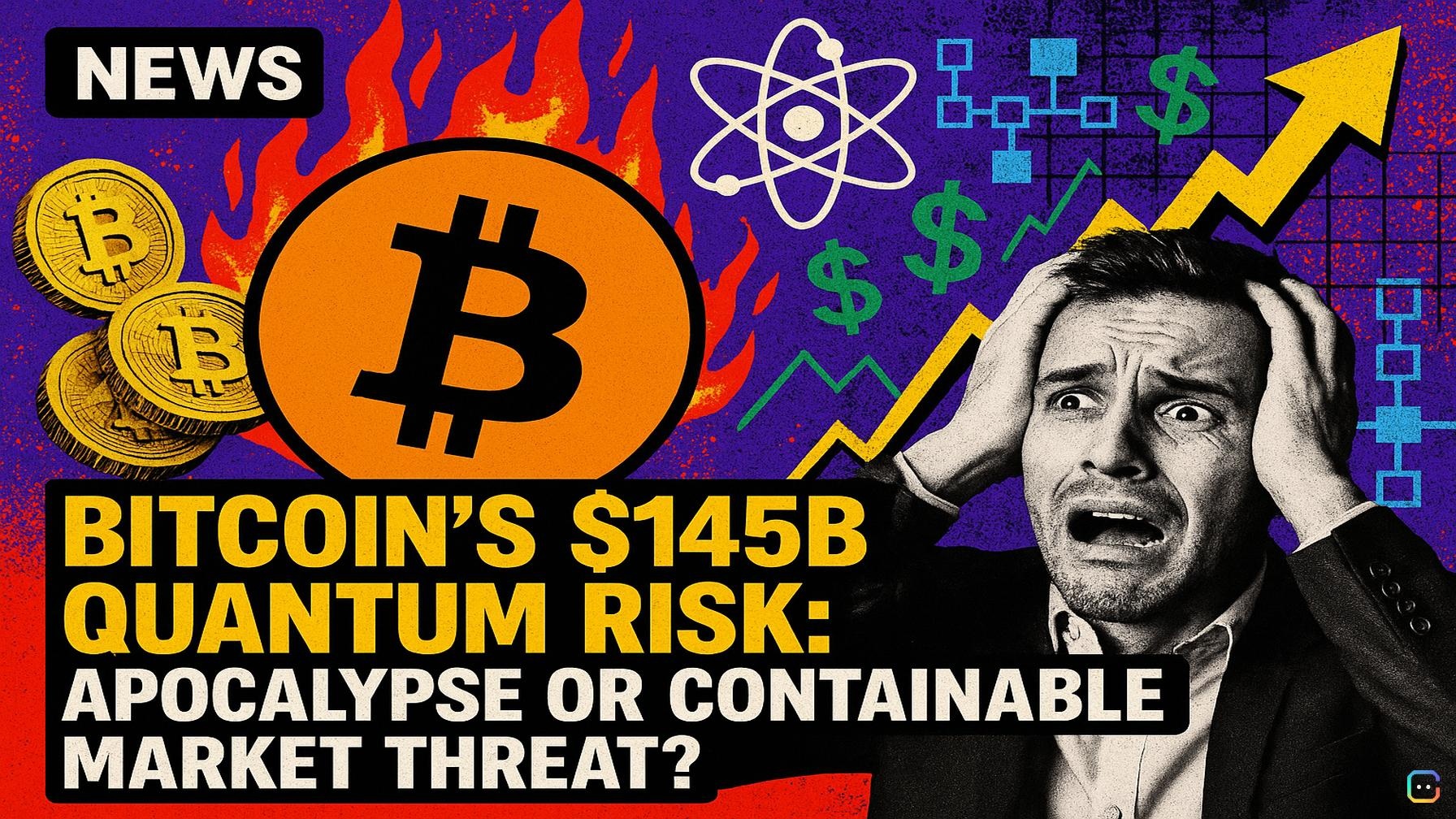
The $145 billion question: is bitcoin’s quantum risk an apocalypse — or a math problem we can solve?
Recent advances in quantum computing have rekindled an old fear: a sufficiently powerful, cryptographically relevant quantum computer could crack bitcoin’s elliptic-curve signatures (secp256k1), exposing private keys for addresses that have already revealed their public keys on-chain — notably many early, Satoshi-era wallets. That’s a real threat in theory, and analysts estimate roughly 1.7 million BTC could be vulnerable — about $145 billion at the quoted price of $77,859.82 per BTC. On the face of it, that sounds catastrophic. But the market context matters.
Why the risk looks smaller in practice
- Liquidity and regular flows dwarf the headline number. During bull markets, long-term holders (defined as wallets holding for 155+ days) typically distribute 10,000–30,000 BTC per day. At those rates, the entire Satoshi-era pool equates to roughly two to three months of normal profit-taking.
- Exchanges and derivatives already move massive volumes. Monthly exchange inflows can approach 850,000 BTC, and derivatives markets rotate notional volumes on the order of the entire Satoshi stash every few days.
- Historical precedent shows markets absorb big shocks. In the most recent bear market, over 2.3 million BTC changed hands in a single quarter — more than the 1.7M BTC quantum “target” — without a systemic collapse.
What a quantum exploit would actually do
A sudden, concentrated dump of exposed coins would certainly spike volatility and could trigger a sharp downturn. But that extreme assumes irrational behavior. Any actor who can access such a trove would be financially motivated to sell gradually, use derivatives to hedge, and otherwise limit market impact. In short, even a successful quantum crack is more likely to translate into months of managed distribution and elevated volatility than an immediate market wipeout.
So what’s the real vulnerability?
It’s governance, not just raw computational risk. The bigger question is how the network and community would respond to large-scale private-key exposure. Proposals such as BIP-361 have been floated as governance paths to mitigate or “freeze” at-risk coins, buying time for coordinated fixes and orderly market responses.
Bottom line
Quantum computing is a valid long-term threat to elliptic-curve cryptography used by bitcoin, and a nontrivial portion of BTC could be vulnerable if and when a powerful quantum computer appears. But measured against everyday liquidity, exchange flows and derivatives activity, the headline $145 billion is not an existential shock so much as a significant market event that can be managed through gradual distribution, hedging, and governance actions. The takeaway for traders and holders: prepare, monitor technological developments, and follow community coordination — the danger is real, but far from an automatic apocalypse.
Read more AI-generated news on: undefined/news