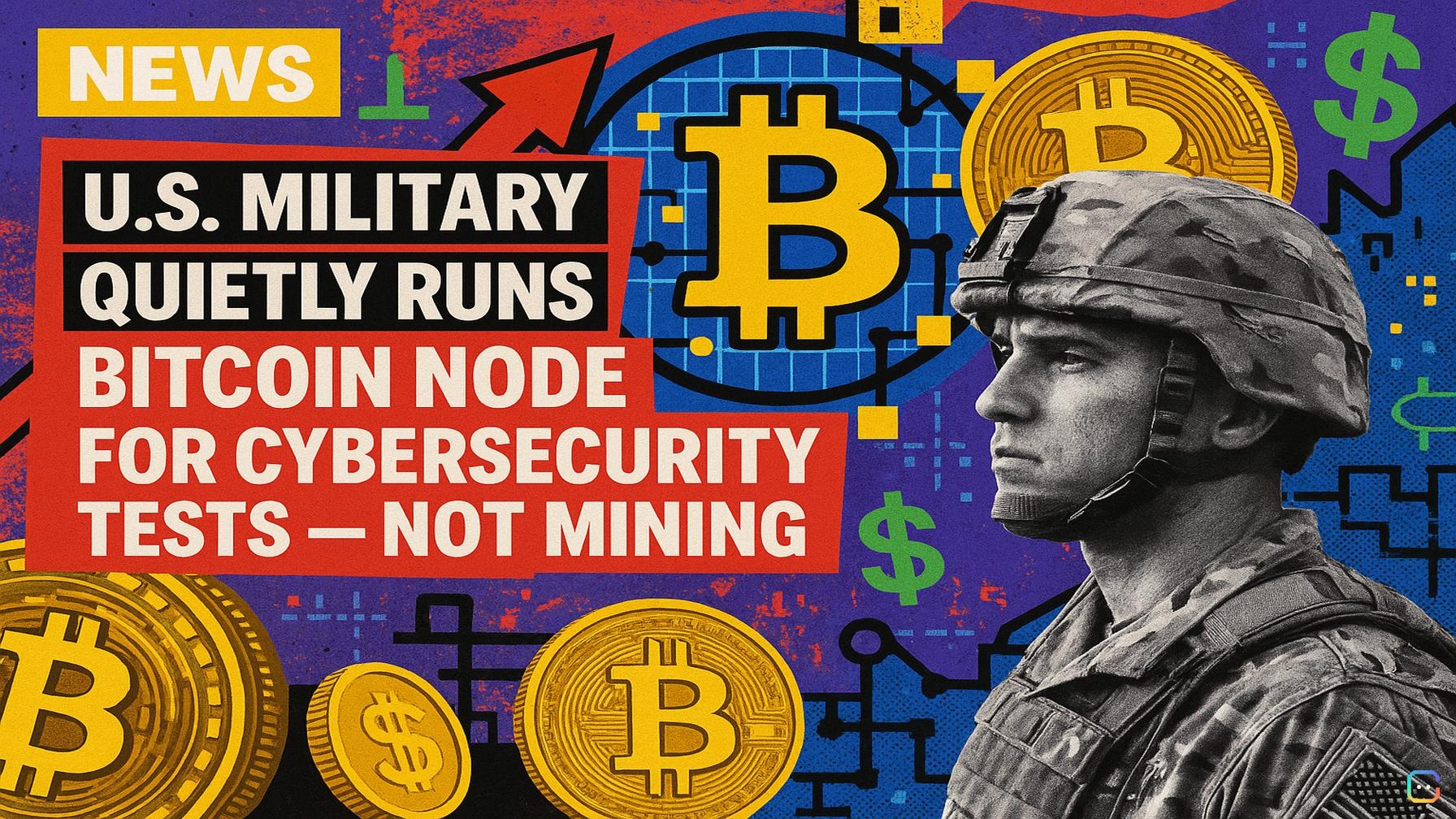
The U.S. military is quietly participating in the Bitcoin network — but it isn’t mining coins.
Admiral Samuel Paparo, commander of U.S. forces in the Pacific, told the House Armed Services Committee Wednesday that the government “has a node on the Bitcoin network right now.” He was careful to add: “We’re not mining Bitcoin. We’re using it to monitor, and we’re doing a number of operational tests to secure and protect networks using the Bitcoin protocol.”
Why a node matters
Bitcoin’s security and uptime depend on tens of thousands of independent nodes around the world that validate transactions and propagate blocks. That decentralized architecture is what prevents any single actor — even a powerful nation-state — from controlling Bitcoin’s transaction validation. Running a single node, therefore, does not threaten Bitcoin’s independence. But the revelation is noteworthy because Bitcoin’s “censorship resistance” has long been promoted as a hedge against state takeovers, so any official involvement draws scrutiny from the crypto community.
Military experimentation, not investment
Paparo framed the U.S. operation as part of an “experimentation” phase. The military’s interest, he said, lies in Bitcoin’s underlying technology rather than as a treasury asset. “Our interest in Bitcoin is as a tool of cryptography, a blockchain, and a reusable proof-of-work — as an additional tool to secure networks, and to project power,” he told lawmakers. “From the military application standpoint, my interest in Bitcoin is as a computer science tool.”
Policy context: dollars and stablecoins
Paparo also tied the Pentagon’s broader strategic view to U.S. dollar hegemony, saying that supporting the dollar’s global role aligns with military interests. He pointed to the GENIUS Act — a law signed last summer that legalized issuance of dollar-pegged stablecoins — as “a great step forward” toward that objective.
What this means for crypto
- The U.S. government running a node underscores growing official interest in blockchain tech for cybersecurity and operational uses.
- Because a single node does not grant control, Bitcoin’s decentralization remains intact in practice — though symbolic concerns about state involvement will persist.
- The dual focus on defensive tech applications and policies that reinforce the dollar (like stablecoin legalization) highlights the strategic balancing act between embracing crypto innovation and maintaining existing monetary influence.
For the crypto community, the news is a reminder that governments are moving beyond rhetoric to hands-on experimentation, viewing Bitcoin as both a technological asset and a piece in broader geopolitical strategy.
Read more AI-generated news on: undefined/news