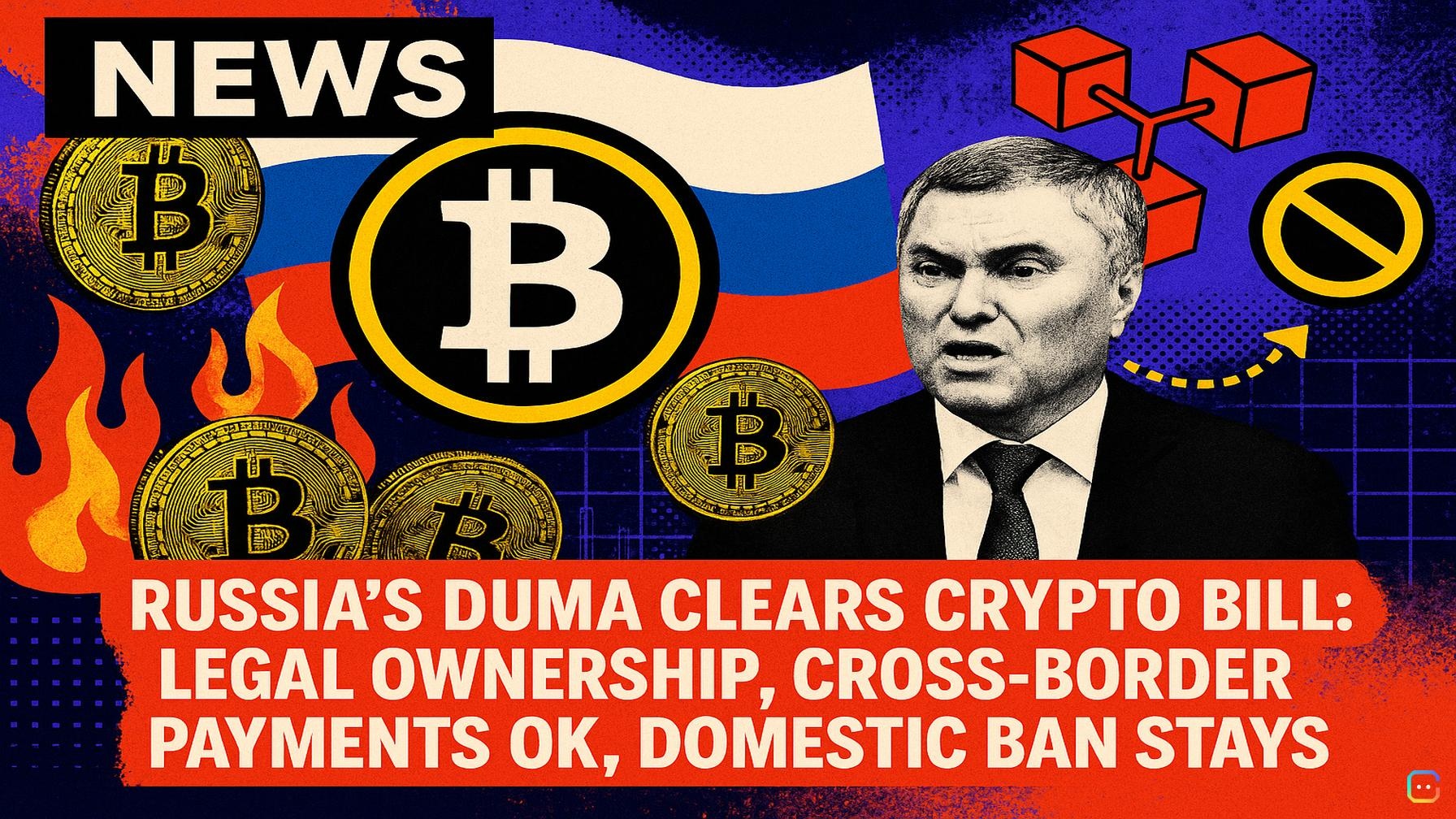
Russia’s lower house of parliament has cleared a sweeping crypto bill in its first reading that would create the country’s first formal digital-asset framework — while explicitly preserving rules that bar cryptocurrency as a domestic means of payment.
What passed
- The State Duma approved a draft law that would classify cryptocurrencies as property, giving digital assets legal protections in court proceedings — for example in bankruptcy and divorce cases.
- Retail (non‑qualified) investors would be capped at 300,000 rubles (~$3,900) in crypto purchases per year; professional market participants would face no such ceiling.
- The Bank of Russia would be the licensing and supervisory authority for crypto market participants under the proposal.
- The ruble remains Russia’s only legal settlement currency, but the bill carves out a specific exception allowing crypto use in foreign trade. “This allows Russian companies to use cryptocurrency to pay foreign counterparties, circumventing sanctions restrictions,” said Kaplan Panesh, deputy chairman of the State Duma Committee on Budget and Taxes.
Timing and next steps
- If the bill clears second and third readings in the State Duma, wins Federation Council approval and is signed by the president, it would take effect on July 1, 2026.
Why it matters
- The legislation is Russia’s most comprehensive attempt to formalize digital-asset rules to date — balancing tighter state control over domestic monetary policy with legal recognition and regulated pathways for crypto activity.
- The explicit authorization of crypto for cross‑border trade creates a potential alternative payments channel for Russian companies, allowing business with foreign counterparties outside traditional banking rails that Western authorities have curtailed since the 2022 invasion of Ukraine.
Context: sanctions, on‑chain flows and regulatory responses
- Russia outlawed cryptocurrency as a means of payment in 2020 while allowing ownership. Since the 2022 invasion the state has gradually opened limited pathways for institutional crypto use and international transactions amid tightening Western restrictions.
- Blockchain forensics firms have flagged large crypto flows linked to sanctions evasion. A September 2025 Elliptic report tied a Russia‑linked network to at least $8 billion in stablecoin transactions over 18 months, described as “sanctions evasion as a service.” By January, transactions in the ruble‑pegged stablecoin A7A5 reportedly surpassed $100 billion; the 2026 TRM Crypto Crime Report estimated A7A5 and its associated wallet network moved about $70 billion in sanctions‑related flows in 2025.
- In response to relaunches of sanctioned crypto providers under new names — notably the shuttered exchange Garantex resurfacing as Grinex — the EU moved in February to ban all crypto transactions with entities based in Russia. Grinex later halted trading this month after alleging a $13 million exploit by what it called “Western special services.”
Bottom line
If enacted in its current form, the bill would formalize crypto ownership and regulated market infrastructure in Russia while deliberately restricting domestic use — and carve out an official channel that could help Russian firms transact internationally despite banking and sanctions headwinds. That dual approach is likely to attract increased scrutiny from Western regulators and compliance teams monitoring cross‑border crypto flows.
Read more AI-generated news on: undefined/news