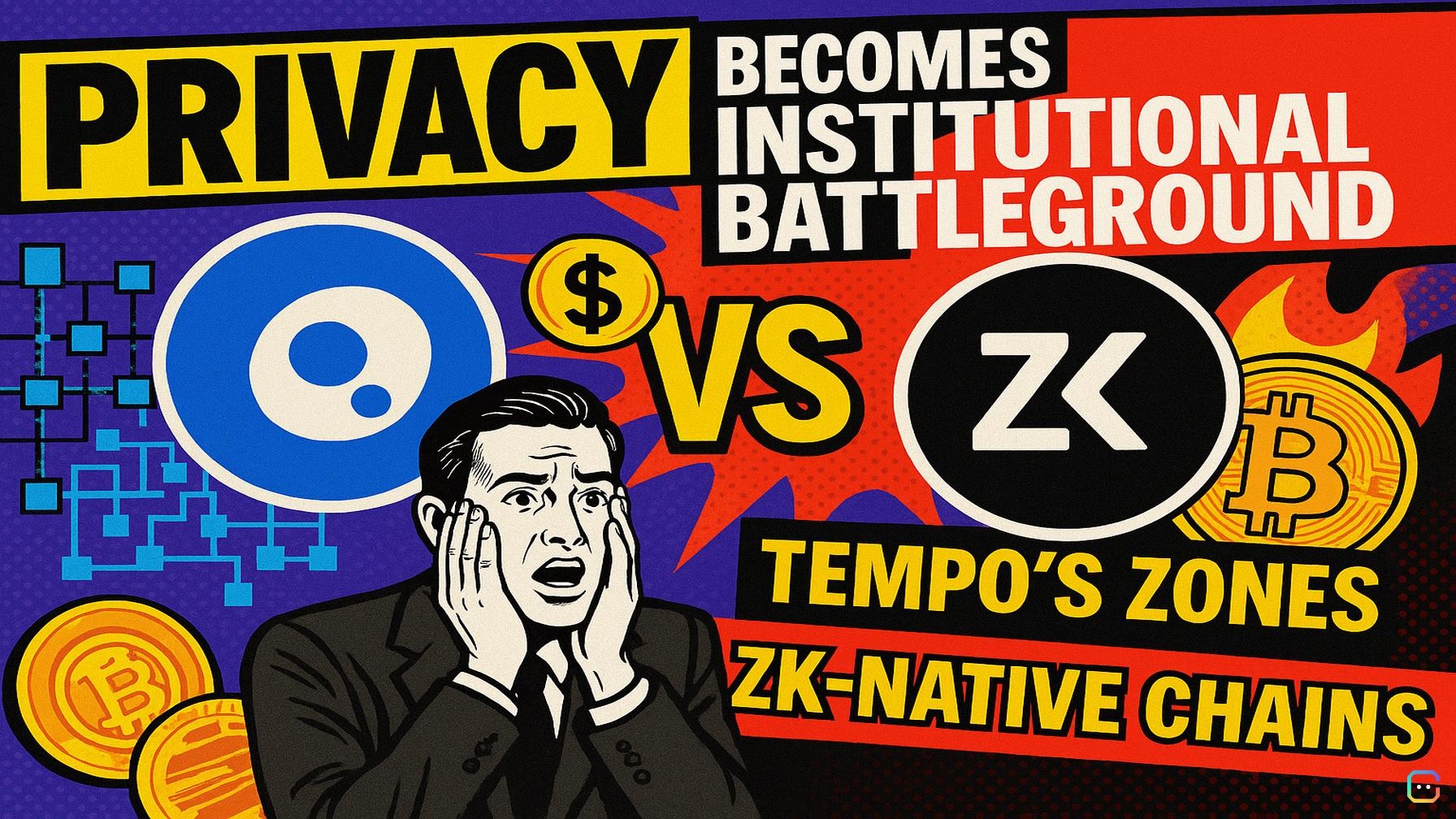
Privacy on blockchains is no longer a theoretical debate — it’s the next battleground for institutional finance.
This month, Tempo — the Stripe-backed payments blockchain that raised $500 million at a $5 billion valuation and counts Visa, Mastercard, Paradigm, and UBS among its backers — published a detailed architectural proposal for private enterprise stablecoin transactions. Tempo isn’t an obscure privacy experiment; it’s one of the most institutionally credentialed launches in years, staffed by engineers who understand how banks, payments firms, and corporate treasuries operate. When a project with that pedigree puts privacy front and center in its launch-week roadmap, it’s not a hint. It’s a ruling.
Why this matters: public blockchains expose every wallet, balance, and transaction in real time. That transparency is a brilliant tool for censorship resistance and auditability, but it’s lethal for institutional activity. Imagine every hedge fund position, corporate treasury move, and pension rebalancing instantly visible to competitors and bad actors — front-running, strategy leakage, and targeted attacks would follow. For large-scale finance, public-by-default ledgers are a non-starter.
Tempo’s April 16 announcement offers a practical response: Zones. Zones are private parallel chains tethered to Tempo’s public mainnet. Inside a Zone, participants transact privately; the broader network sees only cryptographic proofs that transactions are valid, not the underlying data. Compliance controls can be embedded with the token, and assets stay interoperable with Tempo Mainnet. For payroll, settlement, and treasury workflows, it’s a pragmatic design that aligns with enterprise needs.
But there’s an important caveat: Tempo’s Zones are operator-visible. The Zone operator — typically an enterprise or infrastructure provider — can see everything that happens inside the Zone. The public sees nothing; the operator sees everything. For many regulated entities that’s acceptable, or even necessary for compliance. But it does reintroduce a single point where trust and risk concentrate: you’ve moved privacy off the public chain and into the hands of an intermediary rather than eliminated visibility altogether.
An alternative architectural approach removes that intermediary trust entirely: zero-knowledge (ZK) cryptography. ZK proofs let parties prove a transaction’s correctness without revealing its details. In ZK-native blockchains, execution is privacy-preserving at the protocol layer: accounts compute locally, chains store only cryptographic commitments, transaction histories aren’t browsable, and no operator has a god’s-eye view. If Bitcoin solved trustless transfer and Ethereum added programmability, ZK-native chains offer verifiable privacy — proof that things happened correctly without exposing what actually happened.
That raises the old regulatory objection: privacy versus compliance. The framing that they are mutually exclusive is breaking down. Regulators don’t need unrestricted access to everything; they need conditional, verifiable assurance that transactions follow the rules. Selective, programmable disclosure — revealing only what a regulator needs under defined conditions — is precisely what ZK tools enable. Tempo’s model provides compliance at the operator level; ZK-native approaches bake it into cryptography. Both can meet compliance goals, but they distribute trust in very different ways.
Put simply, institutions have decided they cannot run on fully public blockchains. The industry’s next big choice is the type of privacy to build:
- Operator-trusted privacy (Tempo Zones): practical, enterprise-friendly, places visibility and risk with a known operator.
- Cryptographic privacy (ZK-native chains): minimizes trusted intermediaries, enforces privacy at the base layer, and supports selective disclosure via proofs.
Both are legitimate, but they aren’t equivalent. The privacy model you adopt determines your risk surface, compliance posture, and what failure modes you’re exposed to. Architecture isn’t an afterthought — it shapes everything that follows.
The privacy debate is over. The real questions now are what kind of privacy institutions will standardize on, and who — if anyone — they’re willing to trust with the view. Tempo’s announcement didn’t just start a conversation; it sharpened the choice institutions must make as onchain finance goes mainstream.
Read more AI-generated news on: undefined/news