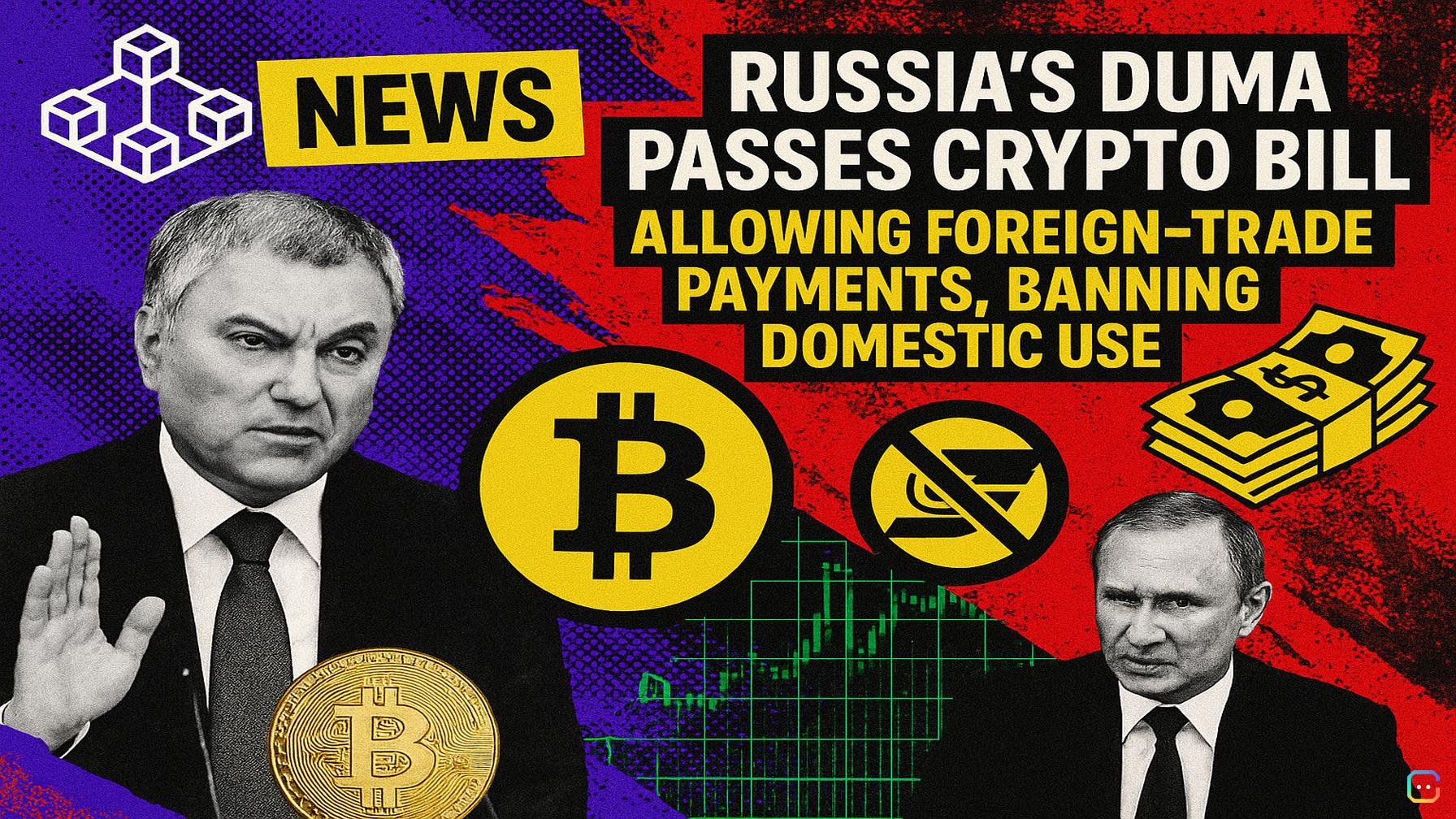
Russia’s State Duma has taken a major step toward a formal crypto framework, passing a wide-ranging digital asset bill in its first reading that would create the country’s first comprehensive legal structure for cryptocurrencies — while still banning their use for domestic payments.
What the bill would do
- Classify cryptocurrency as property, giving digital assets legal protections in court cases including bankruptcy and divorce.
- Cap annual purchases for non-qualified (retail) investors at 300,000 rubles (roughly $3,900). Professional market participants would face no such limit.
- Keep the ruble as Russia’s only legal tender for domestic settlements, but carve out a targeted exception for foreign trade. As Kaplan Panesh, deputy chair of the State Duma Committee on Budget and Taxes, put it: “This allows Russian companies to use cryptocurrency to pay foreign counterparties, circumventing sanctions restrictions.”
- Put the Bank of Russia in charge of licensing crypto market participants under the new regime.
Timing and next steps
The bill still needs second and third readings in the State Duma, approval from the Federation Council, and the president’s signature. If enacted, the law is slated to take effect on July 1, 2026.
Why it matters
By explicitly authorizing cross-border crypto settlements while maintaining a domestic payments ban, the legislation would create a regulated pathway for international trade outside conventional banking channels that Western nations have restricted since Russia’s 2022 invasion of Ukraine. Proponents present this as a way to enable trade with foreign partners; critics warn it could formalize a route around sanctions.
Context: sanctions, on-chain flows and market moves
Russia has banned cryptocurrency payments since 2020 while allowing ownership and has gradually opened limited institutional and cross-border uses amid sanctions. Independent blockchain reports cited in recent years highlight heavy on-chain activity tied to sanctions avoidance:
- A September 2025 Elliptic report linked one Russia-connected network to at least $8 billion in stablecoin transactions over an 18-month period, describing it as specializing in “sanctions evasion as a service.”
- By January, transactions in a ruble-pegged stablecoin known as A7A5 reportedly topped $100 billion.
- The 2026 TRM Crypto Crime Report found that A7A5 and its associated wallet network handled roughly $70 billion in sanctions-related flows during 2025.
Regulatory backlash and provider relaunches
In response to these developments and to relaunches of sanctioned crypto services under new names — for example the shuttered exchange Garantex re-emerging as Grinex — the EU moved in February to ban all crypto transactions with entities based in Russia. In a recent twist, Grinex halted trading earlier this month after alleging a $13 million exploit carried out by what it called “Western special services.”
Bottom line
Tuesday’s vote marks Moscow’s most extensive attempt yet to formalize crypto rules: it balances tighter legal recognition and oversight with continued state control over domestic monetary operations, while potentially opening regulated windows for cross-border crypto payments that could alter how Russian firms transact internationally under sanctions pressure.
Read more AI-generated news on: undefined/news