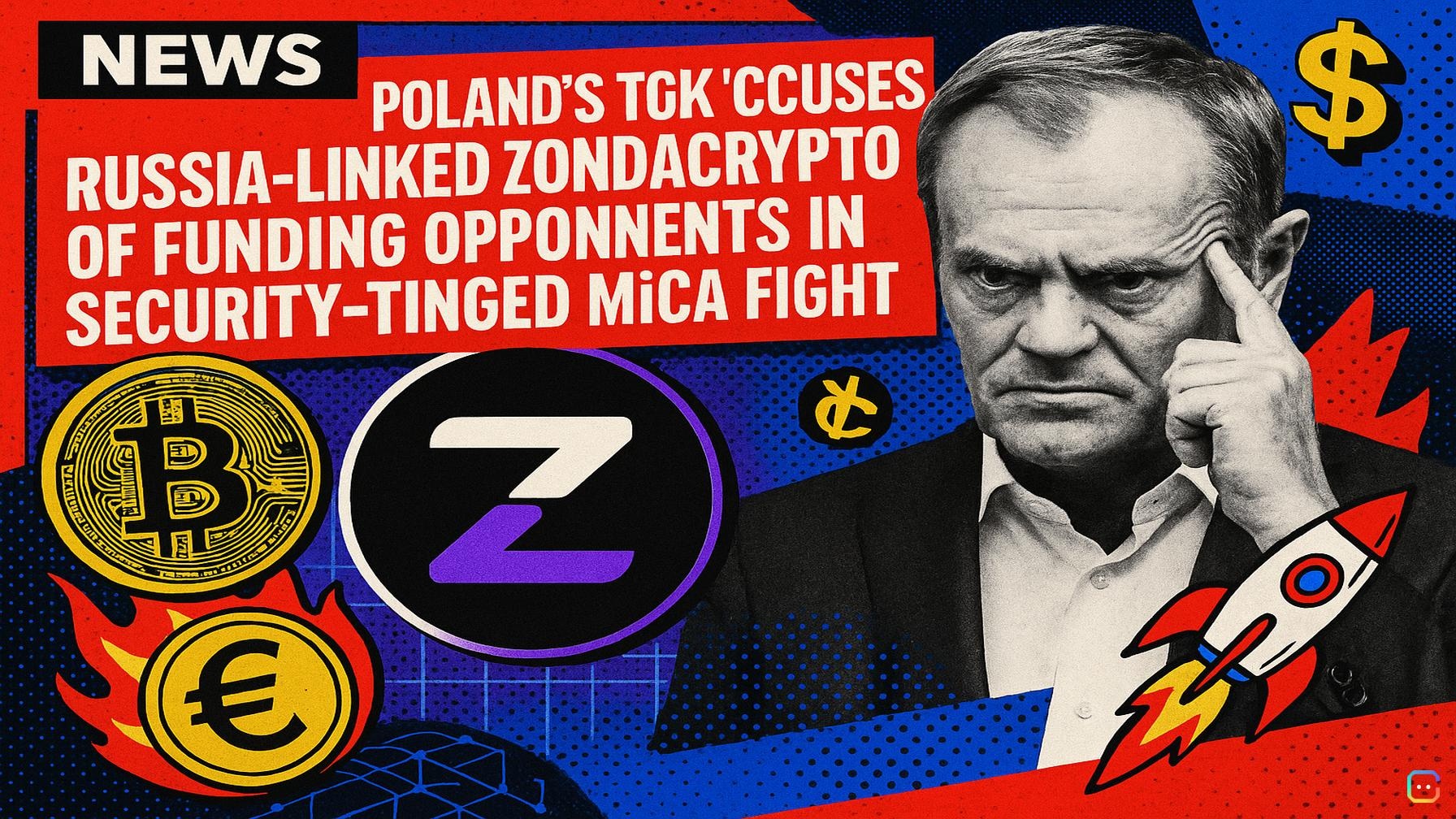
Poland’s prime minister has accused a Russia-linked crypto firm of funnelling money into his political opponents, framing the dispute as both a national‑security threat and a test of the country’s crypto-policy direction.
Speaking in the Sejm ahead of a vote to overturn President Karol Nawrocki’s veto, Prime Minister Donald Tusk named Zondacrypto as a major backer of right‑wing causes in Poland. He told lawmakers that Poland’s internal security agency has found the exchange “sponsors political and social gatherings in Poland and champions very particular political factions,” including figures from the former ruling Law and Justice party and the far‑right Confederation. Tusk added that the platform’s financial backers include “not only Russian capital” but also groups linked to the so‑called bratva — a term used for Russian mafia networks — and to Russian security services.
Tusk highlighted Zondacrypto’s role as a prominent sponsor of a Conservative Political Action Conference (CPAC) event in Rzeszów in March 2025, where U.S. politician Kristi Noem publicly endorsed President Nawrocki’s campaign. He cast the upcoming parliamentary vote as a security litmus test, warning that the crypto market is “extremely vulnerable to manipulation by foreign services, intelligence organizations, and criminal enterprises.” On X, he framed the choice starkly as “Russian money and services versus the security of the state and citizens.”
The allegations come amid a longer political battle over how — and whether — Poland should implement the EU’s Markets in Crypto‑Assets (MiCA) framework. President Nawrocki has twice vetoed government attempts to bring national law into line with MiCA, rejecting a bill in December 2025 and striking down what he called a “practically identical” proposal in February. The president’s office says it is not against crypto regulation per se but objects to the government’s approach.
Poland’s refusal to enable MiCA domestically leaves the country an outlier in the EU. Without national enabling legislation, Polish exchanges and wallet providers cannot start the MiCA licensing process, putting them at a competitive disadvantage compared with peers in member states already issuing authorizations. A previous parliamentary effort to overturn Nawrocki’s veto also failed in December 2025, despite warnings from Tusk about unregulated platforms’ susceptibility to foreign intelligence and organized crime.
Zondacrypto has not issued a detailed response to the accusations. The row has widened beyond party politics into a broader debate over how national security, party financing and digital‑asset regulation intersect in Europe: is the Polish crypto market a funnel for Russian “bratva” money, or is the regulatory fight primarily political point‑scoring that risks stifling the industry?
This story sits alongside other regulatory and security discussions shaping crypto policy globally — from U.S. moves to support tokenization to evolving MiCA‑aligned stablecoin rules in other jurisdictions, and the legacy of regulatory changes during the Trump era on U.S. enforcement — all of which will influence how Europe’s digital‑asset ecosystem develops.
Read more AI-generated news on: undefined/news