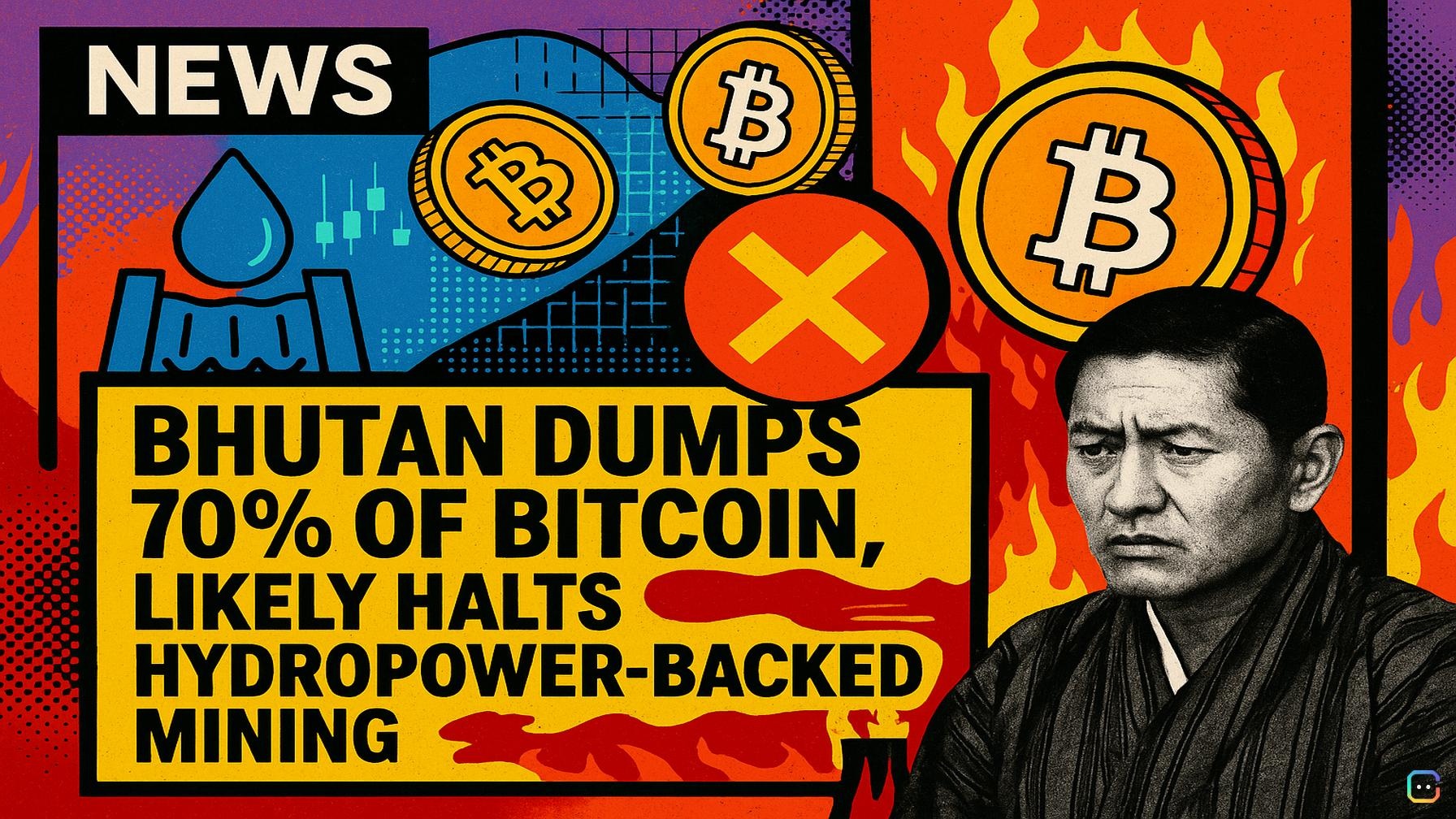
Bhutan appears to be unwinding one of the crypto world’s most unusual experiments: a sovereign, hydropower-backed bitcoin mining program. Over the past 18 months the Himalayan kingdom has sold roughly 70% of the bitcoin it once held, and on-chain signals suggest its mining operation may have quietly stopped.
What happened
- Arkham Intelligence data shows the Royal Government of Bhutan moved about 319.7 BTC (roughly $22.7 million) on Thursday to two addresses. About 250 BTC went to a wallet previously used to route sales via Galaxy Digital and OKX; the remaining 69.7 BTC was sent to a new, unlabeled address.
- Those transfers are part of a longer selling campaign. Bhutan’s holdings peaked at about 13,000 BTC in October 2024—acquired through a mining program run by the country’s sovereign wealth fund, Druk Holding and Investments—and have since fallen to roughly 3,954 BTC (about $280.6 million today).
- Arkham’s chain analysis indicates $215.7 million worth of bitcoin left Bhutan’s wallets this year alone, with about $162.6 million directed to unlabeled wallets.
Is mining still running?
- On-chain inflows tied to Bhutan’s addresses have been minimal: Arkham notes the last sizable bitcoin inflow (over $100,000) was recorded more than a year ago. That suggests the country may be spending down an existing stockpile rather than selling newly mined BTC.
- Druk Holding did not respond to repeated requests for comment and has not publicly addressed either the transfers or the status of the mining operation.
Why sell now?
- The economics that made Bhutan’s project attractive have shifted. Mining was more profitable when difficulty was lower and bitcoin traded above $90,000. With BTC trading near $71,000, network difficulty at all-time highs, and the post-halving block reward reduced to 3.125 BTC, small-scale sovereign mining margins have compressed.
- Bhutan’s cheap hydropower—once ideal for running rigs—may now generate more reliable revenue selling electricity to neighboring India than by powering depreciating mining gear.
How this compares to broader flows
- The sell-off stands in stark contrast to other major holders and buyers. In recent weeks and months, large private buyers and U.S. spot ETFs have been net accumulators: about 50,000 BTC flowed into U.S. spot ETFs in March, and one firm reportedly bought roughly 4,871 BTC (~$330 million) in a single weekend. Non-bitcoin holders like the Ethereum Foundation preferred staking $93 million of ether instead of selling.
- At present, Bhutan’s remaining 3,954 BTC is smaller than the amount some large buyers accumulate in just days—underscoring how one small nation’s experiment has been overtaken by institutional demand elsewhere.
What it means
Bhutan’s moves provide a practical snapshot of the tension between bitcoin’s appeal as a strategic reserve asset and the real-world economics of maintaining production and exposure during drawdowns. The kingdom’s pivot—selling a majority of its bitcoin and possibly halting mining—illustrates how operational costs, asset prices and local energy markets can reshape a nation-state’s approach to crypto.
Requests for comment from Druk Holding remain unanswered. The kingdom’s experiment—mining bitcoin from its mountain-fed rivers—now looks like a case study in the limits of sovereign crypto initiatives when macro conditions turn against them.
Read more AI-generated news on: undefined/news