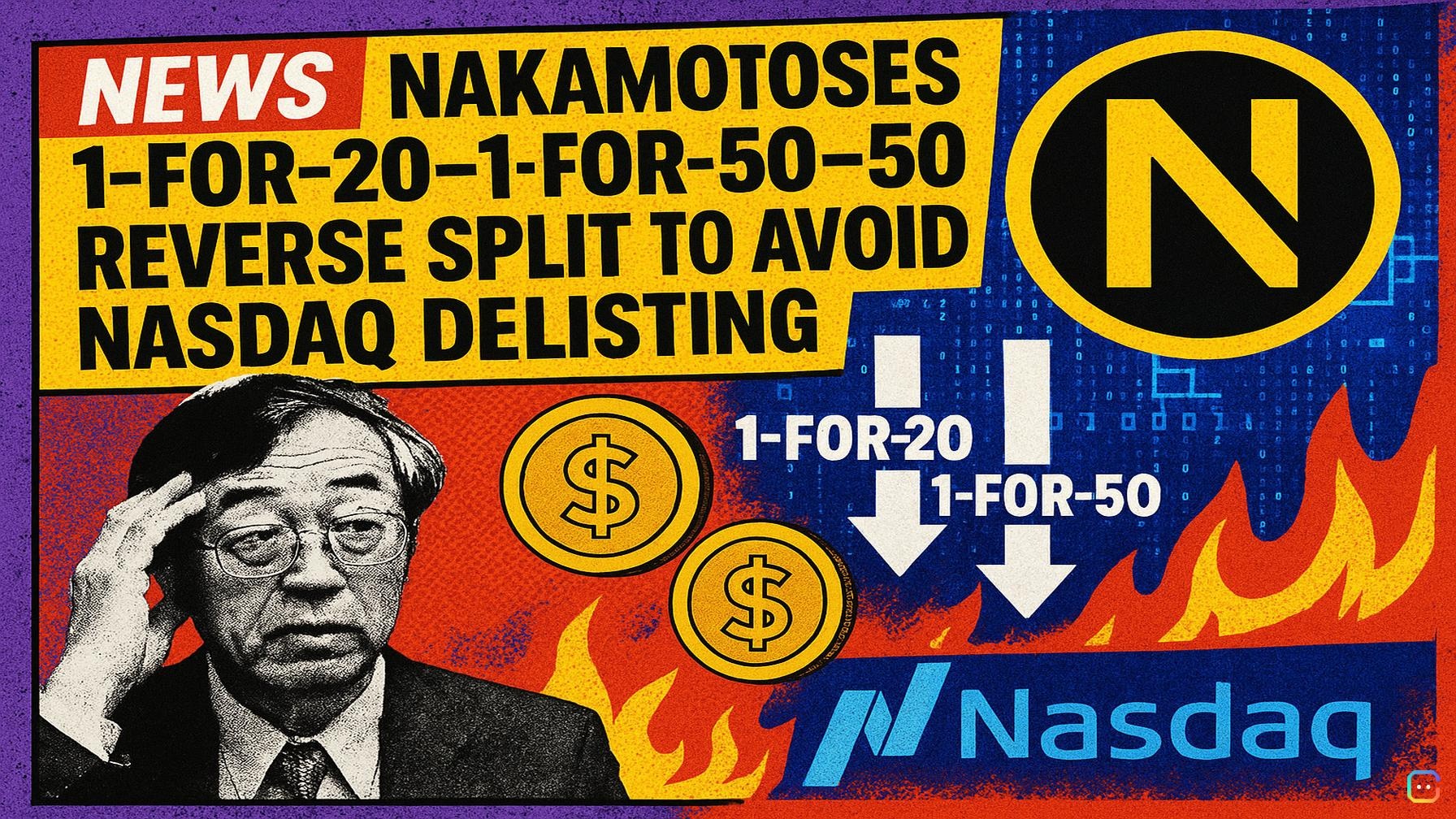
David Bailey’s bitcoin-holding company Nakamoto (NAKA) is lining up a Wall Street fix to avoid Nasdaq trouble: a reverse stock split.
Why it matters
Nakamoto has asked shareholders to approve a reverse split between 1-for-20 and 1-for-50, according to a preliminary Schedule 14A proxy. The move is aimed at lifting a share price that has plunged to roughly $0.22—about a 99% drop from its May 2025 peak—and avoiding Nasdaq’s $1 minimum bid-price rule that can trigger delisting.
What a reverse split does
A reverse split consolidates shares so the per-share price rises proportionally without changing the company’s market value. For example, 20 shares at $0.20 would become one share at $4. Companies often use the tactic to meet exchange listing requirements.
Liquidity and treasury moves
Nakamoto recently sold roughly 5% of its bitcoin stash and now holds about 5,058 BTC, signaling active liquidity management. The broader sector has also felt the squeeze: many bitcoin-treasury stocks have been battered as BTC’s spot price fell from north of $126,000 in October to roughly $70,000 today (BTC trading around $73k at the time of reporting).
Share overhang and future issuance
Alongside the reverse split, Nakamoto filed a Form S-3 registering more than 400 million shares for potential resale by existing investors—an overhang that could pressure the stock even though it doesn’t raise new capital. The company also maintains a shelf registration that could allow roughly $7 billion in future securities issuance and an at-the-market (ATM) program of up to about $5 billion to sell newly issued shares into the market over time.
Peers taking similar steps
Other bitcoin treasury firms have pursued comparable measures—Strive Asset Management was an earlier example—underscoring how companies with large crypto treasuries are juggling volatile bitcoin prices, shareholder optics, and exchange compliance.
Bottom line
Nakamoto’s proposed reverse split is a familiar fix to preserve its Nasdaq listing, but the combination of a large registered-share overhang and ongoing market volatility means the move may only be a partial solution to the company’s share-price woes.
Read more AI-generated news on: undefined/news