Headline: Adam Back Says “I’m Not Satoshi,” but NYT Investigation Keeps Spotlight on Bitcoin’s Mystery Founder
Key takeaways
- Adam Back publicly denied being Satoshi Nakamoto in response to a New York Times investigation.
- The NYT’s case is circumstantial — linguistic analysis, historical correspondence and technical overlap — not cryptographic proof.
- Back argues the unresolved identity of Satoshi helps Bitcoin remain decentralized and founderless.
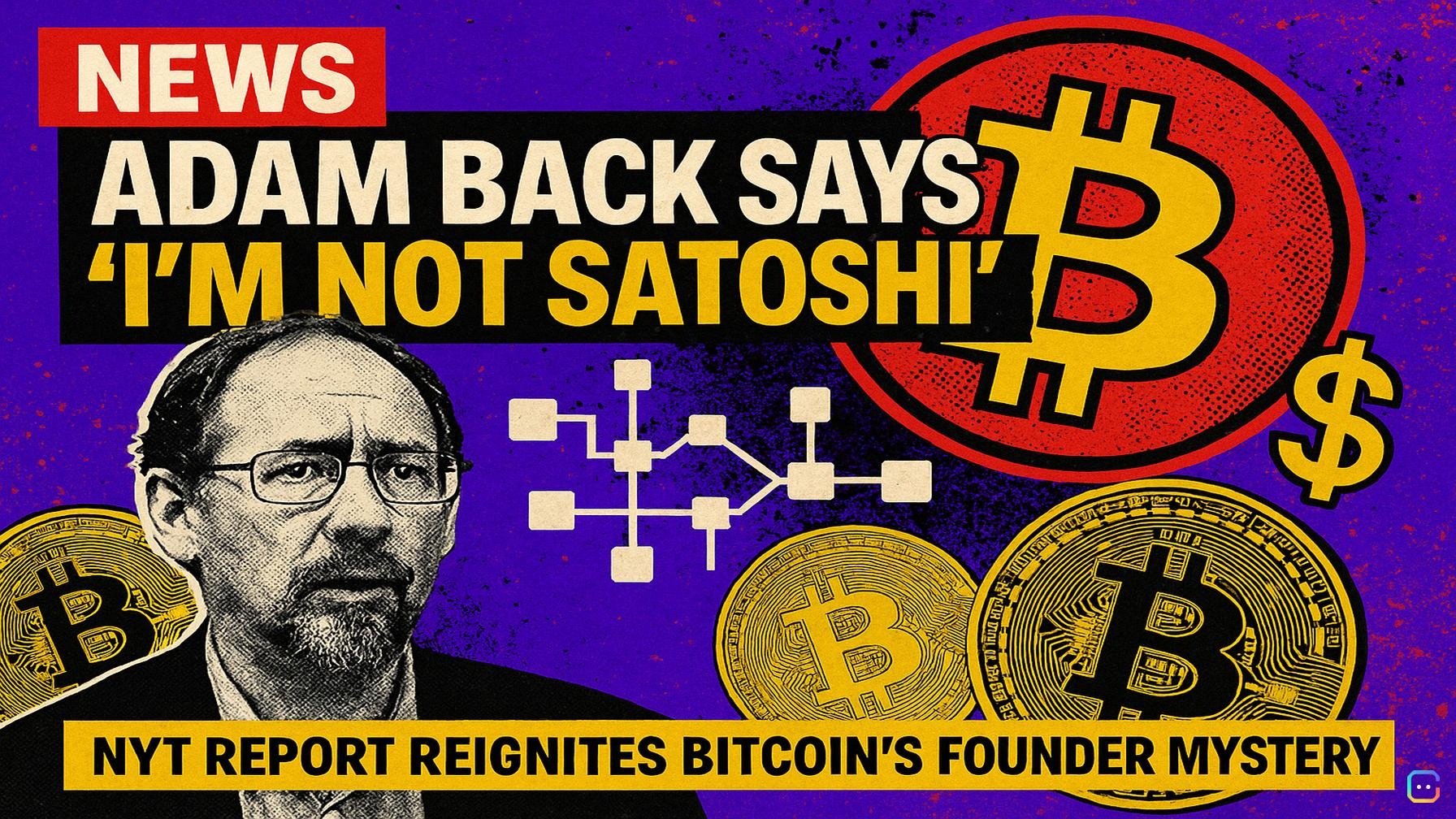
Adam Back — longtime cryptographer, Blockstream CEO and creator of the Hashcash proof-of-work system — has pushed back against a New York Times investigation that named him as a leading candidate for Satoshi Nakamoto. Responding on X to journalist John Carreyrou’s reporting, Back offered a terse denial: “I’m not Satoshi.” He provided no further details.
Why Back is a natural suspect
The NYT piece leans on historical materials, language patterns and technical background rather than any cryptographic attribution. That kind of circumstantial detective work tends to point at Back for several reasons:
- He was an active member of the Cypherpunks mailing list beginning in the early 1990s, contributing to debates about digital cash, privacy and monetary policy — the same intellectual soil that produced Bitcoin.
- He invented Hashcash, a proof-of-work scheme explicitly cited in the Bitcoin white paper.
- His technical résumé (distributed systems experience, C++ familiarity) and British background align with what limited clues exist about Satoshi.
- The report found more than 100 overlapping words and phrases between Satoshi’s writings and Back’s archived posts, and flagged a 2002 post from Back about Executive Order 6102 — a piece of monetary history that later surfaced symbolically in Bitcoin-related discussions.
Why this isn’t definitive
Carreyrou himself acknowledges the limits of such evidence: the only “true smoking gun” would be cryptographic proof, and only Back could produce that. Linguistic similarities, shared interests and archival overlap make for a compelling narrative, but they fall short of the kind of proof courts or cryptographers would accept.
A focal point of the reporting is a string of emails from August 2008 in which Satoshi contacted Back to confirm the Hashcash citation before the Bitcoin white paper was published. Those messages, introduced in litigation around Craig Wright’s claims to be Satoshi, are widely interpreted as showing two different people. The NYT noted the alternative possibility — that Back might have written both sides as misdirection — but that theory remains unverified.
Back’s response — and why the mystery matters
Back has pushed back against the recurring speculation, arguing that his extensive public record invites confirmation bias: he’s prolific, his ideas overlap with Bitcoin’s design, and pattern-matching will naturally lead skeptics back to him. He has also framed the unknown identity of Satoshi as a feature, not a bug. In his comments he suggested that not knowing who Satoshi is strengthens Bitcoin’s status as “a new asset class, the mathematically scarce digital commodity,” and supports its image as a decentralized, founder-independent protocol.
Bottom line
The NYT investigation sharpens the circumstantial case linking Adam Back to Bitcoin’s origins, but it does not provide cryptographic proof. The question of Satoshi’s identity remains unresolved — and, for many in crypto, that ambiguity is integral to Bitcoin’s mythos and its decentralized ethos.
Read more AI-generated news on: undefined/news