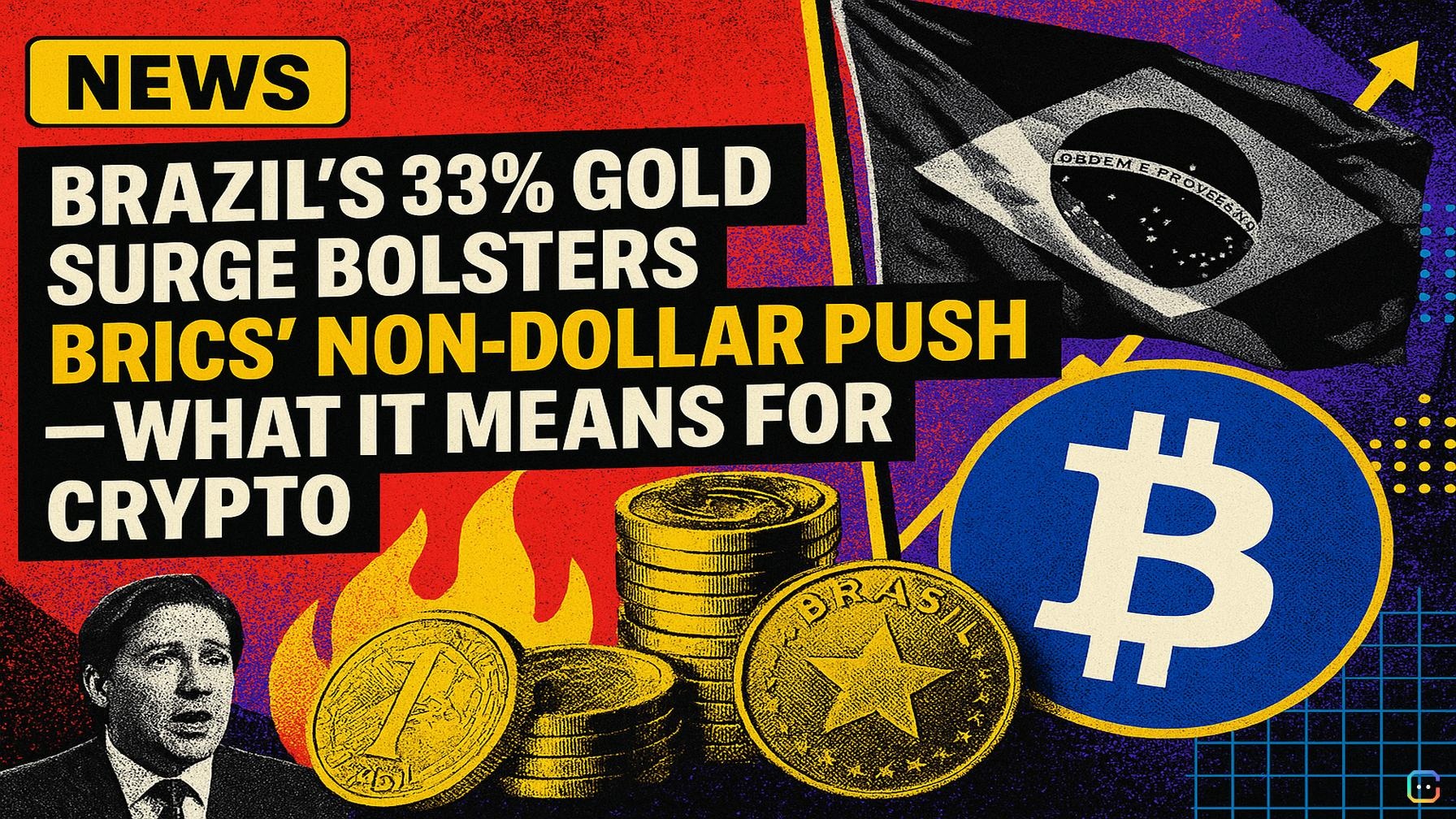
Headline: Brazil’s central bank doubles down on gold — a 33% spike in reserves fuels BRICS’ push for a non‑dollar future
Brazil’s gold hoard jumped by one-third in the final months of 2025, as the Central Bank quietly purchased 42.8 tonnes of bullion between September and November, lifting holdings from 129.6 tonnes to 172.4 tonnes. The move — rapid, deliberate and well-documented — is part of a broader rebalancing of international reserves that has implications for dollar dominance, gold markets, and emerging non‑dollar payment rails that crypto and digital-asset markets are watching closely.
What changed in Brazil’s balance sheet
- Gold: Brazil’s gold holdings now account for 7.19% of its international reserves, making bullion the country’s second‑largest reserve asset behind the dollar.
- Dollar exposure: The share of U.S. dollars in Brazil’s reserves has fallen every year since 2022 — from 80.42% (2022) to 79.99% (2023), 78.45% (2024), and 72% by December 2025.
- Other currencies: The euro is now 6.60% of reserves, the Chinese renminbi 5.94%, and the Central Bank added new positions in the South Korean won as part of its diversification strategy.
- Transaction transparency: According to Brazil’s Annual Report on International Reserves (published March 31, 2026), all gold purchases for reserve purposes were executed abroad.
Why the Central Bank is rebalancing
In its report, the Central Bank said it expanded diversification “in light of increasing economic and geopolitical uncertainties.” The bank increased holdings of gold, euro and renminbi, and took new positions in the South Korean won — signaling an explicit policy choice to reduce concentration risk tied to the dollar while keeping the greenback dominant in the short term.
Geopolitics and pressure from the U.S.
The shift comes against a backdrop of political pressure. In late 2024 and early 2025, then‑President Trump publicly warned BRICS nations against developing dollar alternatives and threatened 100% tariffs on countries that pursued them. Brazil has not made an abrupt break — the dollar still represents 72% of its reserves — but its steady, year‑on‑year trimming of dollar exposure and fast late‑2025 gold buys underscore a deliberate, incremental strategy that the U.S. administration had vowed to resist.
The BRICS and the gold story
Brazil’s recent purchases are small relative to Russia, China and India, but the bloc’s cumulative actions are material:
- Russia: ~2,336 tonnes
- China: ~2,298 tonnes
- India: ~880 tonnes
- Brazil: 172.4 tonnes (post‑late‑2025 purchases)
- South Africa: ~125 tonnes
Combined, BRICS central banks hold more than 6,000 tonnes of gold — roughly 20–21% of the world’s official bullion reserves. Between 2020 and 2024, BRICS central banks accounted for over half of global official gold purchases. Those purchases form part of a coordinated push to reduce reliance on dollar‑based settlements and to create alternative payment mechanisms.
Digital settlements and the “Unit” pilot: why crypto communities care
Beyond physical bullion, BRICS countries have been exploring a digital settlement unit — a pilot proposal reportedly backed 40% by gold and 60% by local currencies. For crypto markets, that’s a potential game‑changer: a state‑backed digital settlement asset with gold backing could shift cross‑border trade away from dollar‑based systems and raise demand for tokenized gold, stablecoins, and interoperable CBDC rails. Analysts cited in recent reports even estimate that, if gold prices rise, the BRICS bloc’s gold stash could surpass their combined U.S. Treasury holdings in value by 2027–2028.
Where this leaves the dollar
Despite these shifts, the U.S. dollar remains dominant globally. A Federal Reserve study (July 2025) showed the dollar still represented 58% of officially declared global reserves in 2024; the euro was next at 20%, the yen 6%, the pound 5% and the renminbi just 2%. The Fed noted the dollar’s share has declined from historical highs, but no single rival has yet stepped in to match its scale.
Bottom line for crypto and markets
Brazil’s late‑2025 gold sprint is emblematic of a broader, steady reallocation among BRICS central banks — not a sudden break. For crypto traders, token issuers and policy watchers, the key takeaways are:
- Central-bank moves toward gold and alternative currencies increasingly blur the lines between traditional reserve policy and the tokenized/digital‑asset space.
- A BRICS‑backed digital “Unit” with gold backing would be highly relevant to stablecoin design, tokenized precious metals, and cross‑border settlement infrastructure.
- Even as the dollar remains dominant, the trend toward diversification is policy‑driven and cumulative; it could reshape demand drivers for safe‑haven assets and digital settlement tools over the next few years.
Watchlists: Brazil’s next reserve reports, BRICS gold purchase schedules, developments in the Unit pilot, and tokenization projects tied to official bullion holdings — all could have outsized implications for crypto liquidity and cross‑border payments.
Read more AI-generated news on: undefined/news