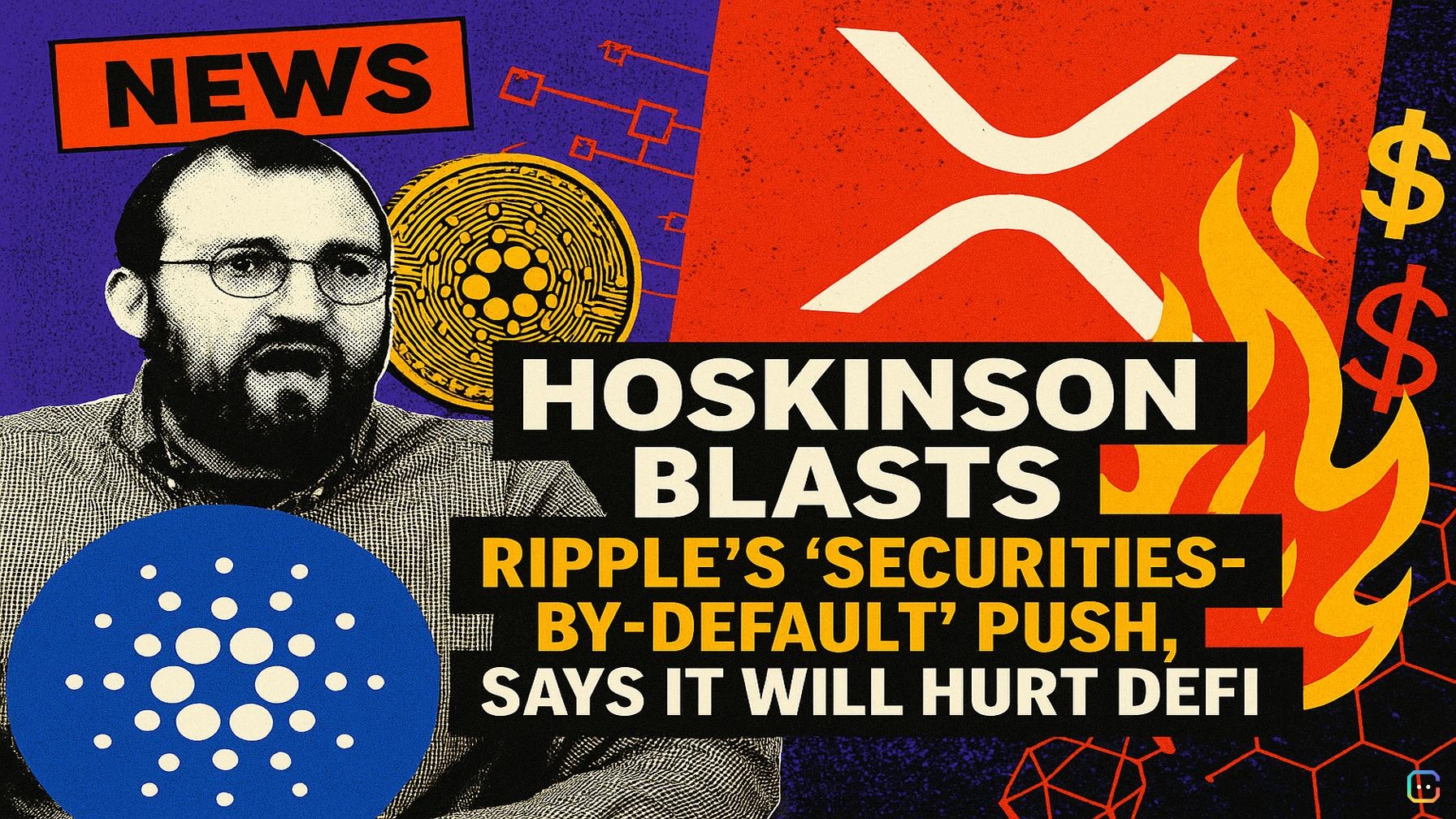
Cardano founder Charles Hoskinson used his latest weekly livestream to sharply criticize Ripple and its chief executive, Brad Garlinghouse—arguing that the company’s policy pushes in Washington could entrench incumbents, weaken protections for DeFi developers, and make it harder for new crypto projects to compete.
Hoskinson’s beef was not with XRP holders, he said, but with what he described as Ripple’s lobbying strategy. At the heart of his critique: a proposed framework that, in his view, would treat new tokens as securities by default while carving out advantages for larger, established players. “He’s trying to pass a bill that makes everything by default a security until proven otherwise,” Hoskinson said, calling such a framework a “non-starter” for the broader market. He added that the approach would replicate the pressure the crypto industry faced under former SEC Chair Gary Gensler—this time effectuated through legislation supported by industry actors rather than enforcement actions alone.
Hoskinson warned that the bill would reduce competition because big firms could secure exemptions that smaller projects couldn’t. He was blunt about the consequences: allowing a securities-by-default standard, combined with carve-outs, would give incumbents a structural advantage and curb innovation.
Beyond market structure, Hoskinson focused on the bill’s treatment of developers. He said the proposal “removed all developer protections for DeFi developers,” leaving open-source coders vulnerable to “transitive unlimited liability.” Using a long-running analogy, he argued that holding software writers legally responsible for how others use their code is a category error—like charging an author with murder because a reader used a fictional idea to commit a crime. He invoked Tornado Cash as an example of developers and projects that could be exposed under such rules.
Hoskinson also addressed the reaction from parts of the XRP community, who he said reflexively defend Ripple whenever he criticizes Garlinghouse. That dynamic, he argued, prevents people from engaging with the substance of his concerns. He pointed out that he had earlier supported Ripple when the SEC sued the company—providing video evidence of his past stance—yet maintained that past support does not obligate him to back Ripple’s current lobbying agenda.
On token economics, Hoskinson attacked Ripple’s balance sheet and token allocation. He argued Ripple did not need outside help to fund legal defenses or acquisitions because the company “gave themselves a mammoth premine.” He contrasted that with Cardano’s token policy: “I didn’t give myself 70% of the ADA supply,” he said, underscoring differences in distribution and fundraising approaches.
The livestream blended policy argument, market critique, and personal calls for principled competition in crypto. Hoskinson warned he had already outlined “four different attack vectors” the SEC could use if a securities-by-default bill became law, and suggested the fallout would reach far beyond token issuers.
At press time, XRP traded at $1.35.
Read more AI-generated news on: undefined/news