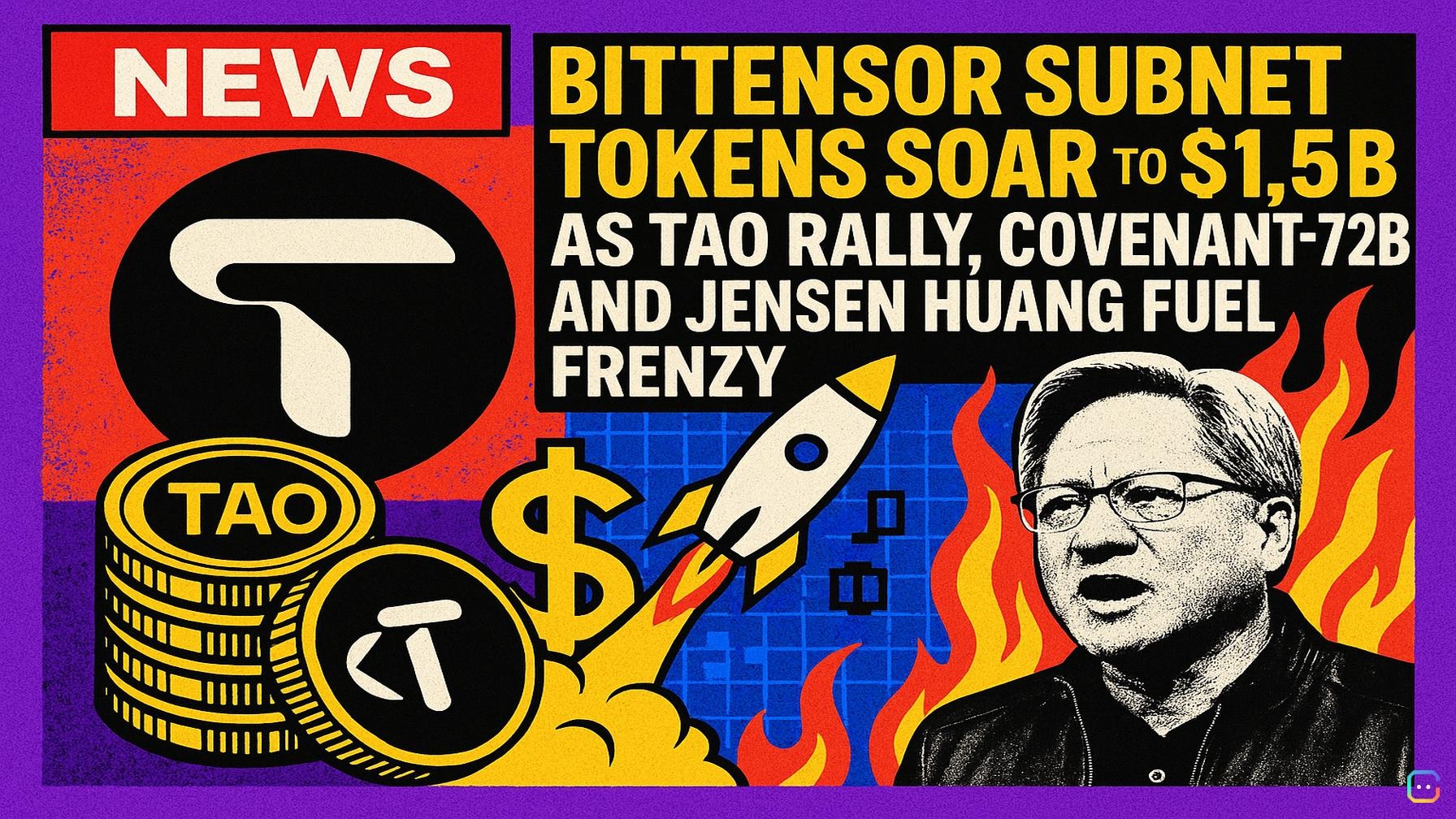
Headline: Bittensor’s subnet tokens surge to $1.5B as TAO rally and Jensen Huang endorsement spark speculative fever
Bittensor’s ecosystem is on a tear. TAO, the network’s native token, has jumped roughly 90% this month—helping ignite an even steeper run among the network’s subnet tokens, whose combined market capitalization hit about $1.47 billion on Monday with $118 million in 24‑hour trading volume, per CoinGecko.
What moved markets
- TAO itself climbed from around $180 to over $332 in March, but the real fireworks are in the subnets — independent tokens tied to specific Bittensor sub-networks.
- Recent 30‑day gains: Templar (Subnet 3) +444%, OMEGA Labs +440%, Level 114 +280%, BitQuant +230%. Even larger subnets posted strong returns: Chutes +54%, Targon +166%.
Why investors are excited
Bittensor is a decentralized marketplace for AI compute, data and models. Rather than being built inside a single lab, models are trained permissionlessly by a distributed network of contributors who earn TAO. The protocol is organized into specialized subnets (128 active today), each focused on different AI tasks — from LLM training to compute orchestration and cybersecurity — and each issuing its own token whose value is directly linked to TAO staked in that subnet.
Catalysts behind the rally
- Covenant‑72B: Subnet 3 (Templar) produced Covenant‑72B, a large language model trained across Bittensor by more than 70 contributors using commodity internet hardware. Trained on 1.1 trillion tokens, the model posted a 67.1 MMLU score in a March 2026 arXiv paper — putting it in competitive range with Meta’s Llama 2 70B. (MMLU measures performance across 57 academic subjects.)
- High‑profile endorsement: Nvidia CEO Jensen Huang and investor Chamath Palihapitiya praised Bittensor’s decentralized training approach on the All‑In Podcast on March 20, 2026, framing it as complementary to proprietary models. Huang’s public support amplified attention beyond the usual crypto circles.
- Protocol mechanics: Since the launch of dynamic TAO in February 2025, each subnet runs an automated market maker whose native token’s valuation is determined by TAO staked in the subnet reserve. When TAO rises, those reserves gain value, producing a reflexive, leveraged effect on subnet token prices.
Market structure and institutional signals
- TAO’s market cap sits at roughly $3 billion, while individual subnet market caps range from about $1 million to $137 million — making subnet tokens effectively leveraged bets on the parent protocol.
- Bittensor plans to expand from 128 to 256 active subnets later this year, potentially fueling new token launches and fresh capital flows.
- Institutional pathways may be forming: a potential regulatory decision to convert the Grayscale TAO Trust into a spot ETF could allow broader institutional access by late 2026. Digital Currency Group’s Yuma is also participating in 14 subnets, signaling institutional infrastructure interest.
Outlook and risks
The key question is sustainability. If Bittensor continues to produce competitive models like Covenant‑72B and attract real usage, the subnet rally has fundamentals behind it. If Covenant‑72B proves a one‑off or if external sentiment reverses, the reflexive mechanics that amplify gains could just as easily magnify losses.
Bottom line: Bittensor’s mix of decentralized AI training, dynamic TAO mechanics and high‑profile endorsements has created a powerful short‑term narrative — and the subnet tokens are trading like leveraged plays on that story. Investors should weigh the technical achievements and growing ecosystem against the speculative structure and execution risk.
Read more AI-generated news on: undefined/news