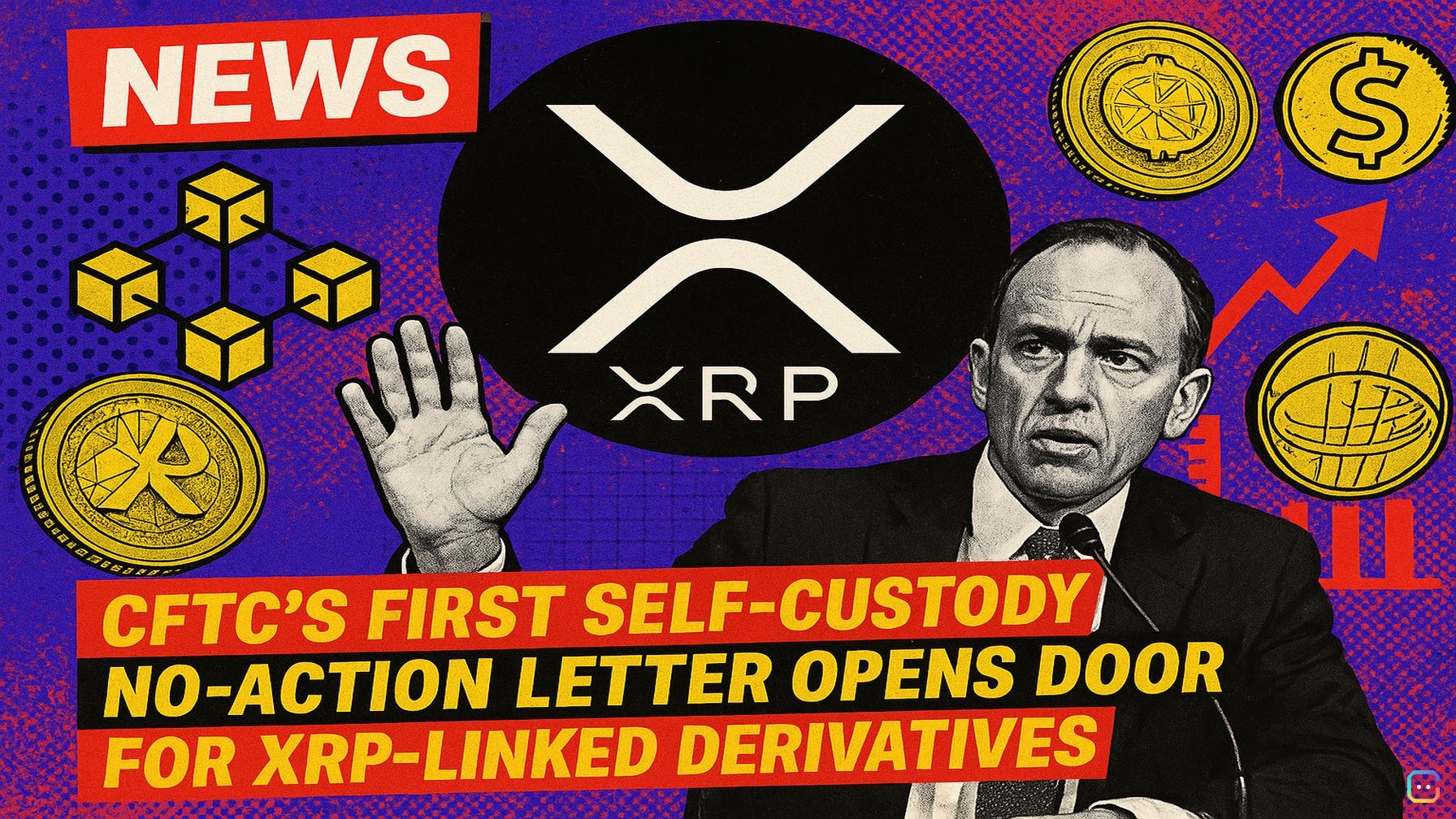
CFTC’s first self-custody no-action letter opens door for XRP-linked derivatives
A little-noticed regulatory move last week could accelerate the entry of non-custodial XRP infrastructure into regulated derivatives markets. On March 17 the U.S. Commodity Futures Trading Commission issued its first-ever no-action letter for a self-custodial wallet provider — a development XRP backers say pairs perfectly with a same-day joint SEC-CFTC decision classifying XRP as a “digital commodity.”
The CFTC’s Letter No. 26-09 grants no-action relief to Phantom Technologies Inc., the team behind Phantom, one of Solana’s most popular self-custodial wallets. Under the letter, Phantom can provide front-end access to CFTC-regulated derivatives (for example, futures traded on designated contract markets) without registering as an introducing broker or associated person — on the condition that it never takes custody of users’ funds, offers robust risk disclosures, maintains records and compliance controls comparable to those of a registered introducing broker, and follows the other conditions laid out by the agency.
Evernorth, an XRP-focused treasury firm that flagged the letter on March 24, summarized the ruling’s core takeaway: “If you don’t hold customer funds, you’re not a financial intermediary.” The firm argues the framework has direct implications for non-custodial XRP infrastructure given Ripple’s long-standing emphasis on settlement models that avoid custodial control. Crypto chart analyst @ChartNerdTA summed up the reaction on social media with the headline: “XRP Was DESIGNED For This.”
That regulatory tailwind arrived alongside a major classification shift. On the same day the CFTC issued the Phantom letter, the SEC and CFTC published a joint interpretive release designating XRP as a “digital commodity,” explicitly placing the Ripple-linked token outside the scope of U.S. securities law. Ripple’s Chief Legal Officer Stuart Alderoty quickly responded on X: “We always knew XRP wasn’t a security — and now the @SECGov has made clear what it is: a digital commodity.”
Markets reacted sharply. XRP’s trading volume spiked 125% to $3.22 billion on March 17 when the commodity designation was published, briefly boosting its market cap to about $93.4 billion and overtaking BNB in the global rankings. At the time of reporting the token was trading around $1.41 with a 24-hour volume near $2.29 billion and a market cap of roughly $86.4 billion.
Why this matters: the Phantom no-action letter creates a clear regulatory pathway for self-custodial wallets to act as user-facing interfaces to regulated derivatives without being treated as financial intermediaries — so long as they never control user assets and meet the CFTC’s compliance and disclosure conditions. For XRP-focused projects and other non-custodial platforms, the decision is strategic rather than immediately transformative: it reduces a major regulatory obstacle to connecting non-custodial wallets and services with regulated derivatives markets.
The move also reflects a broader CFTC posture under newly confirmed Chairman Brian Quintenz, which observers describe as more pro-innovation. The agency has been working to streamline digital-asset oversight, including advancing a Memorandum of Understanding with the SEC on March 11, 2026, aimed at reducing regulatory fragmentation for firms operating across both regimes.
Bottom line: together, the CFTC’s no-action letter for self-custodial wallets and the SEC-CFTC classification of XRP as a digital commodity create complementary regulatory clarity. That combination could make it easier for non-custodial XRP infrastructure to plug into regulated derivatives markets — a development that proponents say aligns with how XRP and similar tokens were architected.
Read more AI-generated news on: undefined/news