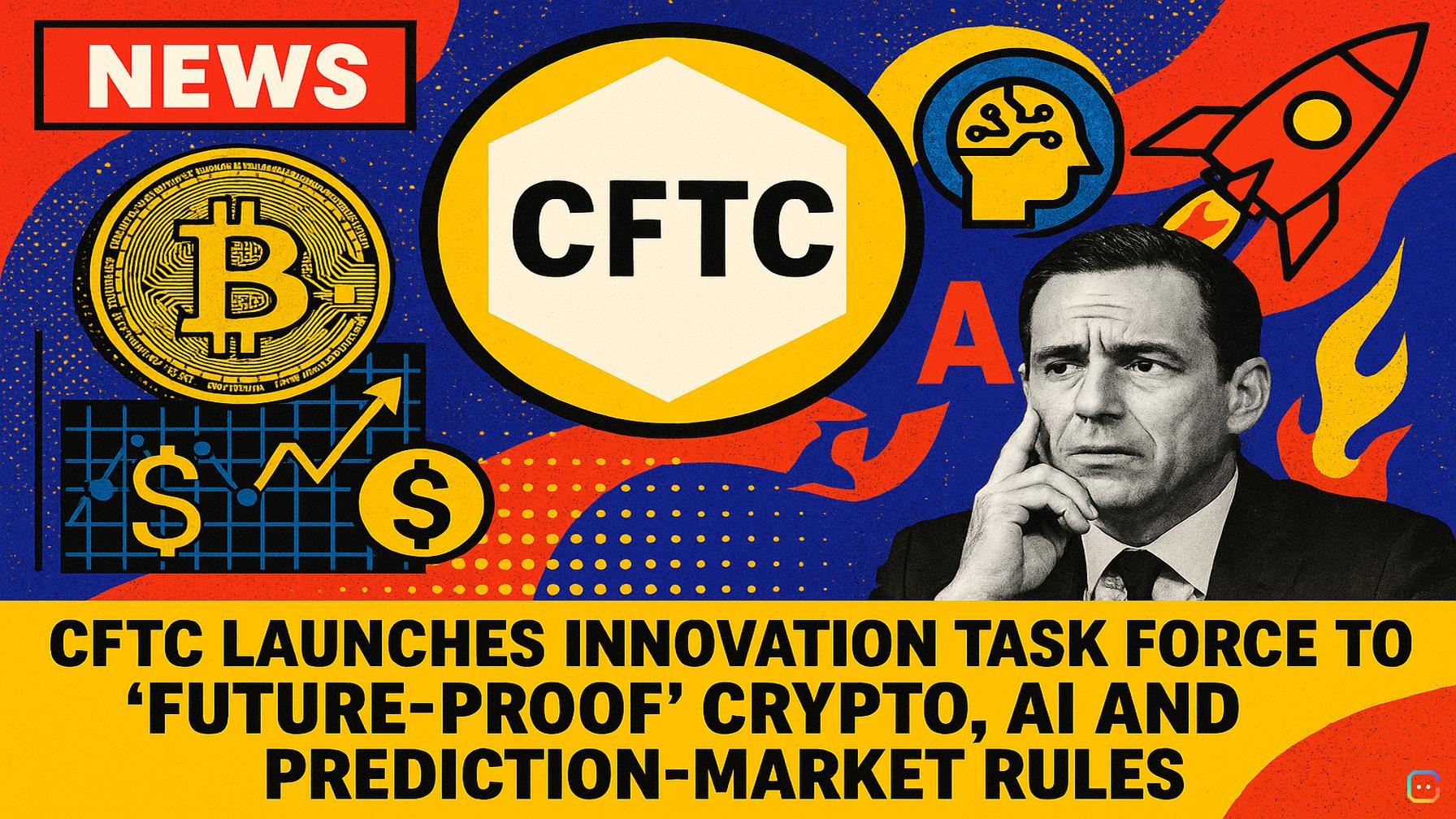
The Commodity Futures Trading Commission has launched a new Innovation Task Force to carve out clearer rules for emerging technologies in U.S. derivatives markets — with a special focus on crypto and blockchain, artificial intelligence and autonomous systems, and prediction markets.
CFTC Chairman Michael Selig framed the move as part of a broader effort to “future‑proof” regulation and keep American firms competitive. “By establishing a clear regulatory framework for innovators building on the new frontier of finance, we can foster responsible innovation at home and ensure American market participants are not left on the sidelines,” Selig said when announcing the initiative on X on March 24, 2026.
The Innovation Task Force (ITF) will be led by Selig’s senior advisor, Michael J. Passalacqua, and is intended to build on the agency’s Innovation Advisory Committee work. Passalacqua said the ITF will advance the CFTC’s innovation agenda across crypto, AI, and prediction markets and will coordinate with other regulators, including the SEC and its Crypto Task Force, on cross‑agency innovation initiatives.
The timing reflects the CFTC’s recent focus on prediction markets. In March the agency published guidance for registered exchanges on compliance and product requirements for event contracts — the instruments used by platforms such as Kalshi and Polymarket — and opened a public comment period on whether new or amended rules are needed to supervise these markets.
That scrutiny comes amid growing political and regulatory pressure over potential market abuse and the social risks of certain event contracts. Democratic lawmakers and regulators have raised concerns about insider trading and event contracts tied to terrorism or war. In response, both Kalshi and Polymarket moved to tighten integrity controls: Kalshi added preemptive screening barring politicians and certain sports insiders from trading on related markets, while Polymarket clarified and strengthened its insider‑trading and market integrity rules.
The CFTC has been emphatic about its jurisdiction over prediction markets. Chairman Selig warned parties challenging the agency’s authority — including state regulators — that the CFTC will defend its role, saying to challengers, “see you in court.” That stance follows legal and regulatory pushes at the state level: Arizona filed charges accusing Kalshi of operating an illegal gambling business, and Nevada last week obtained a temporary order blocking Kalshi from offering sports, politics, and entertainment event contracts in the state for at least 14 days.
The CFTC has also broadened cooperation with outside stakeholders. Earlier this month it signed a memorandum of understanding with Major League Baseball aimed at limiting markets that could pose “integrity risk.”
Beyond prediction markets, the agency made a consequential ruling last week affecting crypto infrastructure: the CFTC determined that the self‑custodial wallet Phantom can give users access to derivatives markets without registering as a broker. That decision signals the agency’s continued willingness to draw new lines around crypto custody and market access as innovation accelerates.
What to watch next: the ITF’s early outputs, responses to the CFTC’s prediction market comment request, and whether interagency coordination with the SEC produces unified or divergent approaches to crypto and AI products. The new task force marks the CFTC’s clear intent to shape how novel technologies intersect with U.S. derivatives law — and the coming months should show how aggressively it will translate that intent into rules and enforcement.
Read more AI-generated news on: undefined/news