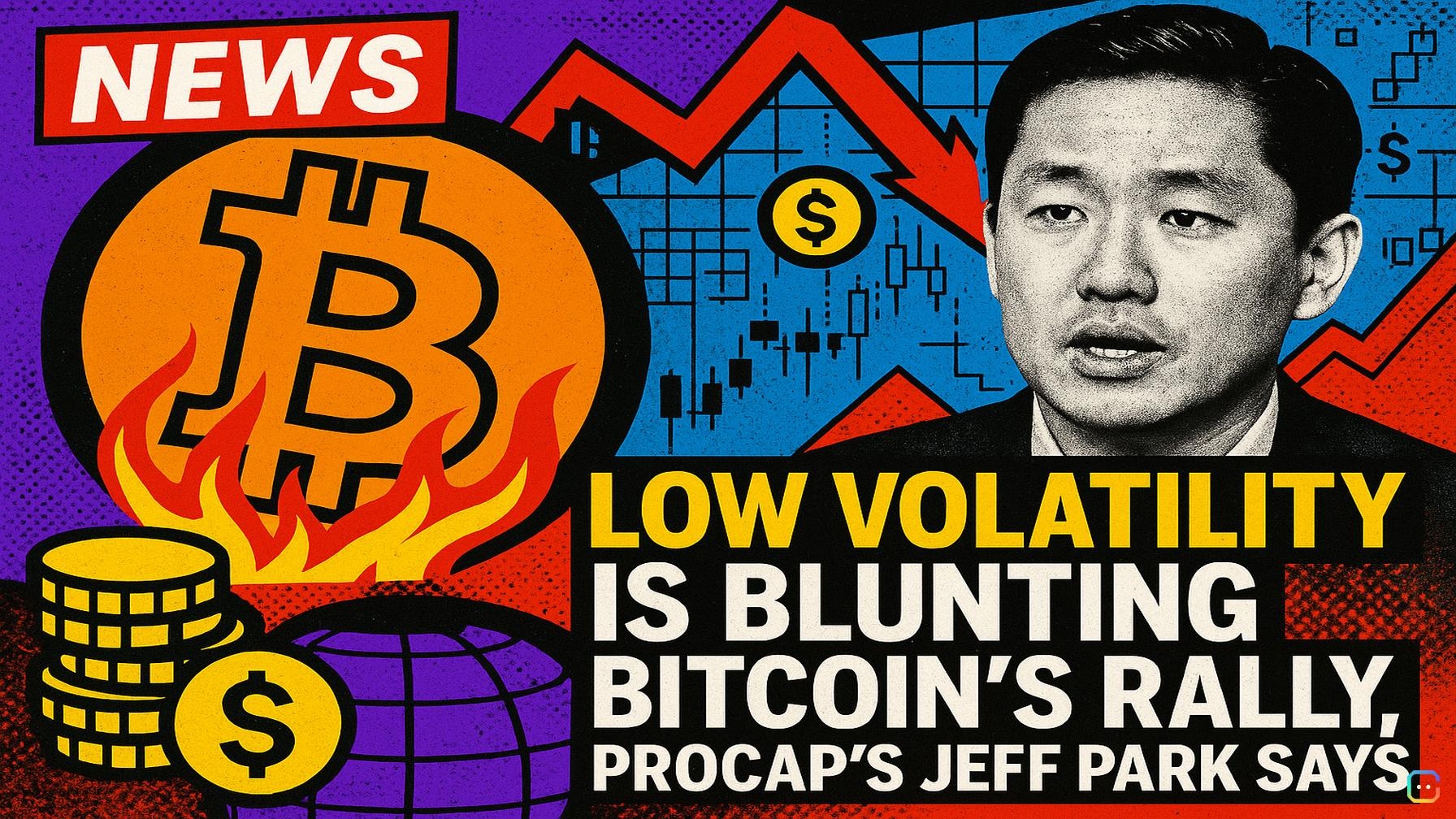
Bitcoin’s rally has hit a quiet patch — and that calm matters more than it looks. After a blistering start to the year that pushed the BTC price above $100,000 and briefly toward $125,000, the market has settled into a low-volatility grind. On the 1000x podcast, ProCap partner Jeff Park argued that this structural shift is the central reason Bitcoin hasn’t been able to rekindle momentum, even as gold and other commodities race to fresh highs.
Park’s argument is simple: Bitcoin’s upside has historically been a volatility story. Big moves — and the outsized returns that attract early, risk-taking buyers — depend on both implied and realized volatility rising together. When volatility compresses and stays low, one of Bitcoin’s main hooks for marginal risk capital disappears.
He also urged investors to stop thinking of Bitcoin as an isolated “crypto” play and instead view it in a broader relative-value context: equities, rates, FX and commodities are all competitors for the same allocation dollars. What made Bitcoin stand out for many allocators was its potential for asymmetric upside — a feature expressed by volatility. Without that element, Bitcoin looks less compelling alongside other asset classes.
That helps explain a notable contrast: gold has been making new highs while Bitcoin lags. Park didn’t sugarcoat it — gold is finding “real buyers” and has, in his words, product-market fit as a reserve asset within the global monetary framework. Bitcoin, he argues, hasn’t reached that level of structural demand.
Flows this year back up Park’s point. The dominant bids for Bitcoin in 2025 have come from ETFs and corporations, not governments or central banks. ETFs often reflect portfolio-construction demand — decorrelation, optionality and a non-consensus sleeve — rather than the high-conviction narrative-driven buying that once turned Bitcoin into the market’s main event. Corporates, meanwhile, are buying for different, often balance-sheet or treasury-management reasons.
Park also made a cultural case: Bitcoin is a generational movement rooted in youth adoption. Institutionalization can help, but only if it doesn’t replace retail participation. If young people stop engaging, the institutional story risks stalling.
On top of that, Bitcoin carries its own noise and perceived existential risks — renewed “quantum anxiety,” debates over Bitcoin Improvement Proposals, and internal protocol discussions. Those issues, Park said, mean investors require compensation for low-probability but high-impact risks. A subdued volatility regime doesn’t offer that premium. “Gold doesn’t have that,” he noted, calling out the contrast between gold’s settled narrative and Bitcoin’s ongoing protocol debates.
Despite the critiques, Park didn’t declare the long-term case dead. He pointed to practical ownership advantages: unlike physical gold, which brings opaque pricing, logistical friction and authenticity headaches, Bitcoin offers a single, largely transparent global price and easier portability.
The key question, he concluded, is whether Bitcoin can recreate the conditions that historically pulled new participants into the trade — and whether the market is willing to pay for the risk Bitcoin continues to represent.
At press time, Bitcoin traded around $87,779.
Read more AI-generated news on: undefined/news