Ethereum Foundation’s new mandate ignites debate as community splits over stewardship vs. leadership
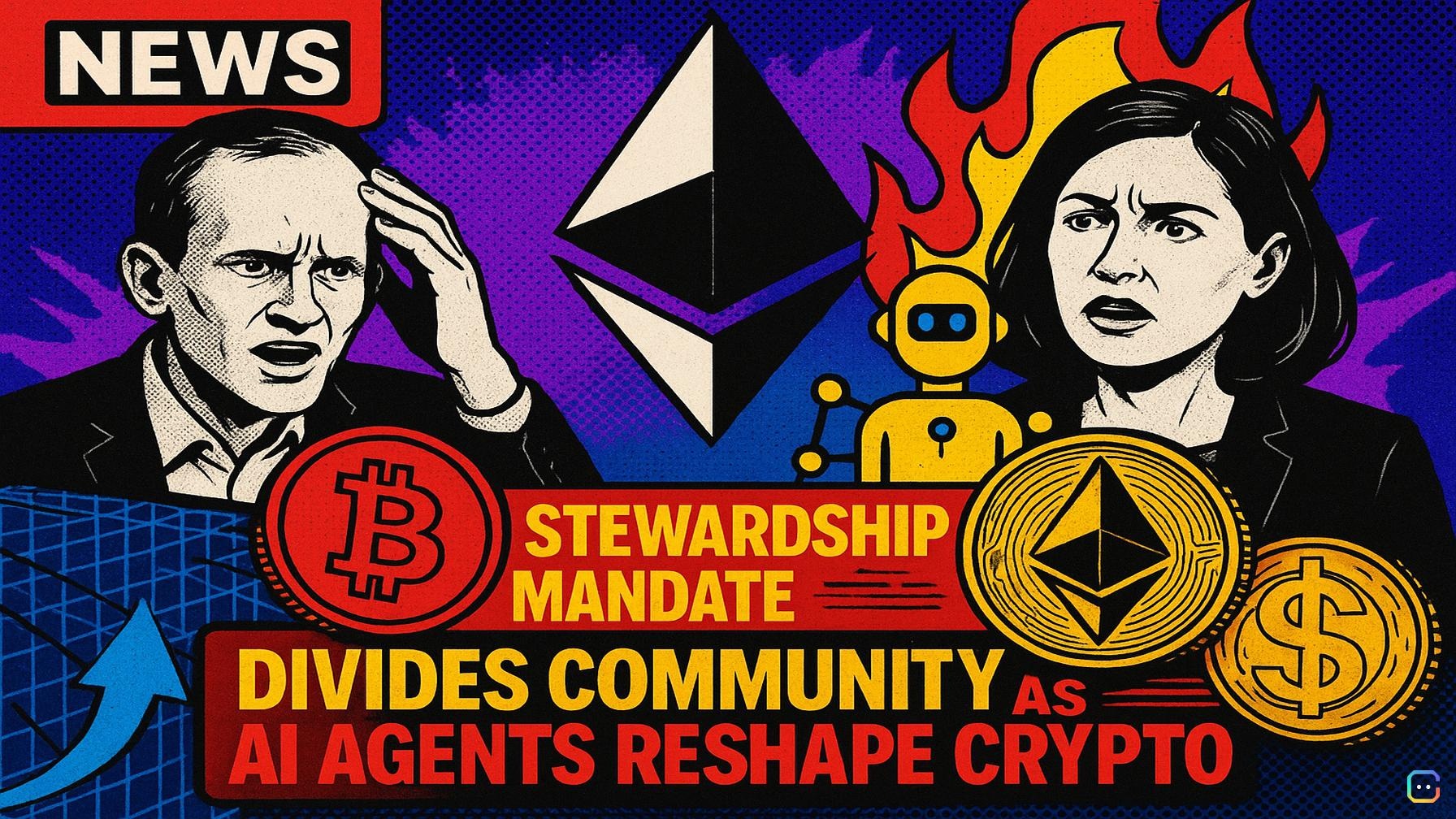
The Ethereum Foundation’s recently released 38‑page mandate — billed as a “constitutional” guide to the nonprofit’s role — has unleashed a torrent of reaction across the ecosystem. The document positions the foundation as a neutral steward focused on keeping Ethereum decentralized and resilient, supporting the protocol layer, and funding public goods, rather than acting as a centralized authority.
Why it matters: Ethereum has matured into one of the largest crypto ecosystems just as the foundation itself faces leadership turnover and renewed questions about how active it should be in shaping the network’s future. The mandate attempts to clarify that role at a pivotal moment for adoption and institutional interest.
How the community reacted
- Critics: Some community members called the mandate too philosophical and light on concrete steps to grow real‑world adoption. Dankrad Feist, a former foundation researcher and major contributor to Ethereum’s scaling roadmap, argued it doesn’t address practical business‑development questions about how the ecosystem serves real users. Others warned the document could entrench a model where the foundation wields soft influence without clearly defined responsibilities.
- Supporters: Backers say the mandate reaffirms core principles and reduces ambiguity around the foundation’s nonprofit stewardship. Chris Perkins of CoinFund said it clarifies the organization’s purpose. Infrastructure firms such as client developer Nethermind also welcomed the paper, saying it maps to the properties institutional buyers already look for when evaluating blockchain infrastructure.
Bottom line: The mandate frames a conservative, stewardship‑first approach just as some ecosystem actors call for stronger, more proactive leadership to compete for institutional and enterprise adoption.
World launches AgentKit to bind AI agents to human identity
As autonomous AI agents start transacting and acting online, identity verification becomes a central problem. World (formerly WorldCoin), the Sam Altman‑backed identity project, unveiled AgentKit — a developer toolkit that lets AI agents carry cryptographic proof they’re backed by a unique human via World ID.
Integration and use case: AgentKit is built to work with x402, a protocol from Coinbase and Cloudflare that embeds stablecoin micropayments into the internet’s communication layer to enable “agentic payments” — letting agents pay each other for services without human intervention. Erik Reppel of Coinbase described the pairing succinctly: “Payments are the ‘how’ of agentic commerce, but identity is the ‘who.’”
Market context: Analysts estimate agentic commerce could be a $3–$5 trillion market by 2030. AgentKit aims to prevent automated traffic or Sybil actors from impersonating humans as agents move into commerce and other economic activity.
Crypto founders spar over whether payments will be dominated by agents
A flurry of posts from industry heavyweights spotlights a structural argument about the future of payments. Coinbase CEO Brian Armstrong predicted a looming era in which AI agents outnumber humans in making online transactions; Binance founder Changpeng “CZ” Zhao went further, suggesting agents could perform millions of times more payments than people.
Why crypto has an edge: Banks and traditional payment rails generally require KYC and identity verification that purely software agents can’t provide. Crypto wallets, by contrast, only require a private key, enabling rapid, permissionless payments. That asymmetry, proponents say, makes crypto a natural backbone for machine‑to‑machine microtransactions.
Economic drivers: Agents don’t spend like humans. When an agent completes a task, it may call dozens of APIs and services — each payment tiny (fractions of a cent) and very different from what Visa or Mastercard are designed to handle. Supporters argue these micropayments for compute, data feeds, scraping, or hiring sub‑agents create a whole new workload better suited to blockchain rails.
Prediction markets meet autonomous traders: agents trading 24/7
Autonomous agents are not only paying — they’re starting to trade. Valory AG, the team behind the crypto‑AI protocol Olas (formerly Autonolas), is building infrastructure for autonomous software agents that run services on blockchains, interact with smart contracts, and earn crypto rewards. CEO David Minarsch says these multi‑agent systems are opening an “agent economy” where agents perform tasks and generate value continuously.
Real experiment: Polystrat, an AI agent deployed on prediction‑market platform Polymarket in February 2026, trades around the clock for self‑custody users, executing strategies even when humans sleep or are offline. “In a nutshell, Polystrat is an autonomous AI agent that trades on Polymarket 24/7 on behalf of its human user,” Minarsch said.
Implication: As markets and API ecosystems become more automated, retail participants may need autonomous tools just to stay competitive. That raises questions about fairness, regulation, and how decentralized protocols will integrate and govern agent behavior.
Takeaway
From governance debates over the Ethereum Foundation’s remit to identity tooling for agentic commerce and a broader push for machine‑scale payments and trading, crypto is rapidly adapting to a future where autonomous software participates directly in economic activity. The technology questions are converging fast with policy, custody, and market‑structure issues — and the next year will likely determine which approaches gain mainstream traction.
Read more AI-generated news on: undefined/news