Headline: Ripple ramps up global push to make XRP a core settlement asset — leadership tour, AI tools, and a claimed banking license signal an ambitious shift
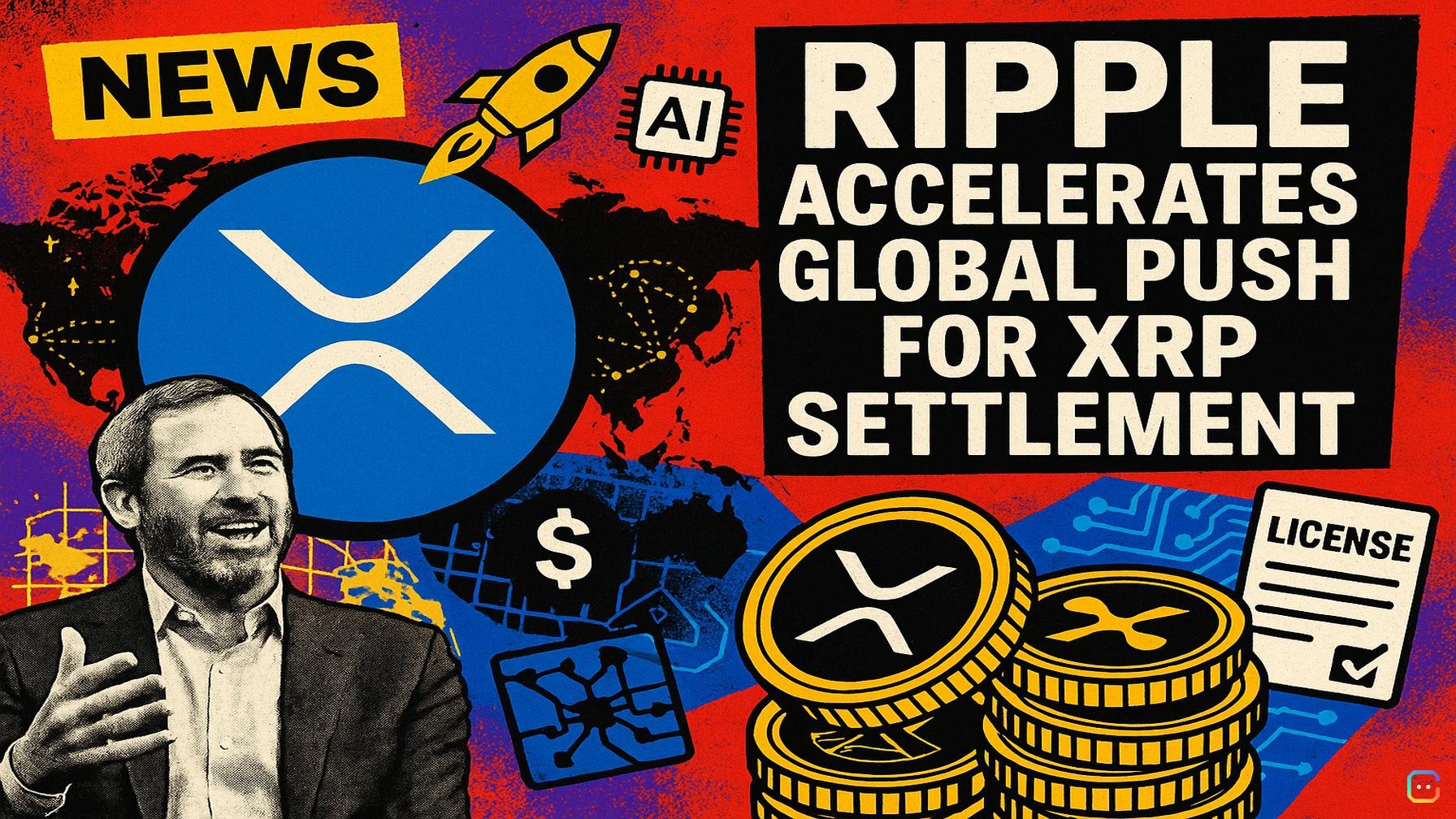
Ripple is intensifying a worldwide expansion aimed at positioning XRP as a core settlement asset for international finance. Over the past week, company leadership has been on an aggressive outreach campaign across major financial hubs — a move intended to accelerate real-world adoption of blockchain payment infrastructure.
Leadership tour and strategy
According to analyst XFinanceBull on X, CEO Brad Garlinghouse and President Monica Long visited four key offices in five days — Dublin, London, Singapore and Sydney — spanning three continents. The tour underscores Ripple’s focus on building a comprehensive financial stack that goes beyond payments to include custody, liquidity and treasury services.
A notable piece of the strategy is integrating artificial intelligence into cash-management products. Ripple is reportedly working on AI-driven, real-time cash forecasting and “CFO-grade” liquidity tools aimed at corporate treasuries and financial institutions, signaling a push to deliver enterprise-grade capabilities rather than just speculative use cases.
From coastal US to global markets
Executives have emphasized engaging directly with international markets and financial hubs, a deliberate pivot away from an inward-looking, US-coastal mindset. Ripple’s leadership frames the company’s efforts as infrastructure-first: building payments rails and liquidity solutions now, rather than waiting for a crypto bull market to validate the thesis. The expectation is that if adoption succeeds, price and market perception will follow.
Banking license claim and balance-sheet math
Separately, crypto commentator 25hoursawake on X has reported that Ripple has secured a banking license — a development that, if verified, could materially alter the company’s regulatory and market posture. The same commentator highlighted Ripple’s large XRP holdings as a potential source of substantial balance-sheet value.
Key figures being cited:
- Ripple reportedly holds roughly 40 billion XRP.
- At $3 per XRP, that equates to about $120 billion in token value tied to the company’s reserves.
- If XRP were to rise above $6, the reserves’ notional value would top $240 billion — numbers that some observers say could place Ripple among the world’s largest financial institutions by balance-sheet metrics.
These scenarios are conditional on token price moves and subject to regulatory and accounting treatment; they do not reflect realized assets unless Ripple were to monetize those holdings.
Bigger-picture projections — and speculation
Commentators have floated ambitious long-term visions, including claims that up to $650 trillion in global assets could, in theory, move across the XRP Ledger over time via RealFi initiatives and a native REAL token. One speculative estimate cited by 25hoursawake suggests that if the REAL token reached a $100 billion market capitalization, its price could climb from $0.043 to roughly $998.90. These projections are highly speculative and depend on many variables, including adoption, token economics, regulatory clarity, and market dynamics.
What to watch
- Verification of the reported banking license and the scope/jurisdiction of that license.
- Product rollouts tied to AI-powered treasury tools, custody, and liquidity products.
- Commercial partnerships or pilot programs with banks and corporates that would demonstrate real-world settlement use of XRP.
- How regulators respond as Ripple pushes deeper into regulated financial services.
Bottom line
Ripple is publicly accelerating a global outreach and product build aimed at making XRP a functional settlement asset for institutions. The company’s leadership tour and stated technology focus signal a strategic bet on infrastructure and enterprise adoption — but key claims about licenses and balance-sheet transformations remain contingent on verification and market realities.
Read more AI-generated news on: undefined/news