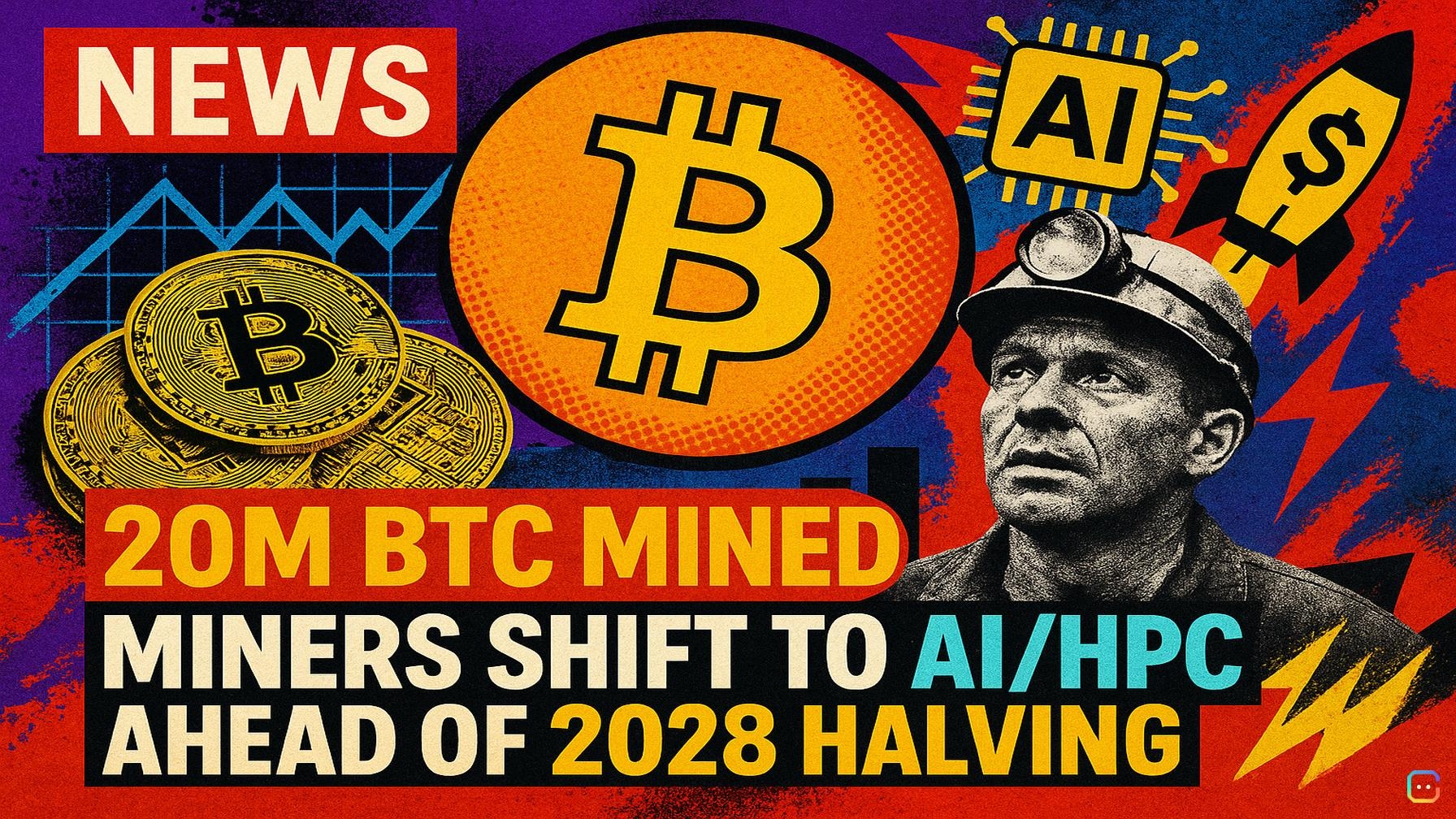
Bitcoin just crossed a big line: the 20 millionth BTC was mined this week, leaving roughly 1 million coins left to be issued as miner rewards. That milestone has the industry rethinking how Bitcoin mining will evolve—and what it means for miners’ business models and BTC’s long-term price dynamics.
Why this matters
- It took about 16 years to mine 20 million BTC; at current issuance schedules, unlocking the final 1 million could take roughly another 115 years, Wolfie Zhao, head of research at TheEnergyMag, estimates.
- Miners secure the network and validate transactions by expending huge amounts of computing power and energy in exchange for newly minted coins and transaction fees. As new supply dwindles, the economics of mining and who survives in the industry are shifting fast.
Mining firms pivot to AI and HPC
Analysts say many publicly traded miners are already preparing for a different future. John Todaro, managing director and senior research analyst at Needham & Company, told Decrypt he expects a wave of public miners to exit Bitcoin mining in 2027–2028. He added that many are likely to sell down most of their BTC by the end of 2026 to fund capital spending on AI workloads.
Why the pivot?
- Low hash prices and the looming 2028 halving make traditional mining margins precarious, Todaro said—many operators are at or near breakeven.
- By contrast, high-performance computing (HPC) and AI workloads can deliver much higher NOI (net operating income) margins—Todaro put HPC NOI north of 80%. NOI measures revenue minus operating expenses, excluding financing costs and taxes.
- As a result, publicly traded miners the firm tracks have already reallocated portions of their compute capacity to HPC and AI.
Industry examples
- Bitdeer (founded by Bitmain co-founder Jihan Wu) is converting several mining facilities into AI data centers while continuing to develop next-generation mining ASICs. Bitdeer’s chief communications officer, Ross Gan, told Decrypt that miners who survive will be those that “control more of the stack” via vertical integration—designing efficient ASICs and securing long-term, low-cost energy globally.
- HIVE Digital Technologies began investing in HPC infrastructure early and diversified its operations before Ethereum’s 2022 merge rendered ETH mining obsolete. Executive Chairman Frank Holmes told Decrypt that Bitcoin miners have been leaders in sourcing stranded and surplus energy and building large-scale power infrastructure; the winners, he said, will be operators that secure low-cost power and convert it into durable computing assets.
What the next halving means
The next halving, expected around mid-2028, will cut block rewards again—intensifying the squeeze on less-efficient miners. Todaro predicts some operators will wind down by late 2027, while Holmes argues the industry won’t disappear but the bar for survival will rise: the fittest miners will have the best power contracts, sites, and operational flexibility.
And Bitcoin’s price?
Block rewards eventually taper to zero by design, and investors have long known supply is finite—so much of that is arguably priced in. Satoshi’s original whitepaper compared Bitcoin issuance to gold mining: a steady addition of supply that requires resource expenditure. Todaro expects the slow, predictable reduction in new Bitcoin to moderate abrupt price impacts. He also notes that most selling pressure historically comes from newly produced BTC rather than long-term hodlers—and miners today hold a relatively small share of circulating supply (around 0.5%). By contrast, certain corporate investors control much larger stakes, meaning miners aren’t the dominant source of potential liquid supply they once were.
Bottom line
Hitting 20 million BTC is a symbolic turning point that puts a spotlight on mining economics. The next decade could see a reshaped industry: miners increasingly diversify into AI/HPC, vertically integrate hardware and power, and chase scale and low-cost energy. The halving countdown and slim margins will force consolidation and innovation—but they won’t necessarily end mining. The survivors will be the ones who secure the cheapest power, control more of their tech stack, and adapt to demand for profitable computing beyond pure hashpower.
Read more AI-generated news on: undefined/news