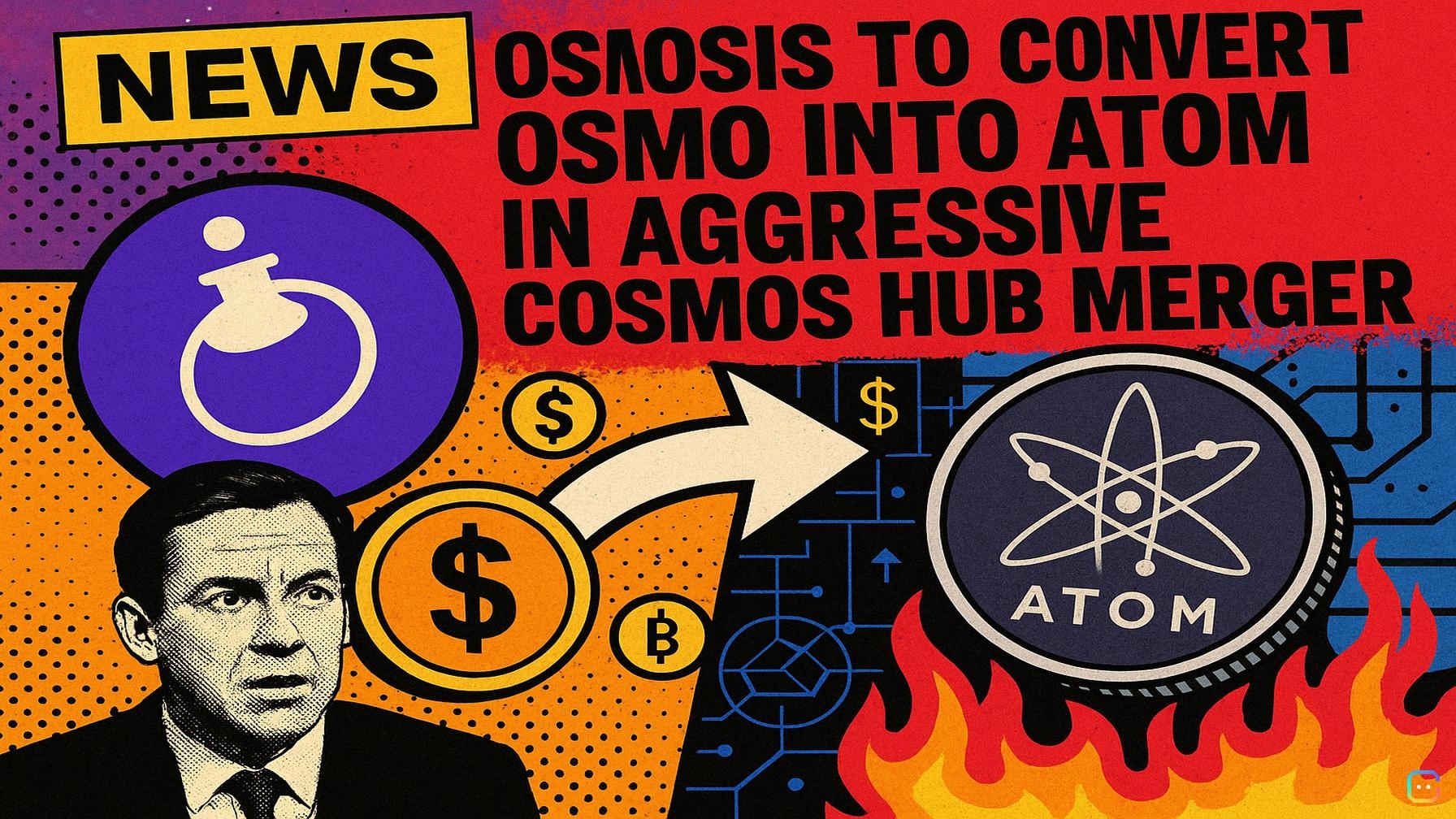
Osmosis has put forward a bold proposal to convert OSMO into ATOM and more tightly fold its core protocol into the Cosmos Hub — a move that would be one of the most aggressive consolidations yet in the Cosmos ecosystem.
What’s being proposed
- All circulating OSMO (excluding undeployed community pool tokens) would be eligible for conversion into ATOM during a six‑month window.
- The conversion would be at a fixed rate: 1.998 OSMO → 0.0355 ATOM.
- Holders who don’t claim their ATOM within the window would see the corresponding tokens returned to the Cosmos Hub community pool, keeping unclaimed value under Hub governance and avoiding open-ended liabilities.
Why this matters
The plan effectively proposes transforming Osmosis from a largely independent app‑chain into a native liquidity engine for the Cosmos Hub. By concentrating liquidity, security, and governance around the Hub and ATOM, proponents argue Cosmos could present a simpler, more unified narrative to users and institutional capital: one base asset (ATOM), one primary venue for liquidity (Osmosis running on the Hub), and consolidated governance.
Potential benefits
- Deeper liquidity and a clearer capital story for external investors who currently see Cosmos as fragmented.
- Broader distribution and visibility for Osmosis liquidity if ATOM’s brand and reach outstrip a standalone OSMO.
- A test case for whether chain mergers and token conversions can unlock higher valuations by consolidating economic and governance power.
Key trade-offs and risks
- OSMO holders would trade protocol‑specific upside for broader ATOM exposure and tighter alignment with the Hub. That represents dilution of the standalone OSMO narrative and potential loss of independent governance leverage.
- The Cosmos Hub would implicitly underwrite Osmosis’s future — taking on its liquidity, fee streams, and the protocol’s technical and governance risks.
- Success would accelerate a “hub‑and‑spokes” model with ATOM at the center; failure would bolster the argument for app‑chain sovereignty and decentralized fragmentation.
Wider implications
This proposal escalates a fundamental debate inside Cosmos: whether to compete with more monolithic ecosystems like Ethereum and Solana by consolidating, or to preserve the modular, app‑chain model. It also creates a live experiment on whether token swaps and protocol mergers can materially deepen liquidity and raise valuations — or merely reallocate governance complexities.
What’s next
The proposal now goes to a vote; outcomes will be watched closely by both OSMO and ATOM holders and by outside investors looking for signals about Cosmos’s long‑term architecture. The ballot will decide whether this high‑stakes consolidation becomes the next chapter in Cosmos or a cautionary tale about centralized economic risk.
Read more AI-generated news on: undefined/news