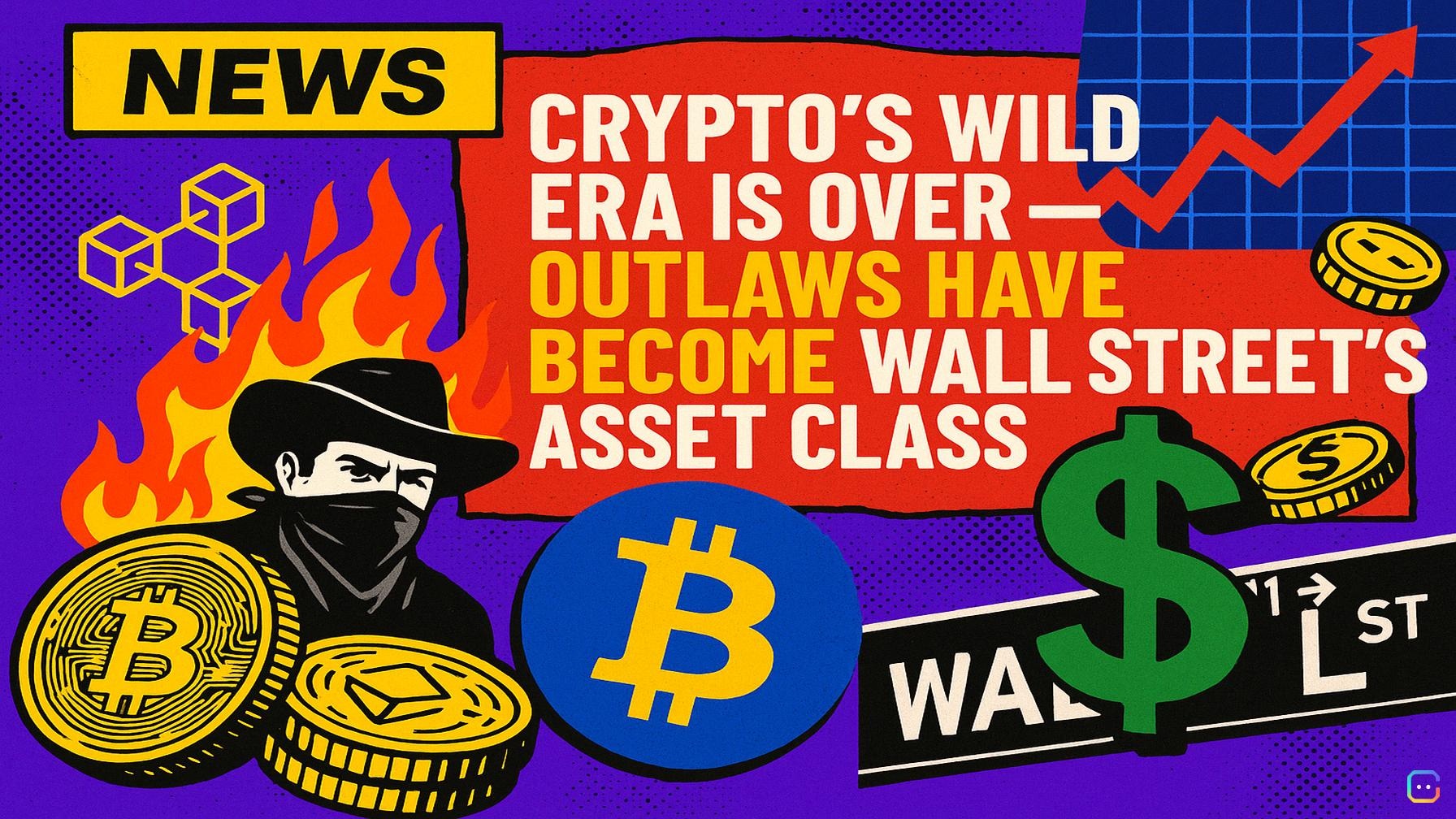
Crypto’s rock‑and‑roll era is over — and that’s not just nostalgia talking. What started as a peer‑to‑peer revolt against banks and surveillance is being folded into the very institutions it aimed to displace. Spot ETFs, institutional custody, bank-grade settlement rails and formal regulation have traded crypto’s outlaw energy for mainstream legitimacy.
A familiar lifecycle
Revolutions tend to ossify. Early insurgents prize disruption; once influence grows, priorities shift toward stability and preservation. The once-radical movement needs capital, counterparties and legal certainty to scale — and to get those it must make peace with the establishment. That pattern has played out in tech and music before, and it’s now playing out in crypto.
From scrappy idealism to boardroom seriousness
Many early adopters remember 2016 as a time of idealism and DIY culture: meetups over pizza, evangelism about self‑custody, and an oppositional rhetoric aimed at surveillance capitalism and a broken financial system. Fast forward a decade and the conversation looks very different:
- 2025 was widely billed as the year crypto went mainstream (a16z’s State of Crypto framed it that way).
- Spot ETFs and institutional custody mean investors can “get exposure” without learning seed phrases.
- Big banks and asset managers — JP Morgan, BlackRock, Morgan Stanley among them — now treat Bitcoin and other crypto as regulated asset classes.
- Davos moved crypto from fringe sideline events into the main stage; heads of state and bank CEOs publicly weigh in.
- Market plumbing is evolving: stablecoins now process annual transaction volumes rivaling major payment networks, and tokenized real‑world assets are shifting from experiments into settlement, collateral and treasury operations.
- DeFi is becoming legible to traditional asset managers, treasuries and family offices hungry for regulatory clarity and operational maturity.
- Regulation itself is clarifying the space: Europe’s MiCA and proposed U.S. frameworks such as the GENIUS Act are turning many gray areas black and white.
Institutional scale is arriving, too. TP ICAP — the wholesale broker that orchestrates roughly $200 trillion in annual commodities flow for banks and hedge funds — is exploring routing portions of that volume through crypto markets. Flows at that level dwarf the retail visions of hot wallets and coffee‑shop payments that early believers once imagined.
Normalization doesn’t mean disappearance
Purists will fret that crypto’s mission was to create a parallel financial reality and that embedding into TradFi is a sellout. That critique captures part of the story, but not all of it. Even as crypto is absorbed, it has left durable innovations in its wake:
- New primitives — tokenization, composable smart contracts, on‑chain settlement mechanics — have rewritten the logic of finance in ways incumbents must adapt to.
- Those primitives can be wrapped, regulated and institutionalized, but they cannot be uninvented. Crypto has forced incumbents to innovate-or-die.
Culture shifts with success
Symbols of underground culture — the laser‑eyes meme or the street‑level pride in self‑custody — have been domesticated as well. Once‑edgy signals are now shared by politicians, CEOs and publicly listed companies stocking crypto on their balance sheets. Normalization is the price of scale.
So what’s left to be weird about?
If history is a guide, much of crypto’s eccentricity will be smoothed into orthodoxy. That doesn’t mean the end of innovation. The next frontier for rebellious thinking could be privacy tech, decentralized identity, emergent governance models, zero‑knowledge scaling, or new applications that subvert the institutional layer that has absorbed today’s crypto.
Bottom line: the insurgent, rock‑and‑roll chapter of crypto is closing. Mass adoption has arrived — but so has consolidation, regulation and institutionalization. For early believers that’s bittersweet: the movement has won legitimacy, but at the cost of some of the very weirdness that made it feel like a revolution. The primitives remain, however, and those will continue to shape finance — even as the scene itself looks more like the new establishment than the old counterculture.
Read more AI-generated news on: undefined/news