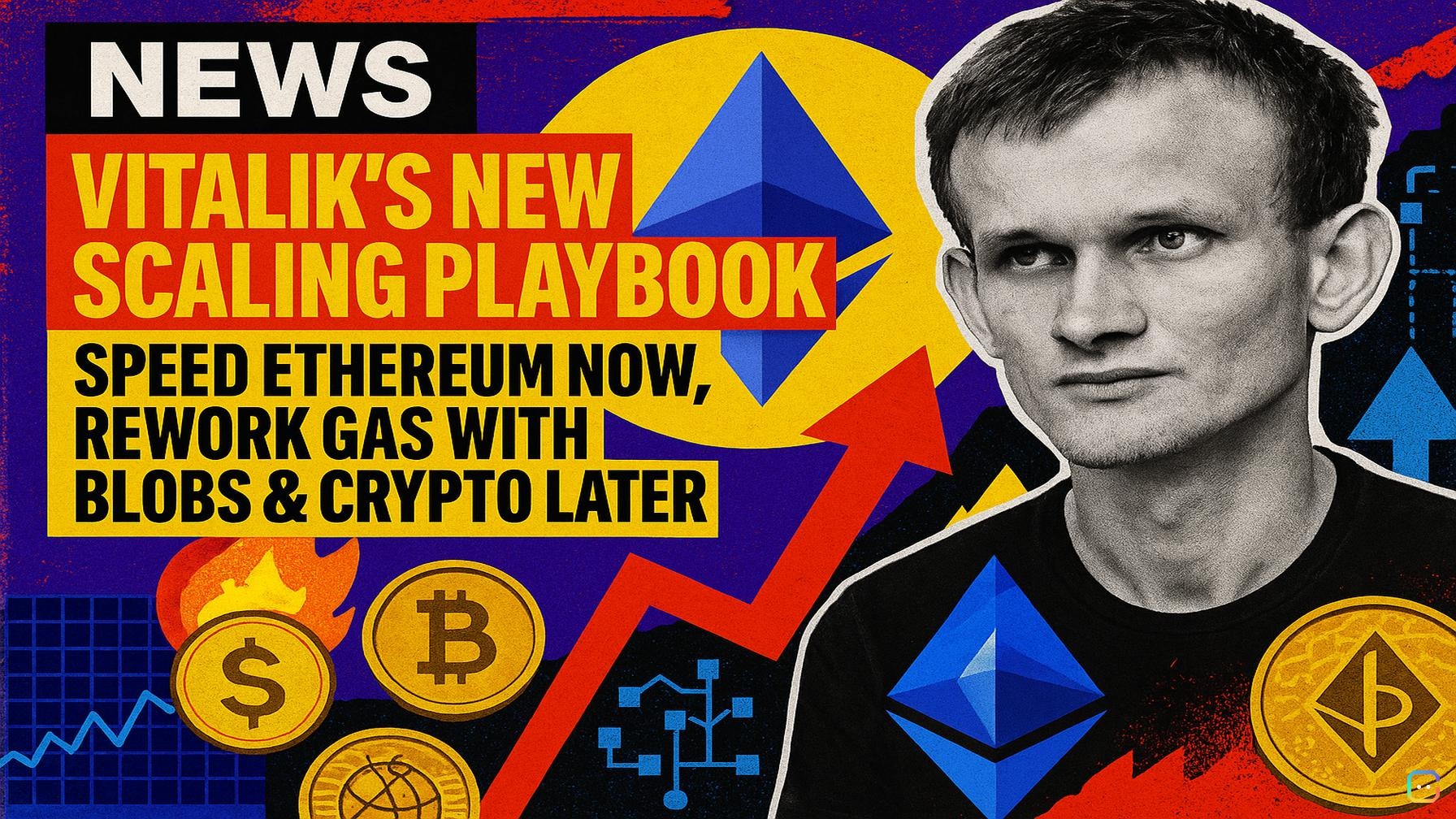
Vitalik’s new scaling playbook: faster blocks now, cryptography and “blobs” later
Ethereum co-founder Vitalik Buterin used a post on X to lay out a refreshed roadmap for scaling the network—one that balances immediate capacity gains with a longer-term architectural shift. After years in which much of Ethereum’s scaling narrative centered on layer-2 rollups, Buterin is refocusing attention on the base layer. The timing follows the Ethereum Foundation’s recently published “strawmap” for longer-term efficiency improvements.
Near-term, Buterin says, Ethereum can safely squeeze more throughput out of the chain by making blocks easier and faster to verify. Upcoming upgrades will enable node software to validate different parts of a block in parallel instead of strictly serial processing. Complementing that, a change to how blocks are built—so the chain uses more of each 12-second slot instead of stopping early out of caution (an approach known as ePBS, to be introduced in the Glamsterdam upgrade)—should allow more transactions per block without adding instability or error risk.
Longer-term, Buterin argues the community must rethink how “gas” (transaction fees) is calculated. Not all activity imposes the same cost: transient computation and permanently stored data have very different impacts on the network. His vision points toward heavier reliance on advanced cryptography and data-heavy “blobs” that would alter how Ethereum is validated and what nodes must store.
OKX rolls out AI layer for autonomous trading agents
OKX has upgraded its developer suite OnchainOS with an AI-focused layer designed to support autonomous on-chain trading agents. The new layer stitches together familiar building blocks—wallet infrastructure, liquidity routing, on-chain data feeds—into a unified execution framework so an AI agent can be given high-level directives (for example, “swap ETH for USDC below X price”) and have the platform handle everything behind the scenes: market monitoring, liquidity sourcing, approvals, gas estimation and settlement.
The move taps into a rapidly growing crypto–AI intersection. Industry forecasts cited by OKX put the blockchain-AI market rising from about $6 billion in 2024 to $50 billion by 2030. Traders are already using AI to exploit opportunities: one report profiled retail traders using AI to hunt for platform “glitches” (e.g., on Polymarket) and then directing agents to execute trades automatically.
NEAR’s co-founder: AI agents will be blockchain’s primary users
Illia Polosukhin, co-founder of NEAR, offered a provocative view on where mainstream blockchain adoption will come from: not humans, but AI agents. Polosukhin argues that AI will sit on the front end—abstracting wallets, explorers and transaction hashes—while blockchains quietly operate as back-end infrastructure. In his view, the current wave of crypto+AI experiments focused on tokens, memecoins and novelty bots misses the point: the real promise is making blockchain invisible to end users so AI agents can execute payments, manage assets, coordinate services and even participate in governance on people’s behalf. “The goal is to make your AI hide all the blockchain,” he said, calling blockchain explorers a sign we still haven’t adequately abstracted the technology.
Bitcoin governance flashpoint over data “spam”
A fresh governance dispute shook Bitcoin after mining pool Ocean produced the first block signaling support for a temporary soft fork proposal, formally labeled BIP-110. The draft would temporarily reinstate strict limits on transaction output sizes and arbitrary data fields for about a year, aiming to curb what proponents describe as “spam” uses of block space—large inscriptions and OP_RETURN payloads that embed non-financial data in transactions.
Supporters say the limits protect Bitcoin’s role as sound monetary infrastructure and reduce storage and bandwidth burdens for node operators. Critics, including Blockstream CEO Adam Back, counter that consensus-level intervention risks damaging Bitcoin’s credibility, could create preferential treatment for some transactions, and increases the danger of a contentious chain split if broad agreement isn’t achieved.
What this means
- Ethereum: Expect more immediate throughput improvements from parallel validation and ePBS/Glamsterdam changes, with larger architectural shifts—new fee models and cryptographic/data “blob” approaches—under discussion for the medium term.
- Crypto + AI: Infrastructure providers like OKX are racing to make AI agents first-class users of on-chain systems, a trend NEAR’s founder says will ultimately hide blockchain complexity from everyday users.
- Bitcoin: Governance debates continue to center on trade-offs between preserving Bitcoin’s monetary focus and maintaining permissionless neutrality, with BIP-110 highlighting how contentious policy changes can become.
Read on for source analyses and technical deep dives from each project as these stories develop.
Read more AI-generated news on: undefined/news