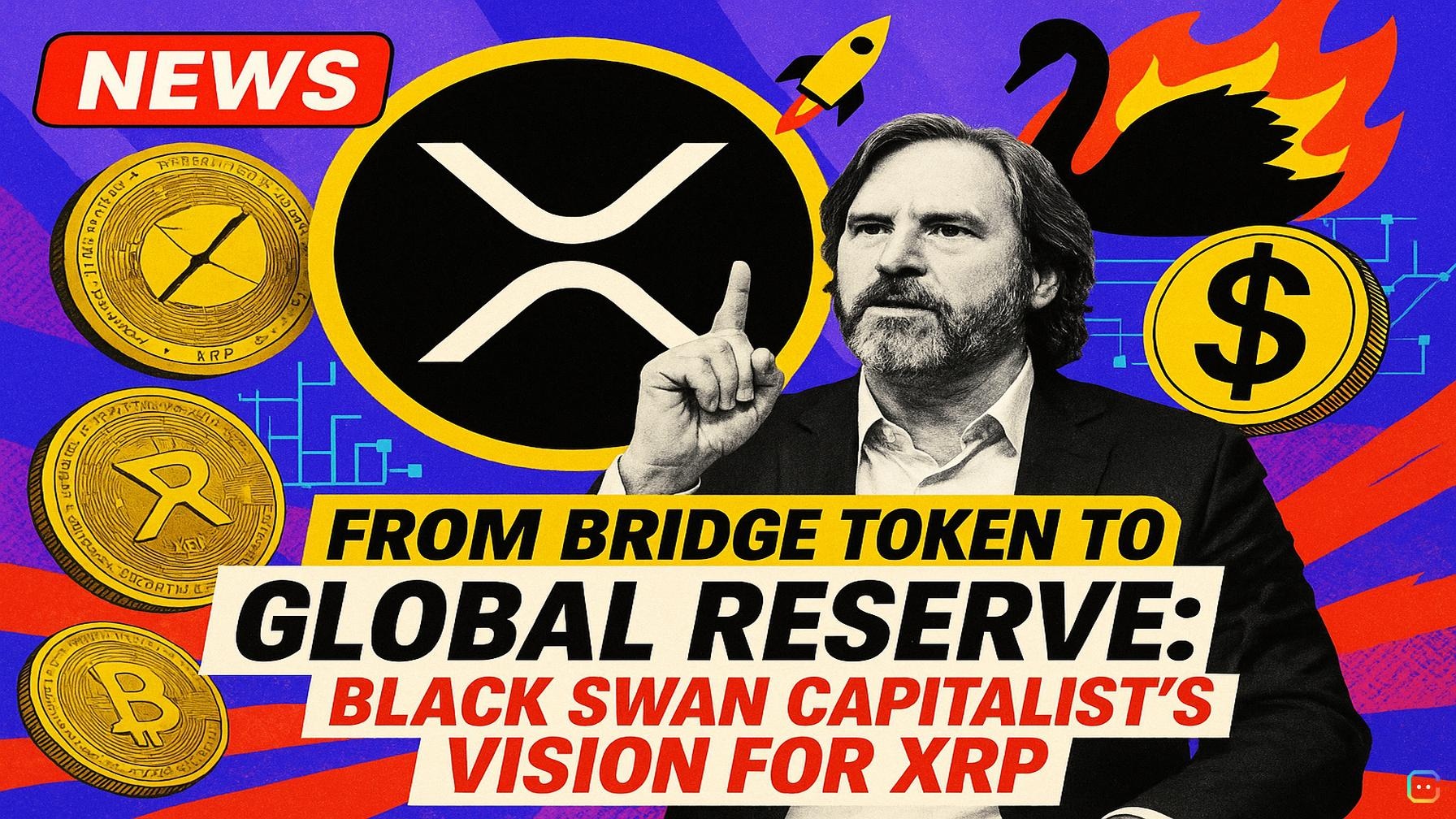
Versan Aljarrah of Black Swan Capitalist is making a big-picture case for XRP that goes far beyond the usual market-cycle chatter. In a recent X post titled “How XRP Becomes a Global Reserve Asset,” Aljarrah argues XRP’s ultimate role could be as a neutral settlement layer within a digitized global financial system — not merely a payments token or bridge asset.
A different frame for XRP
Aljarrah’s core point: the XRP discussion has been stuck on speculation and short-term price forecasts, obscuring a more consequential narrative involving regulation, sovereign adoption, and institutional recognition. “The true potential for XRP isn’t just as a payments token or bridge asset. It’s a foundational layer in a digitized financial order where liquidity, interoperability, and neutrality are all that matter,” he writes.
Three pillars to reserve status
His thesis rests on three interlocking pillars that must align for XRP to evolve into a global reserve instrument:
- Sovereign adoption: Reserve status comes from official acceptance, not market hype. “Before any asset can become a global reserve instrument, it first needs sovereign legitimacy,” Aljarrah says, likening the process to how gold, the U.S. dollar, or SDRs (Special Drawing Rights) derive credibility from state usage.
- Regulatory clarity: Legal frameworks that reduce concentrated control over supply would make XRP more institutionally accessible. Aljarrah points to the CLARITY Act as a potential inflection point — arguing that if Ripple reduces holdings enough to meet the Act’s thresholds, XRP could be treated as legally neutral and non-sovereign, easing sovereign and institutional adoption.
- Institutional recognition (and the IMF): Only after sovereign use and regulatory clarity does he see multilateral institutions playing a decisive role. In a tokenized system, XRP’s valuation would then be driven by settlement utility, liquidity depth, and transaction volume among sovereign participants and bodies like the IMF or regional blocs such as the BRICS.
Why emerging markets matter
Aljarrah emphasizes that adoption would likely begin with nation-states — especially emerging markets seeking to reduce reliance on dollar-based settlement rails. He argues XRP’s design provides a “neutral settlement bridge” that can connect local currencies without forcing geopolitical alignment with the dollar system. “Therefore, it is not a matter of ‘if,’ but ‘when’ nations begin leveraging XRP to solve monetary inefficiencies,” he writes, adding that some countries have already integrated XRP into payment rails for cross-border settlements, setting the stage for broader institutional acknowledgement.
How price and function would change
If his scenario plays out, price discovery would shift away from speculative noise to reflect real utility: institutional liquidity corridors and the value XRP moves in global settlement operations. “Valuation of XRP would be determined by its settlement utility, liquidity depth, and transaction output within a network of sovereign participants and multilateral institutions,” Aljarrah contends.
Framing XRP as infrastructure
Aljarrah closes by reframing the debate from short-term trading to long-term infrastructure: XRP as part of a transition from a centralized, dollar-dominated financial order to a multipolar, interoperable system built on neutral digital settlement technologies. For followers of the XRP narrative, the implication is clear — this is a long-horizon thesis about reserve status and the plumbing of global liquidity, not a near-term trade idea.
Market snapshot
At press time, XRP traded at $1.3576.
Read more AI-generated news on: undefined/news