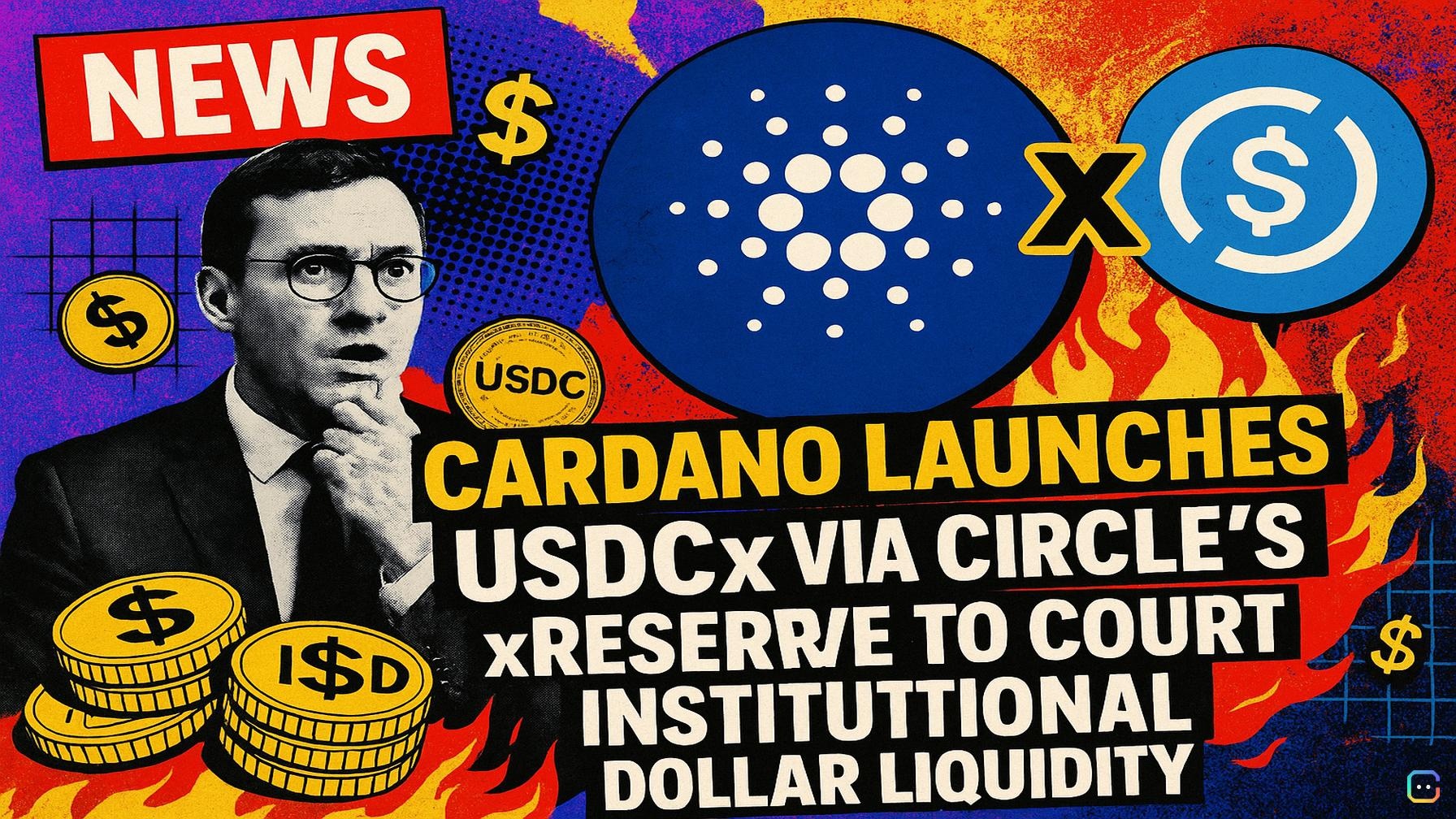
Headline: Cardano adds USDCx via Circle’s xReserve — a push for institutional-ready dollar liquidity
Cardano has launched USDCx, a USDC-backed stablecoin infrastructure built with Circle, signaling a coordinated push toward payments and institution-grade DeFi on the network. The deployment ties Cardano directly into Circle’s xReserve framework, enabling 1:1 minting and redemption of USDCx against USDC held in reserve.
Live integrations are already in place across key Cardano DeFi rails — including Minswap, Liqwid and SundaeSwap — making it straightforward to route dollar liquidity into DEXs or lending markets that support the token.
On-chain picture: stablecoin inflows, muted activity
On-chain metrics show a clear divergence. Cardano’s stablecoin market cap has moved higher while overall TVL continues to slide from prior cycle highs. According to DeFiLlama, Cardano’s stablecoin market cap sits at roughly $34 million, while total value locked is just over $137 million. At the same time, DEX volumes remain modest and network fees are low, indicating limited transactional demand despite growing availability of dollar liquidity.
How USDCx works (and what it isn’t)
USDCx is a reserve-backed representation connected to Circle’s infrastructure — not a native mint of USDC on Cardano. Users can bridge USDC from Ethereum to mint USDCx, burn USDCx to redeem USDC, or deposit/withdraw via supported centralized exchanges without interacting with Ethereum directly. The xReserve link gives Cardano a compliant, dollar-denominated on‑chain rail for settlement and treasury use cases.
Why this matters
Cardano has historically lagged peers in stablecoin depth, which constrained its ability to support dollar-denominated lending, structured products, and real-world asset experiments at scale. By locking in stablecoin rails first, the network appears to be prioritizing predictable settlement and compliance-friendly liquidity — positioning itself for payments, treasury management and institution-aligned DeFi rather than chasing short-term yield-driven TVL spikes.
The rollout arrives while Cardano’s DeFi ecosystem is still recovering from a prolonged downturn. The integration of USDCx could act as foundational infrastructure that attracts conservative dollar capital and, over time, funnels that liquidity into lending, yield and more sophisticated DeFi activity — if on-chain demand follows.
Sources: AMBCrypto, DeFiLlama
Disclaimer: This article is informational only and not investment advice. Cryptocurrency trading carries risk; do your own research before making decisions.
Read more AI-generated news on: undefined/news