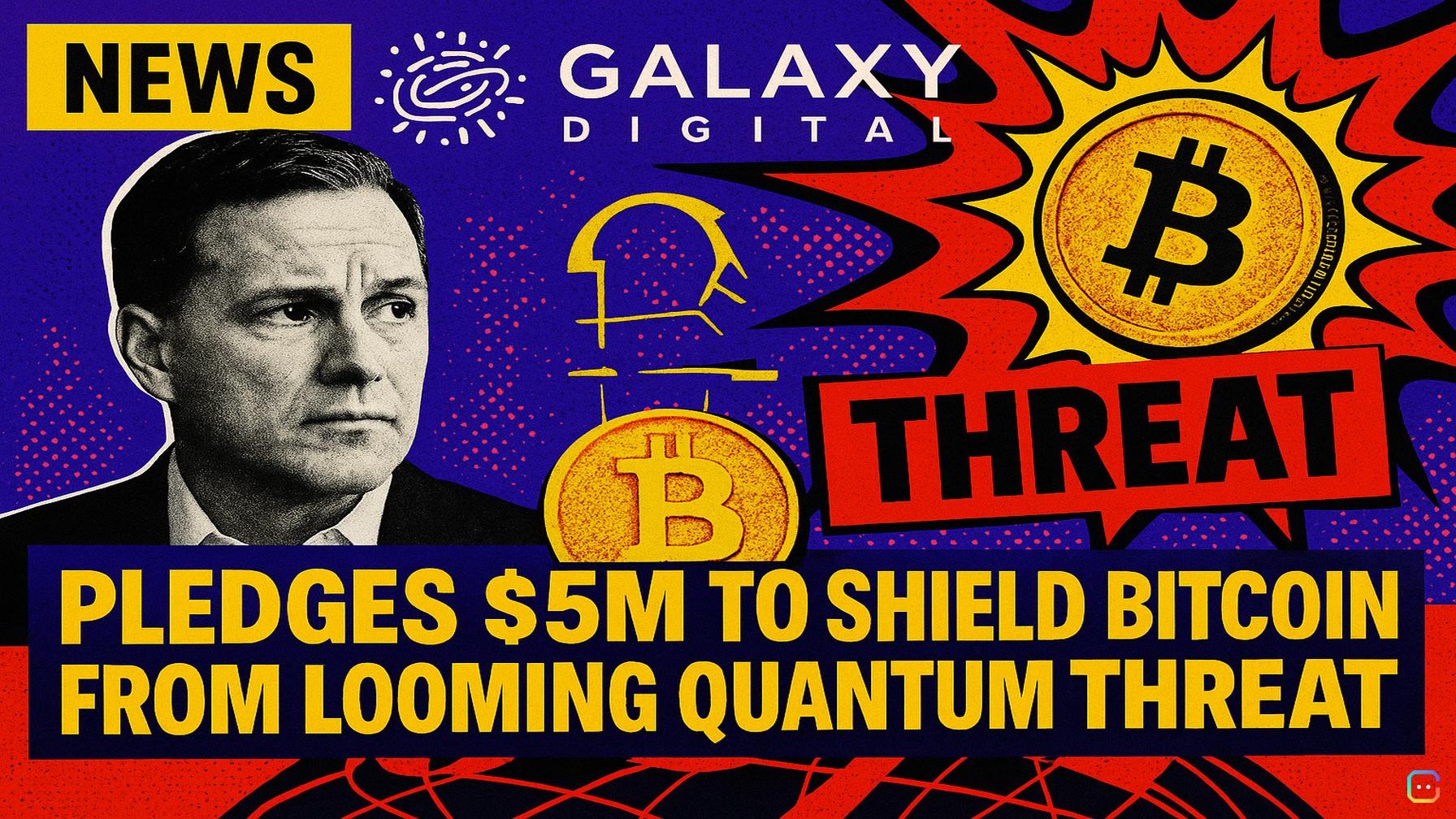
Galaxy Digital pledges up to $5 million to brace Bitcoin for the quantum era
Galaxy Digital this week launched a Bitcoin Quantum Readiness Initiative, committing up to $5 million in developer grants, a dedicated research program and a new advisory council to shore up Bitcoin against the future arrival of powerful quantum computers. The Nasdaq-listed firm says the multi-pronged effort will fund work on post-quantum cryptography, publish technical analysis via Galaxy Research, and bring together experts to guide the community.
The Quantum Advisory Council’s inaugural members include University of Calgary professor Barry Sanders, MIT Sea Grant Knauss Fellow Damien Bérubé, and Boston University computer science professor Eran Tromer. Galaxy said it will begin accepting grant applications immediately.
“As leaders in the digital assets space, we believe it's important that we help be part of the solution to any potential threat quantum computing poses to Bitcoin,” Galaxy founder and CEO Mike Novogratz said.
What’s at stake: Q-Day and Shor’s algorithm
The initiative targets what researchers call “Q‑Day”—the point when a quantum computer powerful enough to run Shor’s algorithm could break the elliptic curve signatures that secure Bitcoin addresses. With such a machine, an attacker could derive a private key from an exposed public key, forge signatures and empty wallets without any on-chain flag indicating the transaction was fraudulent. Old and reused addresses are considered the most vulnerable.
Potential defenses and governance hurdles
Defenses under discussion include migrating funds to quantum-resistant addresses and adopting new signature schemes via proposals like BIP-360 and BIP-361. But such changes could take years given Bitcoin’s decentralized governance and the technical complexity of rolling out new cryptography across the ecosystem.
Context: rising warnings and novel mitigation ideas
Galaxy’s announcement lands amid accelerating warnings from the quantum-security community:
- A May report from quantum firm Project Eleven estimated a “cryptographically relevant” quantum computer is more likely than not by 2033—and possibly as early as 2030—while identifying roughly 6.9 million BTC in quantum-exposed addresses.
- In June, Coinbase’s quantum advisory council urged developers to start migrating vulnerable funds now rather than debate timing, estimating about 7 million BTC are at risk.
- Also in June, President Donald Trump signed executive orders advancing U.S. quantum capabilities and moved the federal deadline for post‑quantum cryptography to December 2031.
- On July 16, Project Eleven unveiled a technique allowing users to prove wallet ownership after Q‑Day by verifying control of a parent key rather than relying on signatures—a fallback that could help recover funds even after signature schemes are compromised, CEO Alex Pruden wrote.
Galaxy: bridging the gap between researchers and Bitcoin devs
“There's a gap between the quantum computing world, which is moving fast, and the Bitcoin development world, which is just beginning to engage with post‑quantum cryptography in earnest,” Alex Thorn, head of Galaxy Research, said. “Galaxy's role is to bridge that gap through research that makes the threat legible to investors and policymakers, as well as grants that fund the developers doing the hardest technical work.”
What to watch
Expect Galaxy’s grants and research to prioritize implementable, peer-reviewed post‑quantum signature schemes and migration tooling. The initiative could accelerate coordination among wallet providers, exchanges and developers—critical if Q‑Day timelines tighten and millions of BTC remain exposed.
Read more AI-generated news on: undefined/news