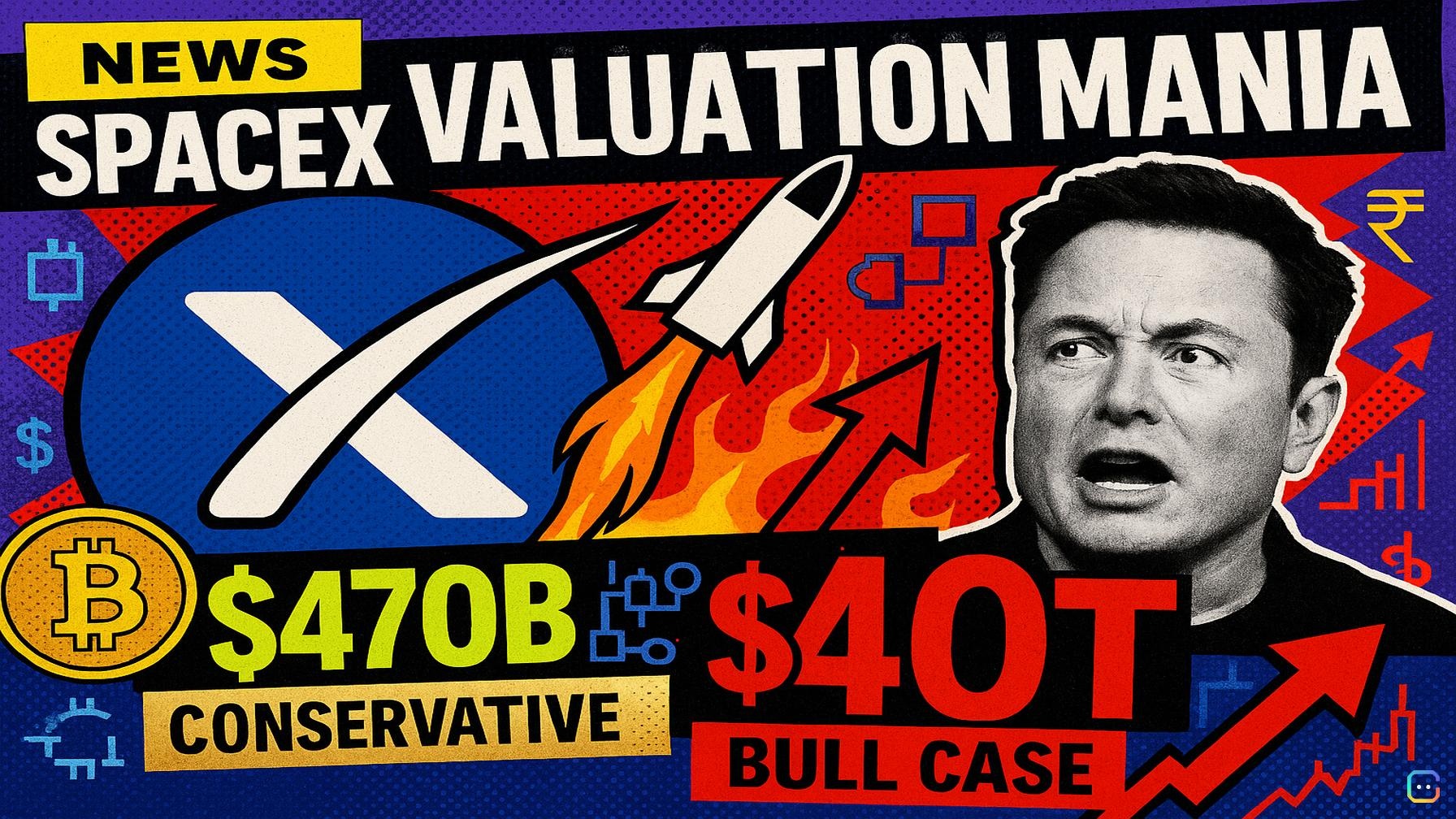
Valuation forecasts for SpaceX over the next decade read like a choose-your-adventure: conservative estimates land around $470 billion, while the most bullish projections skyrocket past $10 trillion — and some optimists even push toward $40 trillion. That dizzying spread reflects one reality: any long-range SpaceX price tag must bake in nascent, high-risk businesses (Starlink’s long-term broadband value, the speculative “orbital data center” market, and Starship-enabled industries) and hinge on whether Elon Musk’s ambitious timelines actually come to pass.
The bull case has a few loud champions. Ron Baron of Baron Capital, who reportedly put roughly $1 billion into SpaceX around the IPO, told CNBC that SpaceX "is going to become the largest company on the planet" and floated valuations of "$10 trillion, $20 trillion, $30 trillion" — even saying on another episode he sees a path to "$20 trillion, $30 trillion, $40 trillion." Those are headline-grabbing numbers that assume monumental growth across multiple new sectors.
Investment bank Raymond James has likewise embraced a hypergrowth view. Its analysts, Brian Gesuale and Ryan Rackley, initiated coverage with an $800 per-share target and a Strong Buy rating — implying a market cap well north of $10 trillion, larger than Apple and Nvidia combined. They argued Starship is “the defining industrial innovation of our generation,” claiming it could cut the cost of sending mass to orbit by more than 99% and drastically expand payload capacity. Raymond James projects SpaceX revenues of $837 billion by 2031 — compared with roughly $18.7 billion the company reported last year.
Not everyone is convinced. Goldman Sachs offers a far more measured outlook: its 2030 base case centers near $470 billion, built on steady growth from xAI and Starlink broadband rather than explosive new markets. Morgan Stanley’s target sits well below Raymond James’ $800, and independent research shop New Constructs warns trillion-dollar valuations set an “impossible bar,” citing capital intensity and margin pressure that could cap upside. A large portion of any ultra-bullish thesis also rests on an orbital data center economy that, today, is still mostly conceptual.
Musk himself has made some of the boldest predictions. In a recent interview with Texas Governor Greg Abbott on Sean Hannity’s radio show, he said SpaceX plans to send “tens of thousands” of people to a lunar base within ten years and that the company will launch its first “AI satellites” next year, scaling to a large commercial operation within two years. He added a long-term vision of a “full blown, self-sustaining city on the Moon, like an actual metropolis.” That kind of rhetoric fuels bullish scenarios — but it also raises skepticism: the New York Times found at least 19 instances since 2011 where Musk made similar Mars- and Moon-related timeline promises that did not materialize.
Bottom line for investors and observers: these forecasts are less a single valuation and more a set of conditional bets. On one end, you have scenarios that assume breakthrough reductions in launch cost plus rapid commercialization of orbital and lunar economies. On the other, sober models emphasize gradual Starlink monetization and execution risk. Until unproven markets like orbital data centers generate real revenue and timelines become demonstrably reliable, SpaceX’s 10-year valuation will remain one of the most polarizing — and speculative — debates in tech and finance.
Read more AI-generated news on: undefined/news