Disclosure: This article does not represent investment advice. The content and materials featured here are for educational purposes only. This content is provided by a third party. Neither crypto.news nor the author endorses any product mentioned. Users should conduct their own research before taking any action.
MiCA’s rollout has forced a seismic shift in Europe’s crypto landscape — and the survivors look very different from the industry that existed before.
What happened
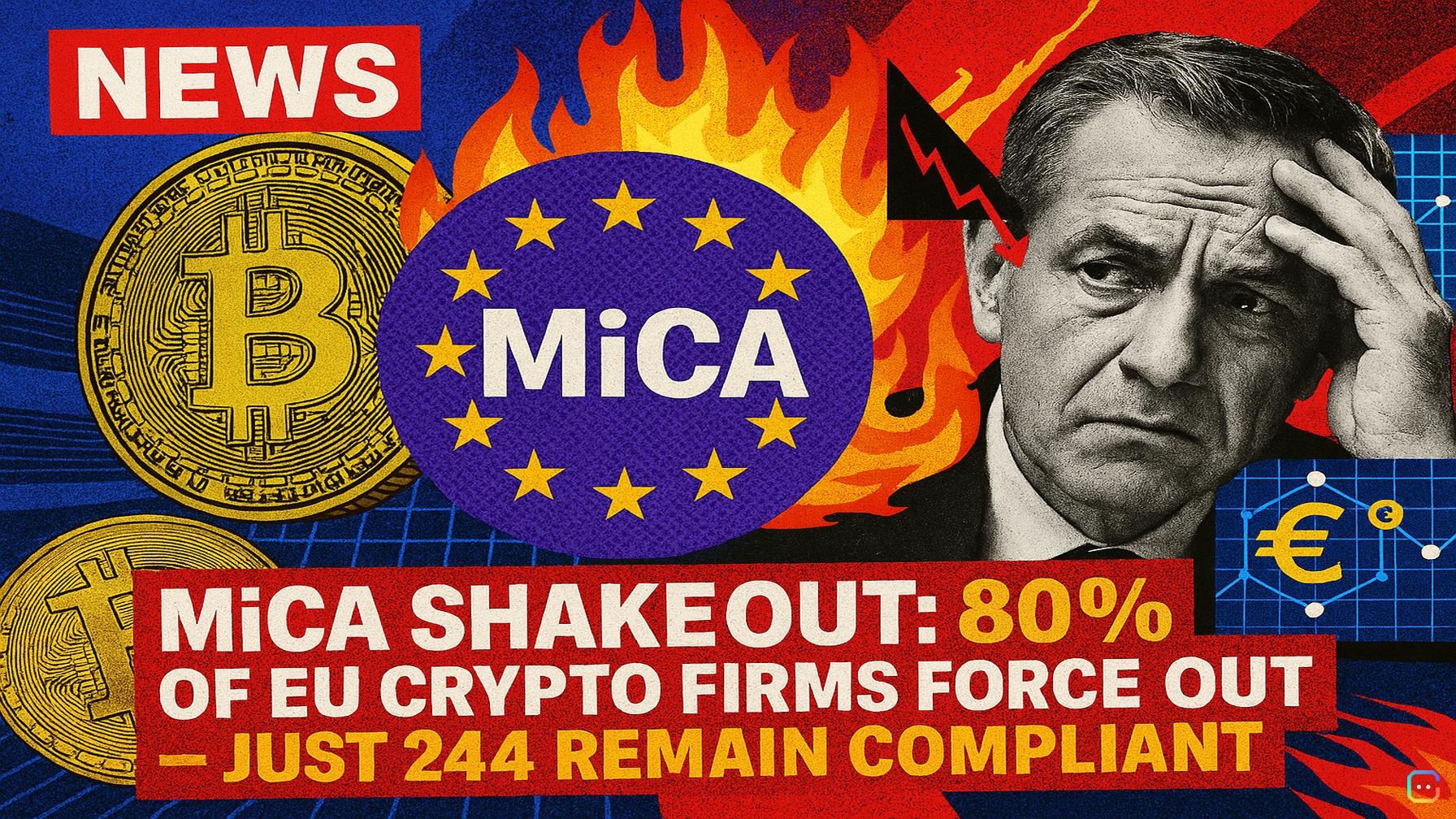
- On July 1, 2026 the EU’s Markets in Crypto-Assets Regulation (MiCA) transitional period expired. More than 3,000 companies that had been operating with Virtual Asset Service Provider (VASP) registrations were suddenly confronted with a binary choice: obtain full compliance under the new MiCA regime or cease regulated activity.
- The immediate result: roughly 80% of those firms were effectively pushed out of Europe’s regulated market. Today about 244 projects have cleared MiCA’s regulatory bar and retained the ability to operate across the bloc with a single registration as Crypto-Asset Service Providers (CASPs).
Major names, mixed outcomes
- Several major exchanges navigated the new regime successfully: Coinbase and Kraken registered with the Central Bank of Ireland; OKX and Crypto.com secured oversight with Malta’s MFSA; Bitstamp went to Luxembourg; Revolut moved under Cyprus’ CySEC.
- Other names struggled. Binance submitted a MiCA application in Greece in January 2026 but did not obtain approval; CEO Changpeng Zhao has characterized the decision as political.
Immediate market effects
- The enforcement date triggered a mass migration of customer balances. An estimated 2,800 platforms lost legal permission to hold or operate on user funds unless they were MiCA-compliant, creating a wave of frozen balances as companies suspended services.
- High-profile operational disruptions included Binance restricting spot trading, sign-ups, deposits and staking in countries such as France, Italy, Spain and Poland. Several DeFi projects and wallets, including Base’s Seamless Protocol and PPL Wallet, shut down or turned off servers when continuing operations became unlawful.
- Conversely, demand for euro-denominated stablecoins surged following MiCA’s phase 1 implementation, highlighting the regulation’s role in instilling confidence in certain token classes.
What MiCA changed — in practice
- Regulatory status: Crypto in the EU is now regulated more like traditional finance. Startups can no longer launch with minimal oversight; MiCA imposes documentation, risk controls, AML/KYC requirements and ongoing reporting.
- Market access: A CASP license grants cross-border access across all EU member states with a single registration — a powerful incentive for projects that do secure approval.
- Reporting and cooperation: Firms must proactively report certain user data to authorities rather than waiting for requests.
- Marketing and targeting rules: Any EU-targeted activity — even a single EU influencer campaign — triggers MiCA obligations.
- Operating while applying: Firms operating under a “pending application” face steep penalties if they continue regulated activities prematurely — fines of about €15M (roughly $17.1M) or the alternative of surrendering 12.5% of annual turnover in some scenarios.
Costs and strategic responses
- Compliance is expensive. Research from Pharaon Production estimates up-front MiCA compliance costs can approach $1M before a company even begins serving customers.
- Many firms are avoiding the EU regulatory fight altogether. Common strategies include relocating to friendlier jurisdictions such as Dubai (VARA) or Singapore (MAS), or pursuing alternative legal frameworks that are less costly and bureaucratic.
- Switzerland has emerged as a popular refuge. Under Swiss law, handling digital assets requires membership in a Self-Regulatory Organization (SRO) supervised by FINMA. Crypto Valley hosts a dense cluster of firms — over 1,700 registrations — and in October 2025 Switzerland introduced two new FINMA-supervised license categories to expand options for crypto businesses.
- Some EU hopefuls pivoted mid-process: projects like Neyro abandoned their MiCA applications and opted to register under a Swiss SRO to continue operating with regulatory legitimacy.
Bottom line
MiCA has tightened the gate to Europe’s regulated crypto market, dramatically reducing the number of active, compliant providers while increasing regulatory certainty for those that remain. The shakeout has redirected capital and tech talent to alternative jurisdictions and raised the financial and operational bar for anyone seeking to serve EU customers. For users and institutional players, the result is a safer, more standardized environment; for innovators, it’s a more costly and bureaucratic one.
Read more about the implications for specific projects and how exchanges are adapting across jurisdictions.
Read more AI-generated news on: undefined/news