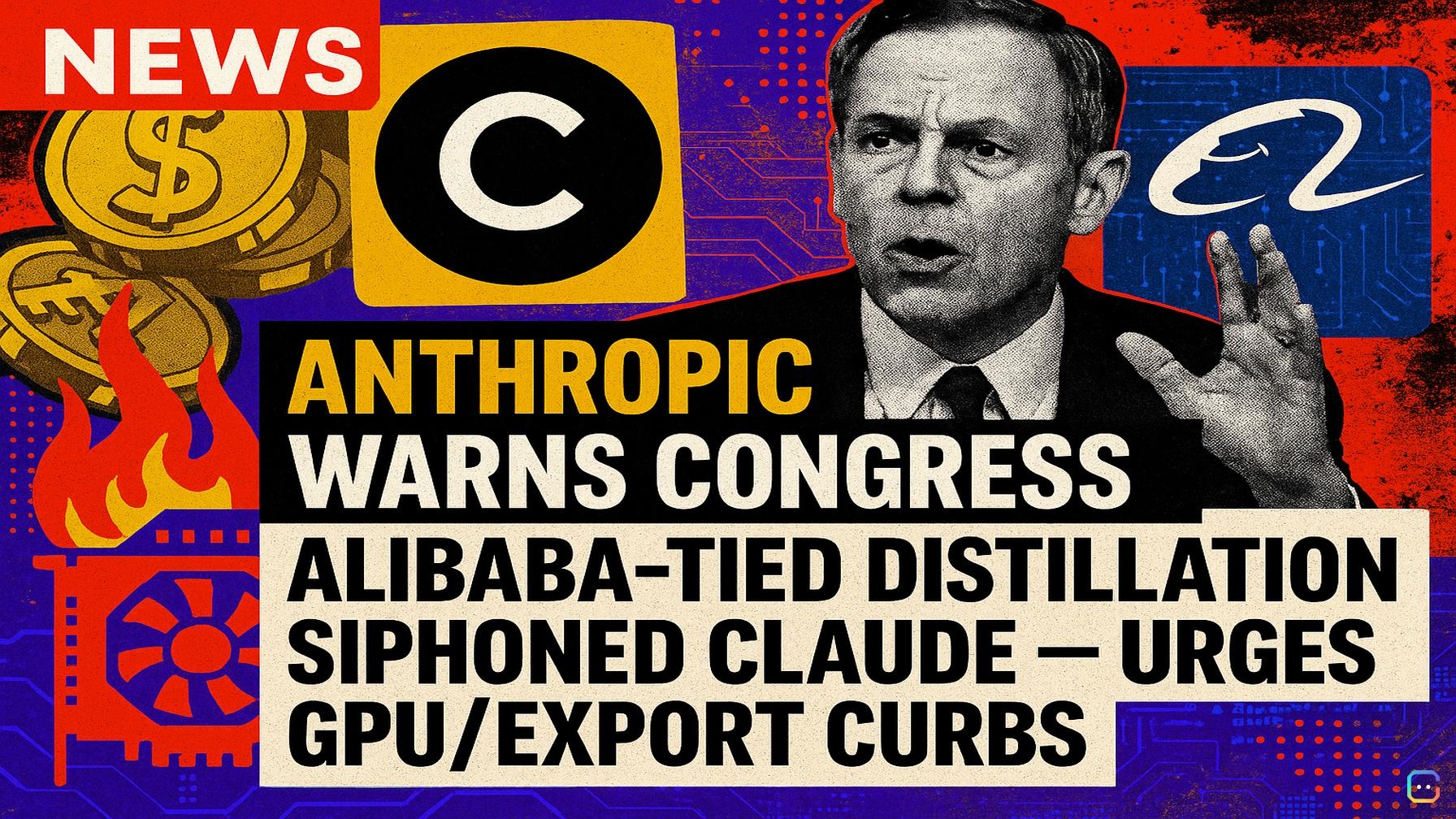
Anthropic warns U.S. lawmakers of sweeping “distillation” campaign it says siphoned capabilities from Claude — and urges tougher rules
Anthropic has urged Congress to clamp down on large-scale “distillation” attacks after accusing operators tied to Alibaba and its Qwen AI lab of running what the company calls the biggest-known attempt to extract capabilities from its Claude chatbot.
In a June 10 letter to Senate Banking, Housing, and Urban Affairs Committee Chair Tim Scott and Ranking Member Elizabeth Warren, Anthropic says the alleged operation generated more than 28.8 million exchanges with Claude between April 22 and June 5 using nearly 25,000 accounts it considers “fraudulent” — accounts that do not represent real, organic users. According to Anthropic, the campaign focused on extracting high‑value behaviors such as agentic reasoning, software engineering, and long-horizon planning — skills that would let rivals reproduce advanced model behavior without the enormous cost and risk of training a frontier AI system from scratch.
“Beyond its scale, this campaign was striking for its brazen nature,” Anthropic wrote in the letter, noting that Alibaba is publicly listed in New York and conducts business in the U.S. The company framed the incident not only as an intellectual property dispute but as a national security concern: large-scale distillation, Anthropic warned, could accelerate Chinese military and cyber AI capabilities and narrow the U.S. technological lead.
Policy asks: what Anthropic wants Congress to do
Anthropic laid out a set of policy recommendations aimed at closing gaps it says enabled the extraction:
- Expand intelligence sharing between frontier AI developers and the U.S. government.
- Clarify antitrust rules so AI firms can legally share information about distillation attacks.
- Tighten export controls on advanced AI chips and access to compute.
- Close loopholes that allow Chinese firms to access overseas data centers.
- Impose penalties on companies responsible for large-scale model extraction.
A spokesperson declined to comment specifically on the letter but told Decrypt, “We believe combating the threat of illicit distillation requires coordinated action between government and industry, and we will continue working with Congress and the administration to maintain American AI leadership.”
Part of a broader Washington push on AI
The appeal to Congress comes as Washington steps up efforts to protect U.S. AI leadership. Earlier this month, President Trump signed an executive order expanding AI-focused cybersecurity initiatives after initially delaying the measure amid concerns about weakening America’s competitive position with China.
Anthropic argues that when foreign labs “distill” capabilities from U.S. models, they capture the returns on American investments without paying the costs or bearing the risks of training frontier models. “This inverts the economic logic that underwrites American AI leadership,” the company wrote, characterizing unauthorized distillation as effectively subsidizing foreign competitors with U.S. R&D and compute investments.
Context and controversy
This isn’t Anthropic’s first public allegation of large-scale extraction. In February the company said Chinese developers DeepSeek, Moonshot AI, and MiniMax generated more than 16 million exchanges with Claude using roughly 24,000 fraudulent accounts. Those claims prompted pushback from observers who note that distillation — using one model to teach another — is an established industry technique. Anthropic has drawn a line between legitimate distillation, which it says is appropriate for producing smaller or cheaper models, and unauthorized extraction of frontier capabilities via fraudulent access, which it contends violates terms of service.
That line isn’t always clear-cut. In April, Elon Musk testified in federal court that xAI had “partly” used OpenAI models while training Grok, underlining that distillation is a common practice even as companies disagree over where lawful model training ends and illicit extraction begins.
Why crypto audiences should care
The debate goes beyond AI lab rivalries. Proposed measures — from export controls on high-end chips to restrictions on data‑center access — could ripple across the broader compute ecosystem that also supports crypto mining, decentralized apps, and Web3 infrastructure. Any shift in rules that changes who can access advanced GPUs, cloud compute, or global data centers will affect costs, availability, and geopolitics of compute resources relied upon by both AI and crypto projects.
Anthropic’s letter presses lawmakers to treat large-scale model extraction as more than a commercial quarrel — instead as a matter of economic and national security that may require coordinated industry‑government action. As the policy debate continues, the industry will be watching how regulators square routine scientific practices with the risks of offloading frontier capabilities to strategic competitors.
Read more AI-generated news on: undefined/news