Headline: Cory Doctorow warns AI boom is a bubble — and a threat born of bosses’ hunger to replace workers
Cory Doctorow’s new book, The Reverse Centaur’s Guide to Life After AI, reframes the “AI will replace us” debate with a sharper, worker-focused lens. Where “centaur” in automation theory describes a human aided by a machine, Doctorow coins the “reverse centaur”: a human pressed into service as an assistant to a machine. Think warehouse pickers who pee in bottles to hit algorithmic targets, truck drivers forced to ride in cabs to monitor “self‑driving” rigs, lawyers double‑checking AI summaries of precedent, or musicians eking out a living performing covers of AI‑generated hits. Those are reverse centaurs—people made subordinate to systems that are supposed to replace them.
AI isn’t mystical, Doctorow argues. It’s a statistical trick—very good at predicting the next word or image but not a repository of intent or consciousness. We anthropomorphize language models because in nature sentences and images normally come from writers and painters; when a machine produces them we instinctively assign agency. That impulse fuels headlines about sentient AI while obscuring the technology’s real harms: unreliable “hallucinations” (errors we repeatedly forgive) and systems that amplify existing power imbalances.
Why the hype, then? For Doctorow the answer is blunt: capital seeking to eliminate labor. The classic promise of automation—bosses getting rid of workers—drives much of the investment frenzy. Even when automation underperforms or requires expensive human supervision (remember Amazon’s cashierless stores that still needed staff watching shoppers), investors and corporate leaders cling to the prospect of productizing work away: “products without product designers; workplaces without workers.”
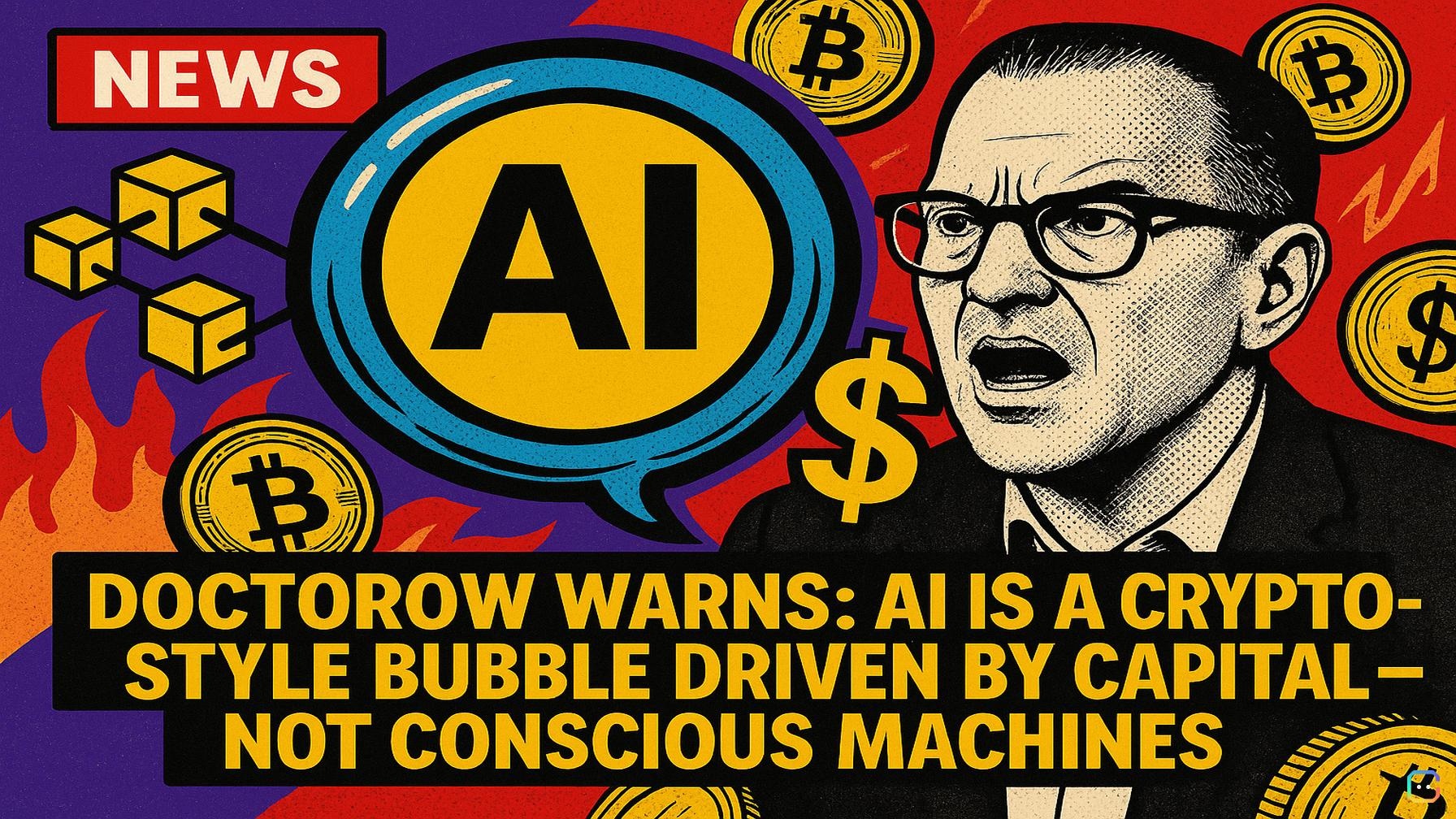
That drive matters for markets as much as for jobs. Doctorow sees AI today as a financial bubble: when he wrote the book it was a roughly $700 billion bubble; he puts the current figure around $1.4 trillion and warns we’re headed higher. He points to the extreme concentration of market value—nine tech firms make up about 35% of the U.S. stock market—so when geostrategic shocks landed, U.S. markets were oddly insulated by tech’s dominance. Bubbles, he reminds us, are inevitable: Stein’s Law says anything that can’t go on forever stops, while Keynesian wisdom warns markets can stay irrational longer than investors can survive. Either way, when the AI bubble pops the fallout will hurt everyone outside the investor class.
For readers of crypto news, the parallels are familiar: breathless promises, feverish capital allocation, and narratives that get recycled from one “next big thing” to the next. Doctorow notes the same enthusiasm that once flogged crypto and the metaverse is now underpinning AI: governments and corporations will save time and money, startups will deliver miraculous efficiencies, and skeptics’ misgivings are dismissed as backwardness. That “crit‑hype” loop—critique that amplifies hype by giving it urgency—helps apocalyptic scenarios stick and keeps money flowing.
There’s also a geopolitical argument lodged behind some AI boosterism, Doctorow says: let us push experimental systems because otherwise rival nations will win. Karen Hao and others have highlighted this “too‑big‑to‑restrict” posture. Doctorow agrees, but keeps returning to the simpler driver: capital.
Who benefits from that capital? Not the workers forced into surveillance and monotony, he says, but wealthy founders and investors insulated from consequences. He makes the provocative claim that extreme wealth breeds a kind of solipsism: “You cannot make billions of dollars without hurting lots of people. And you can’t hurt lots of people without, in some sense, believing that they’re not really people.” He points to Elon Musk’s public behavior—trolling critics as “NPCs” and reportedly using ketamine—as symptomatic of that detachment.
Doctorow doesn’t excuse toxic product behavior either. He calls out Musk’s Grok for being able to generate sexually explicit images (including non‑consensual and underage content), and urges accountability. But he’s realistic about leverage: moral outrage alone won’t stop these companies while investors still expect returns. The effective pressure, he says, must target profitability—make investors believe the business model is broken.
Is this a Marxist critique? Doctorow evades ideological labels, but the core claim overlaps with class analysis: capital seeks to end co‑determination and automate away the bargaining power of labor. Whether you call it Marxism or plain political economy, the result is the same: unchecked AI investment can amplify inequality and unleash an economic shock that will be exploited to push austerity measures.
Bottom line for the crypto and broader tech community: AI’s spectacular capabilities don’t justify uncritical investment or governance laxity. The technology can and will cause harm—but the most predictable harm is not sci‑fi robot overlords; it’s mass disruptions to jobs, a concentrated market bubble, and a political environment primed to canalize crisis into austerity. If you care about where capital flows, how labor is valued, or how markets are regulated, Doctorow’s message is clear: target the money and the incentives, not just the machines.
The Reverse Centaur’s Guide to Life After AI (Verso) expands on these themes for readers who want to dig deeper.
Read more AI-generated news on: undefined/news