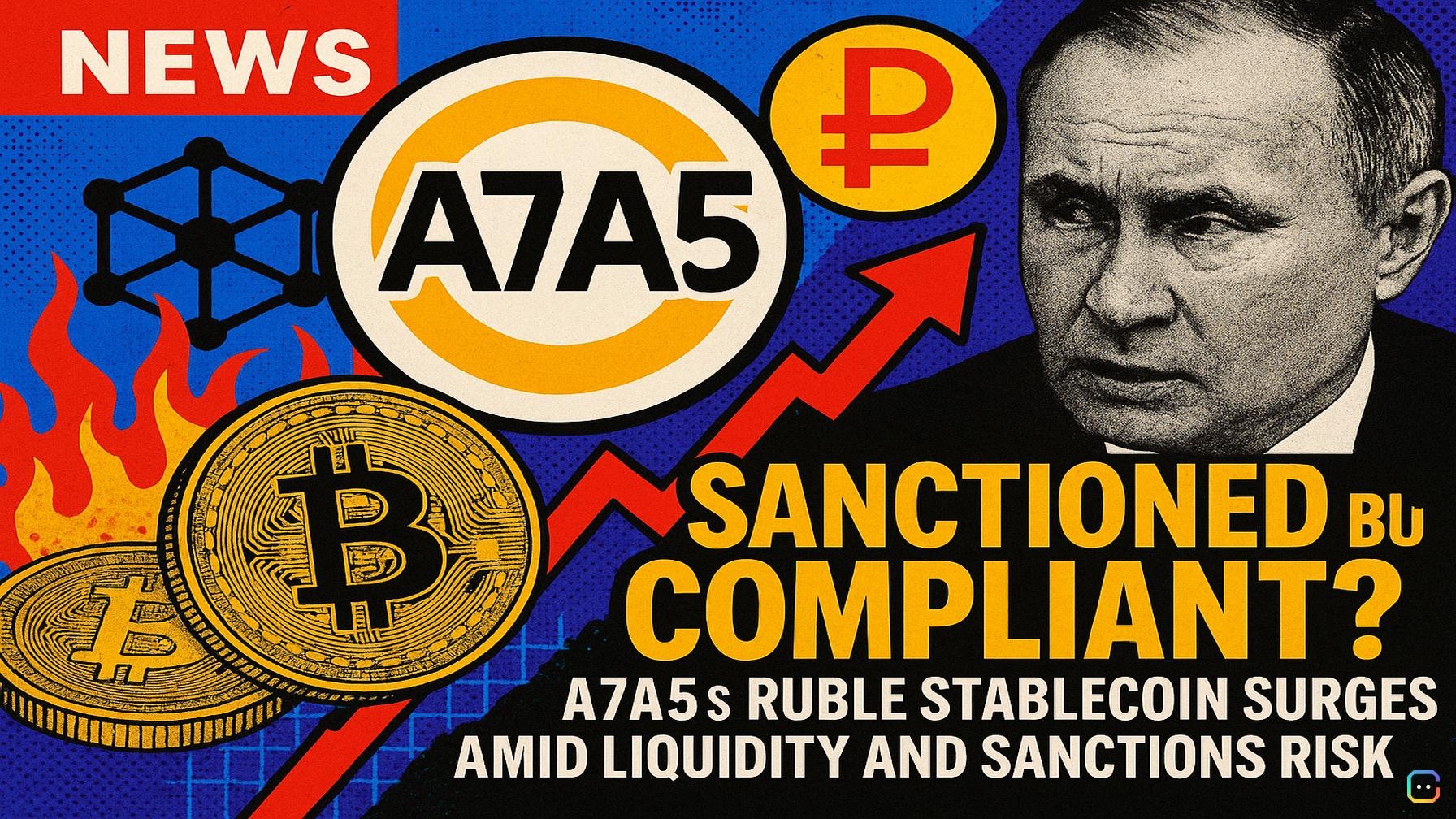
“We do not do illegal things,” insists Oleg Ogienko, the public face of A7A5, as the ruble-denominated stablecoin issuer courts partners and defending its compliance record amid U.S. sanctions.
Speaking to CoinDesk at Consensus Hong Kong, Ogienko — A7A5’s director for Regulatory and Overseas Affairs — pushed back against accusations that the company flouts compliance. He said A7A5 is incorporated in Kyrgyzstan, follows local regulations, undergoes regular audits, and has KYC and AML systems built into its platform. “We do not violate any Financial Action Task Force principles,” he added.
That legal posture, however, exists alongside a major geopolitical problem: A7A5’s issuing entities (Old Vector LLC and A7 LLC) and the bank holding its reserves, Promsvyazbank (PSB), are sanctioned by the U.S. Department of the Treasury. Those designations cut A7A5 off from much of the U.S. dollar-denominated financial system and raise secondary-sanctions risks for counterparties.
The sanctions, Ogienko argues, have not killed the project — they helped create demand. A7A5’s circulating supply ballooned by nearly $90 billion last year, outpacing Tether (USDT), which grew by about $49 billion, and Circle’s USDC, which rose roughly $31 billion, according to Artemis data cited by CoinDesk. Much of the demand, Ogienko says, comes from businesses in Asia, Africa and South America trading with Russian exporters and importers who face banking restrictions.
Legality is a patchwork. While U.S. sanctions constrain interactions in dollar-based finance, using A7A5 to facilitate cross-border payments is not a crime under Kyrgyz or Russian law. That mismatch has allowed Russian firms to use the stablecoin for payments and — via decentralized finance (DeFi) bridges — to access USDT liquidity without A7A5 itself holding dollar stablecoins.
But liquidity remains a major bottleneck. Centralized exchanges have balked at listing A7A5 because of secondary-sanctions risk, and on-chain liquidity is thin: A7A5’s dashboard shows roughly USDT 50,000 available in DeFi pools for swaps. Ogienko said he was in Hong Kong to try and expand liquidity and partnerships, meeting exchanges and other blockchain projects; the token is already deployed on Tron and Ethereum and may be added to other chains.
The political sensitivity of A7A5’s presence at conferences has already surfaced. At Token2049 in Singapore, where A7A5 was listed as a sponsor via Hong Kong-registered BOB Group, references to the company were later removed after other sponsors raised concerns — a sign of how sanctions complicate even legally permissible regional activities.
Despite the friction, Ogienko is bullish. He told CoinDesk he hopes A7A5 can capture a significant share of Russia’s trade settlements, targeting “more than 20%” over time. There are real constraints: A7A5 cannot yet be used in Russia because lawmakers are still drafting domestic stablecoin rules. Ogienko says the firm is in consultative talks with Russian authorities on blockchain and payments infrastructure but stresses A7A5’s neutrality. “We’re not politicians. We are traders. We are businessmen,” he said.
The A7A5 story highlights a growing fault line in global crypto: projects that portray themselves as compliant and auditable can still find themselves operating in legal grey zones when national sanctions regimes and cross-border trade needs collide. For now, A7A5’s growth and ambitions are real — but so are the liquidity constraints and regulatory headwinds that could shape its future.
Read more AI-generated news on: undefined/news