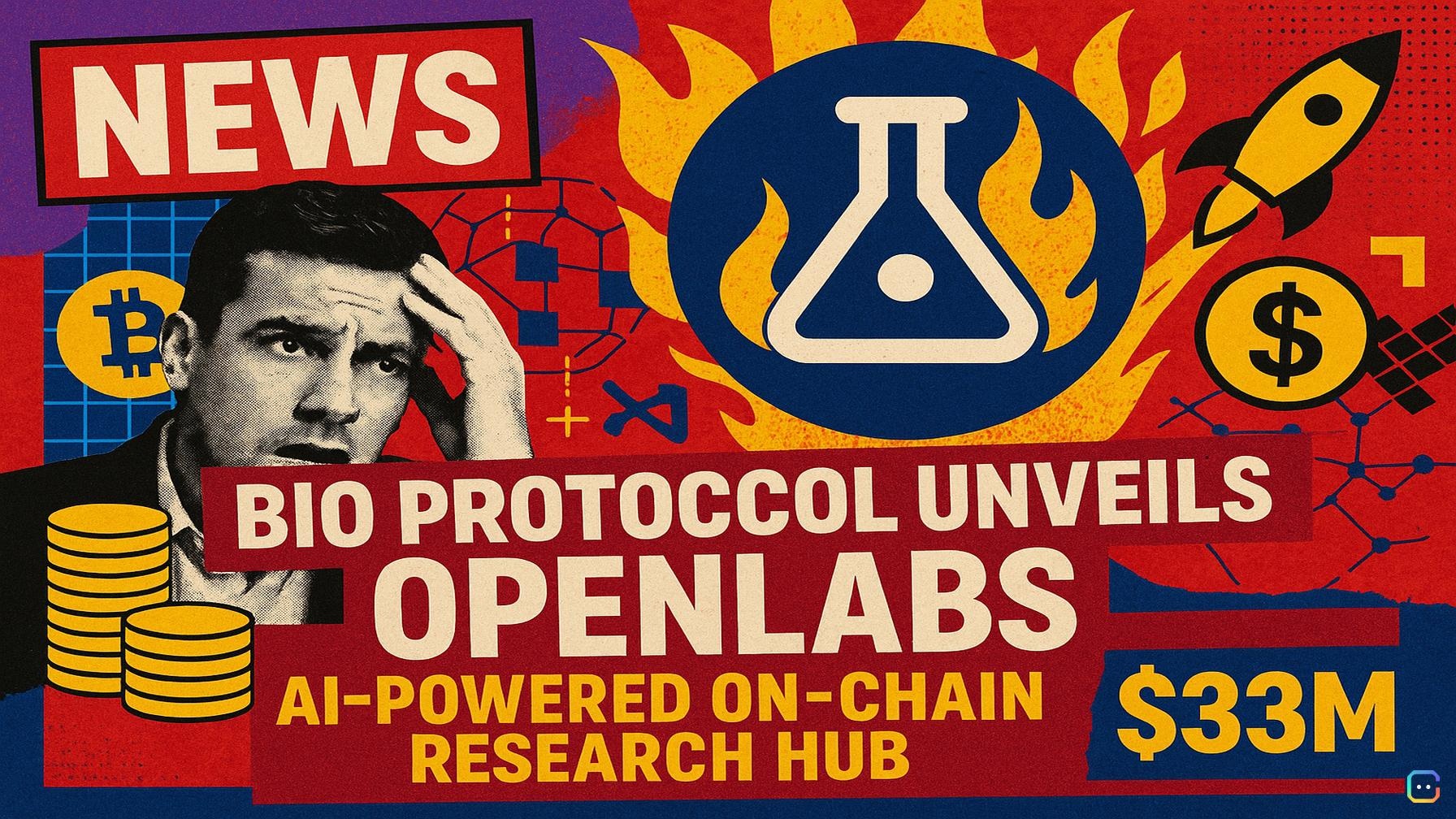
Bio Protocol has unveiled OpenLabs, a new AI-powered research hub that aims to streamline how scientific ideas become funded projects — and it did so as its ecosystem reported more than $33 million in capital raised.
The platform was announced June 19 at DeSci.Berlin 2026, held at KÖNIG GALERIE during Berlin Blockchain Week. OpenLabs combines AI-assisted project development, community funding and on-chain governance into a single interface intended to replace fragmented grant processes, separate governance tools and slow institutional review.
What OpenLabs does
OpenLabs provides a shared workspace where researchers, contributors and automated agents collaborate on proposals. AI-driven workflows help teams develop and refine projects, while tokenized community governance enables collective review and financing. Instead of relying exclusively on traditional grant committees and lengthy review cycles, proposals can be assessed and supported through on-chain voting using Bio Protocol’s native BIO token, which serves as the platform’s governance and utility asset.
Featured projects
At the launch, Bio Protocol highlighted two early projects in the OpenLabs environment:
- RheumaAI — an AI agent focused on rheumatology research.
- PeptAI — an AI system aimed at accelerating peptide discovery.
Context in the Bio Protocol roadmap
OpenLabs builds on Bio Protocol’s broader decentralized-science (DeSci) strategy, which uses tokenized intellectual property and BioDAOs to channel funding toward biotech and scientific research. The team says its BIO Genesis fundraising initiative has raised more than $33 million to date, supporting research-focused organizations across the ecosystem.
The project’s work with AI-assisted research predates OpenLabs. In August 2025 Bio Protocol launched an Ignition Sale for Aubrai — developed with VitaDAO — a decentralized BioAgent designed for longevity research that can generate hypotheses and help design laboratory experiments. DeSci.Berlin itself has been a known incubator for decentralized science projects, with past editions helping spawn initiatives like Molecule Labs.
Market reaction and risks
Despite the launch, BIO token traded lower alongside the broader crypto market, falling more than 8% in the past 24 hours as investors reacted to a hawkish tone from Federal Reserve Chair Kevin Warsh and uncertainty around a proposed U.S.-Iran peace framework.
Regulatory and commercialization challenges remain important caveats. Tokenized IP and DeSci models touch securities laws, patent regimes and pharmaceutical oversight. As projects move from early research to commercial development, legal and compliance requirements could become more complex for teams operating in the decentralized science space.
Why it matters
OpenLabs represents a concrete step toward embedding AI and on-chain governance into the research lifecycle — promising faster iteration and more democratized funding decisions. Whether the model scales will depend on regulatory clarity, community adoption and the ability of on-chain systems to meet the compliance needs of biotech and pharmaceutical development.
Read more AI-generated news on: undefined/news