Ripple sets sights on $1B revenue run rate for 2026 — and it’s not counting XRP
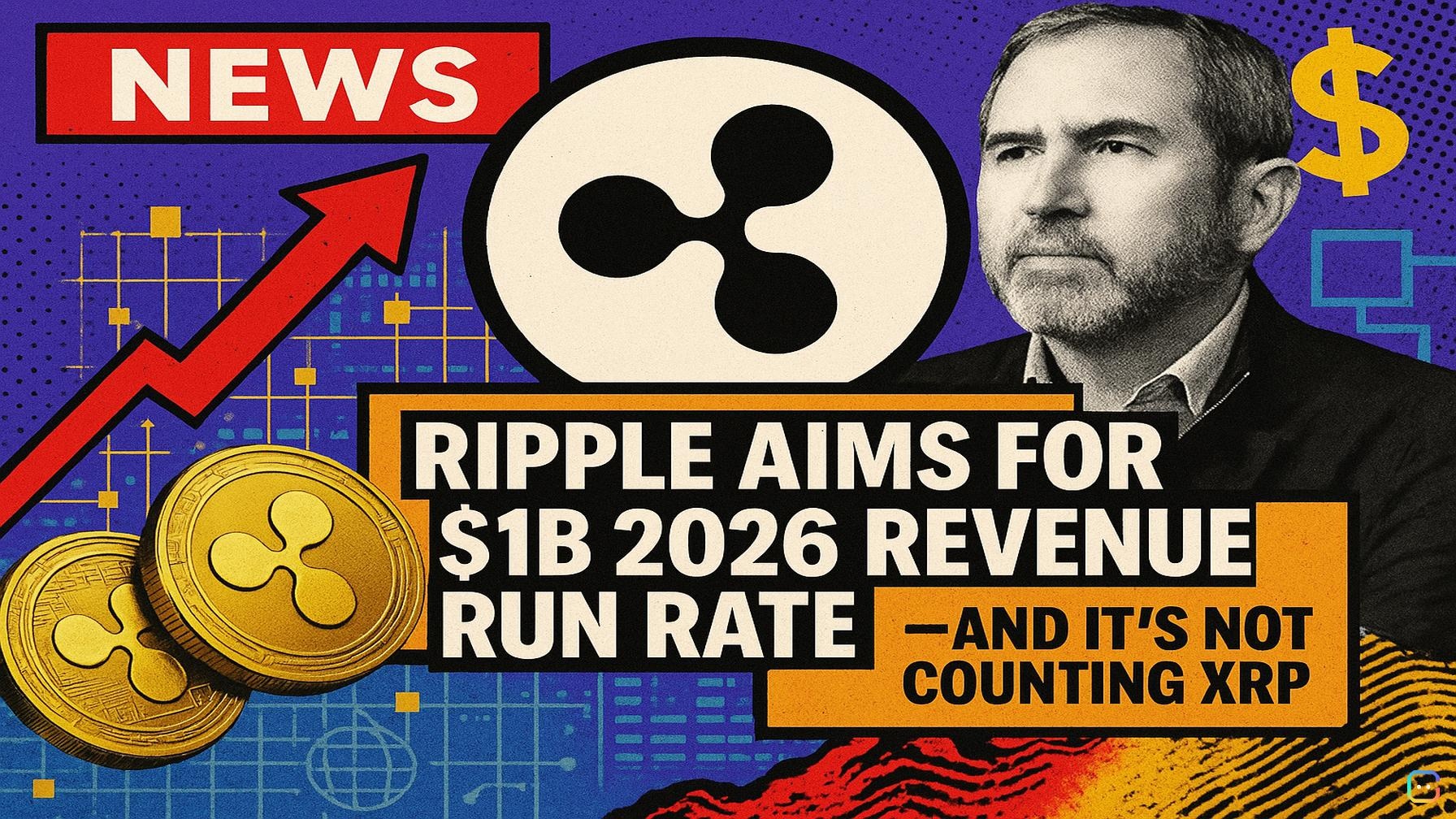
Ripple CEO Brad Garlinghouse has put a concrete figure on the company's next big milestone: a $1 billion revenue run rate by the end of 2026 — explicitly excluding XRP holdings from that total. The announcement, shared in posts picked up by CoinMarketCap and crypto accounts on X, underscores Ripple’s push to be seen as a payments and fintech infrastructure provider whose revenue derives from products and services rather than token sales or balance-sheet crypto.
Why the caveat matters
Ripple has long faced scrutiny over how its business and XRP holdings interact. By separating operating revenue from token inventory, Garlinghouse is framing Ripple as a platform that makes money from customers — banks, corporates and institutions — through services like custody, treasury management and liquidity, rather than from fluctuations in XRP’s market price.
Expansion beyond payments
The company’s roadmap extends past cross-border payments. In 2025 Ripple agreed to buy prime broker Hidden Road for $1.25 billion, bringing credit, clearing and prime brokerage services into its stack. Ripple says Hidden Road clears roughly $3 trillion annually — a capability that dovetails with institutional offerings and bolsters Ripple USD (RLUSD), the firm’s enterprise-focused stablecoin. Ripple has been positioning RLUSD for settlement and collateral use, and recent reports show the stablecoin being integrated into new payment tools, including services for AI agents and machine payments on the XRP Ledger.
Product focus and target customers
Ripple’s materials emphasize regulated custody, treasury management and liquidity services aimed at banks and corporate treasuries that need faster settlement and tighter account control — not retail trading features. The $1 billion run rate target framed without XRP holdings is intended to give financial customers and partners a clearer metric to evaluate Ripple’s core business independent of crypto market volatility.
Market signals
XRP market action is moving on its own pace: crypto.news data showed XRP around $1.15 on June 14, while XRP-linked ETF products logged inflows for a fifth straight week. Data for the week ended June 12 showed about $10.68 million flowed into XRP products, even as Bitcoin and Ethereum funds experienced outflows. Those flows highlight that investor appetite for XRP can diverge from Ripple’s operating performance — which is precisely why Garlinghouse emphasized excluding XRP from the revenue target.
Regulatory backdrop
Ripple’s growth plans are unfolding alongside a busy U.S. policy calendar. The CLARITY Act cleared the Senate Banking Committee in a 15-9 vote on May 14, 2026, but still requires further consolidation (including text from the Agriculture Committee) before a full Senate vote. Garlinghouse has urged clearer rules for digital assets, arguing banks need legal certainty to deepen their crypto services. A robust regulatory framework could bolster Ripple’s ambitions for payments, custody, liquidity, treasury tools, stablecoins and token settlement in the U.S.
Automation and AI payments
Ripple is also building automated payment rails. As reported on June 13, the company released an XRPL AI Starter Kit that enables AI agents to use XRP and RLUSD for payments via the x402 protocol with limited human involvement. The kit lets software agents create wallets, check balances, track transactions and execute payments — a step toward machine-to-machine economic activity on the XRP Ledger.
Bottom line: Ripple is staking its future on institutional revenue streams and infrastructure growth, while drawing a clearer line between its operating business and the market dynamics of XRP.
Read more AI-generated news on: undefined/news