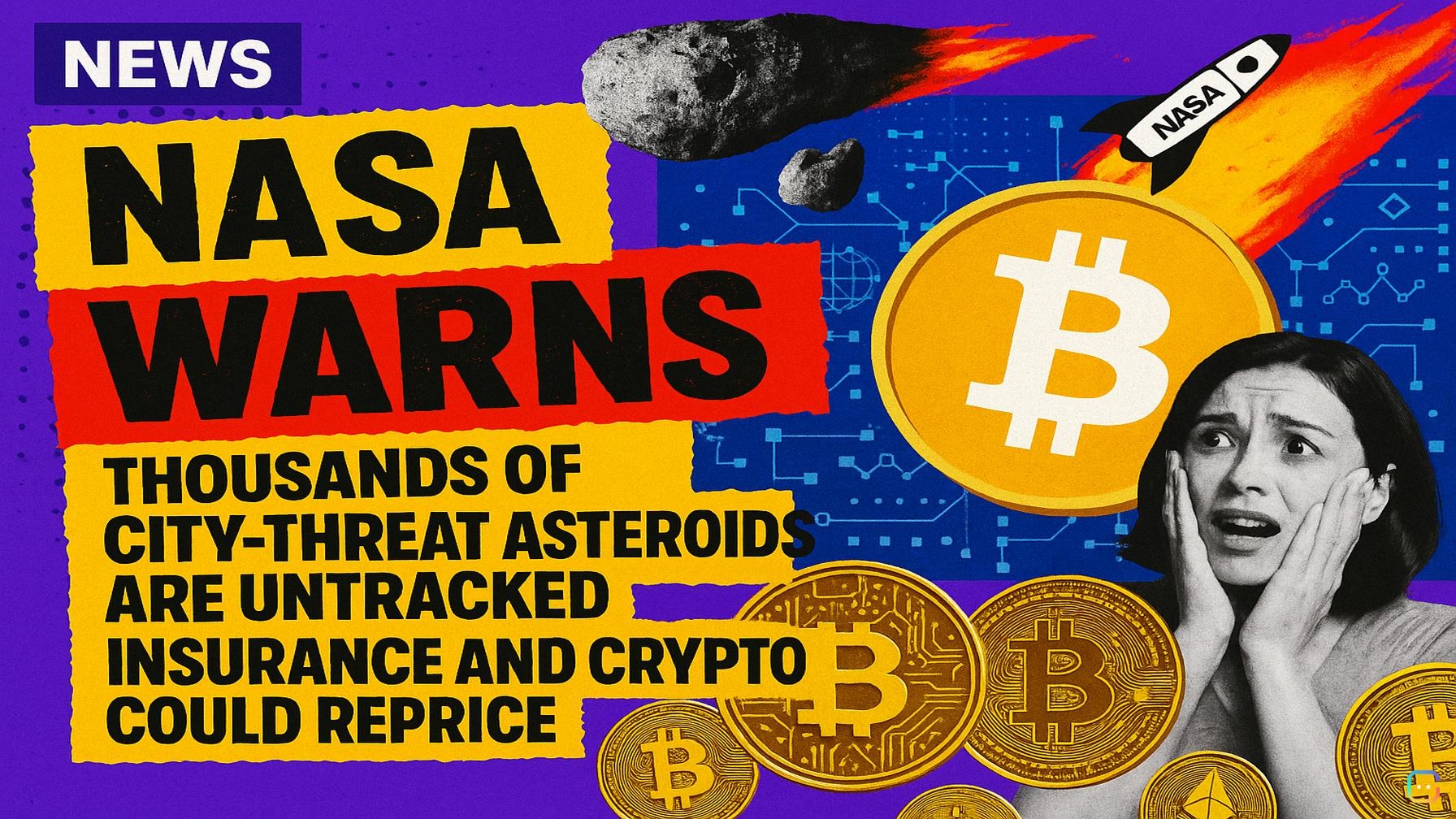
Hollywood-sized asteroid scenarios just left the movies and landed in the boardroom. At the AAAS conference in Phoenix, NASA’s planetary defense leaders issued a blunt wake-up call: we’ve found only about 40% of the mid-sized near-Earth asteroids that could flatten a city, tens of thousands remain untracked, and there is no ready-to-launch deflection system on standby.
Why it matters
- Mid-sized asteroids aren’t extinction-level events, but they can devastate a city and produce regional fallout that current insurers aren’t priced to absorb.
- NASA’s acting planetary defense officer, Dr. Kelly Fast, stressed the real danger isn’t the blockbuster “big” rock but the unseen “in-between” objects: “It’s really the asteroids that we don’t know about. It’s the ones in-between that could do regional damage… And we don’t know where they all are.”
- The takeaway for markets: even a credible, non‑impact threat can prompt rapid repricing of catastrophe risk—and that has historically boosted insurance company revenues and stock performance.
A recent near-miss that tested the system
NASA and its teams closely tracked 2024 YR4 through early 2025. For a short time, its Earth-impact probability for 2032 climbed to 3.2% before additional observations slashed that risk to essentially zero. As of the latest update, the chance of impact now sits at about 1 in 26,000—meaning Earth has a roughly 99.9961% chance of avoiding a strike. That rapid swing in public risk perception underscores how sensitive markets and models are to space‑risk headlines: the object briefly earned a Torino Scale rating of 3—the highest ever assigned to a tracked object—before being downgraded to zero.
No standing defense
DART—the 2022 mission led by Dr. Nancy Chabot of Johns Hopkins—proved that deflection is technically possible. But Chabot was equally candid about operational readiness: “DART was a great demonstration. But we don’t have [another] sitting around ready to go if there was a threat that we needed to use it for.” In short, the technology exists at a prototype level, but a ready-to-deploy planetary defense capability is not yet in place.
Market ripple effects (including for crypto investors)
- Traditional insurance: When catastrophe risk is suddenly seen as higher, insurers can reprice policies, which historically boosts premiums and benefits underwriting results. Analysts are watching insurers like Travelers, Chubb, and Kinsale Capital as candidates that could benefit if catastrophe models begin to bake in asteroid risk.
- Broader financial products: Repricing can spill into reinsurance, insurance-linked securities (ILS), and other risk-transfer vehicles.
- Crypto and DeFi angle: Tokenized insurance products, decentralized coverage pools, and smart-contract-based catastrophe bonds could also be affected if traditional models and capital markets start explicitly quantifying space‑impact risk. For crypto investors, that means an emerging intersection between planetary defense headlines and risk allocation in both fiat and digital-native insurance markets.
The policy case
Fast framed the issue crisply: planetary defense is unique because it’s arguably the only natural disaster we might be able to prevent. Yet, according to NASA experts, sustained investment to move from demonstrations to deployable systems is still missing.
Bottom line
The recent NASA warning isn’t a prediction of imminent disaster, but it is a timely reminder that low-probability, high-impact space events are increasingly treated as financial risk factors. Markets—insurance markets in particular—are already sensitive to these headlines, and crypto-native insurance and risk-transfer mechanisms should pay attention as catastrophe models evolve and policymakers decide whether to fund ready-to-deploy defenses.
Read more AI-generated news on: undefined/news