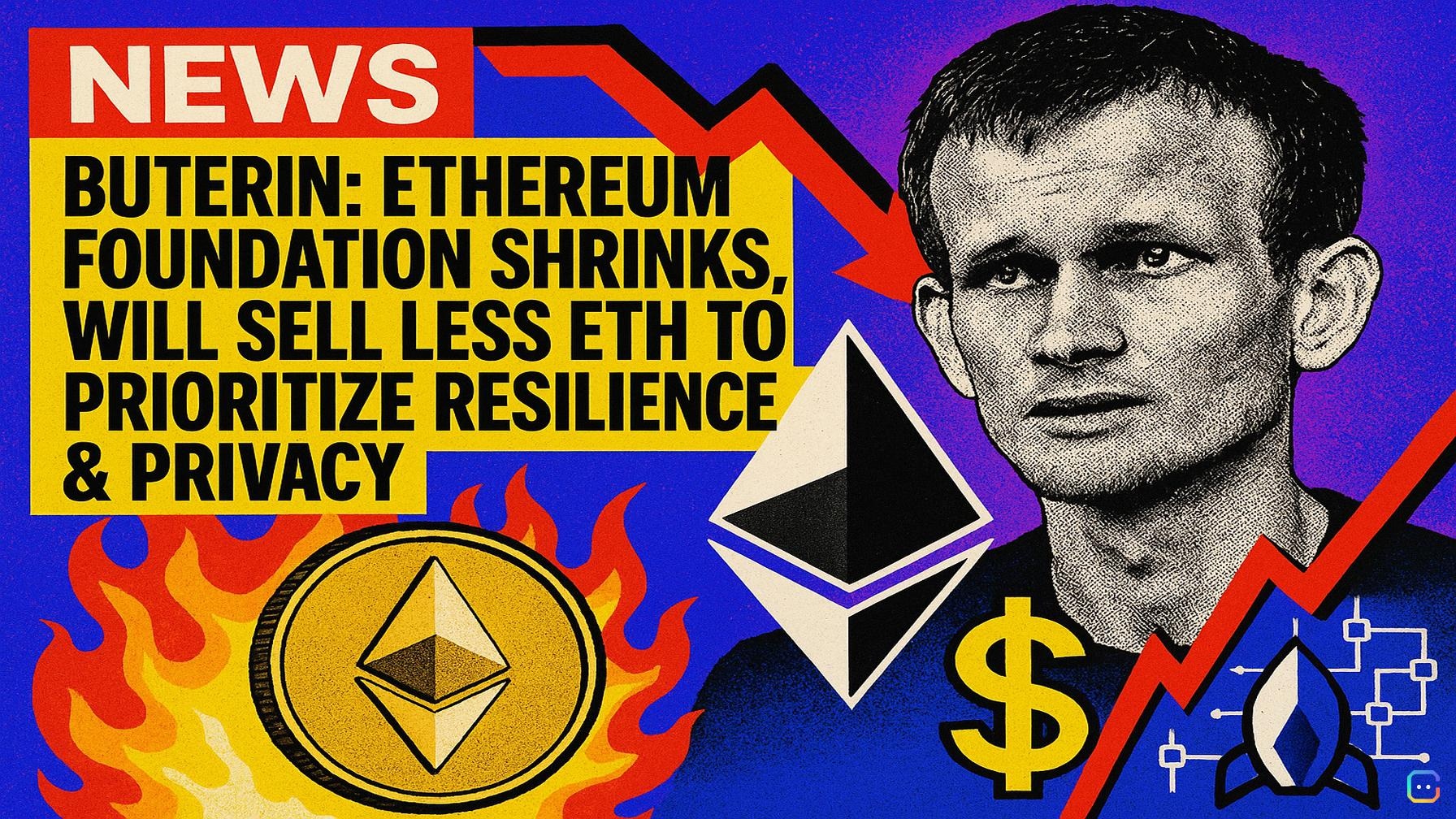
Vitalik Buterin says the Ethereum Foundation is shrinking its footprint and sharpening its focus — selling less ETH and concentrating on a narrow set of technical priorities meant to protect Ethereum’s long-term resilience, privacy, security and resistance to capture.
In a lengthy post on X Sunday, Buterin framed the change as a deliberate move away from treating the Foundation as the “center of Ethereum” and toward a much smaller, more opinionated role inside a broader ecosystem. He was careful to note the post reflects his personal view, not a unilateral board directive: “First of all, this is only my own view. The board is not just me,” he wrote, adding that the board is expanding and his influence will continue to fall — which he welcomed.
Why the shift
Buterin argued that the EF’s 2025-era reforms improved execution and efficiency and largely solved earlier management problems. With those issues diminished, a different criticism gained weight: the Foundation’s actions did not always reflect Ethereum’s public values — decentralization, privacy and “sanctuary technology” — strongly enough. The EF’s response, he said, is to do less work but to do the most critical work with more conviction.
The Foundation’s new identity, he wrote, is “one node, with a defined purpose, alongside other nodes,” rather than Ethereum’s central coordinating body. That has both cultural and financial implications: the EF holds roughly 0.16% of all ETH — “less than many other individual ETH holders,” according to Buterin — far smaller than the large token treasuries seen in some other blockchain ecosystems. He also argued the EF’s original fiscal mission — to fund development milestones outlined before launch — was essentially completed in 2022.
A tighter mandate: CROPS and minimization of intermediaries
Going forward, the EF will prioritize work that is critical to ensuring Ethereum remains censorship- and capture-resistant, open, private and secure — a set of priorities Buterin summarized as CROPS (censorship resistance, openness, privacy, security). He explicitly rejected defining Ethereum’s ambition primarily by ultra-low latency or extreme throughput. “Being as fast and as scalable as possible, and only a small epsilon more decentralized than the others, is a route to mediocrity,” he wrote.
Key technical focuses he highlighted:
- Deepening Ethereum’s defensive edge rather than racing for maximum TPS: examples include AI-assisted formal verification as a step toward “provably bug-free Ethereum.”
- Preserving properties via lean, available chain consensus that sit apart from Bitcoin-style and traditional BFT approaches.
- Intermediary minimization: reducing reliance on third parties for transaction inclusion and privacy. Buterin called it “honestly embarrassing” that many smart contract wallets and privacy tools still depend on intermediaries. He pointed to work such as FOCIL, EIP-8141, EIP-7701 and Kohaku as part of the push for stronger inclusion, public mempool access and user-layer designs that don’t leak private data across services.
ETH as the ecosystem’s monetary backbone
Buterin tied the technical direction to ETH’s economic role. He noted Ethereum secures roughly $250 billion of value and called ETH “the most high-value ‘product’ of the ethereum blockchain, financially speaking.” Nearly 90% of his personal net worth is in ETH; most of his remaining funds are about $40 million of on-chain fiat already earmarked for open-source biotech, software and hardware initiatives. He acknowledged that some work needed to support ETH as an asset will fall outside the EF’s narrower remit and will require other organizations and large ETH holders to step in.
What this means for the Foundation and the ecosystem
Practically, the EF will sell less ETH and reserve its remaining resources for longevity-focused work that wouldn’t happen otherwise. Buterin said the Foundation’s long-term structure should stabilize over the coming months, describing the EF as “a smaller ship than in previous years” — more opinionated, longer-lasting and narrowly tailored to ensure Ethereum “brings something meaningful to the world.”
Market snapshot
At press time, ETH traded at $2,108.
Read more AI-generated news on: undefined/news