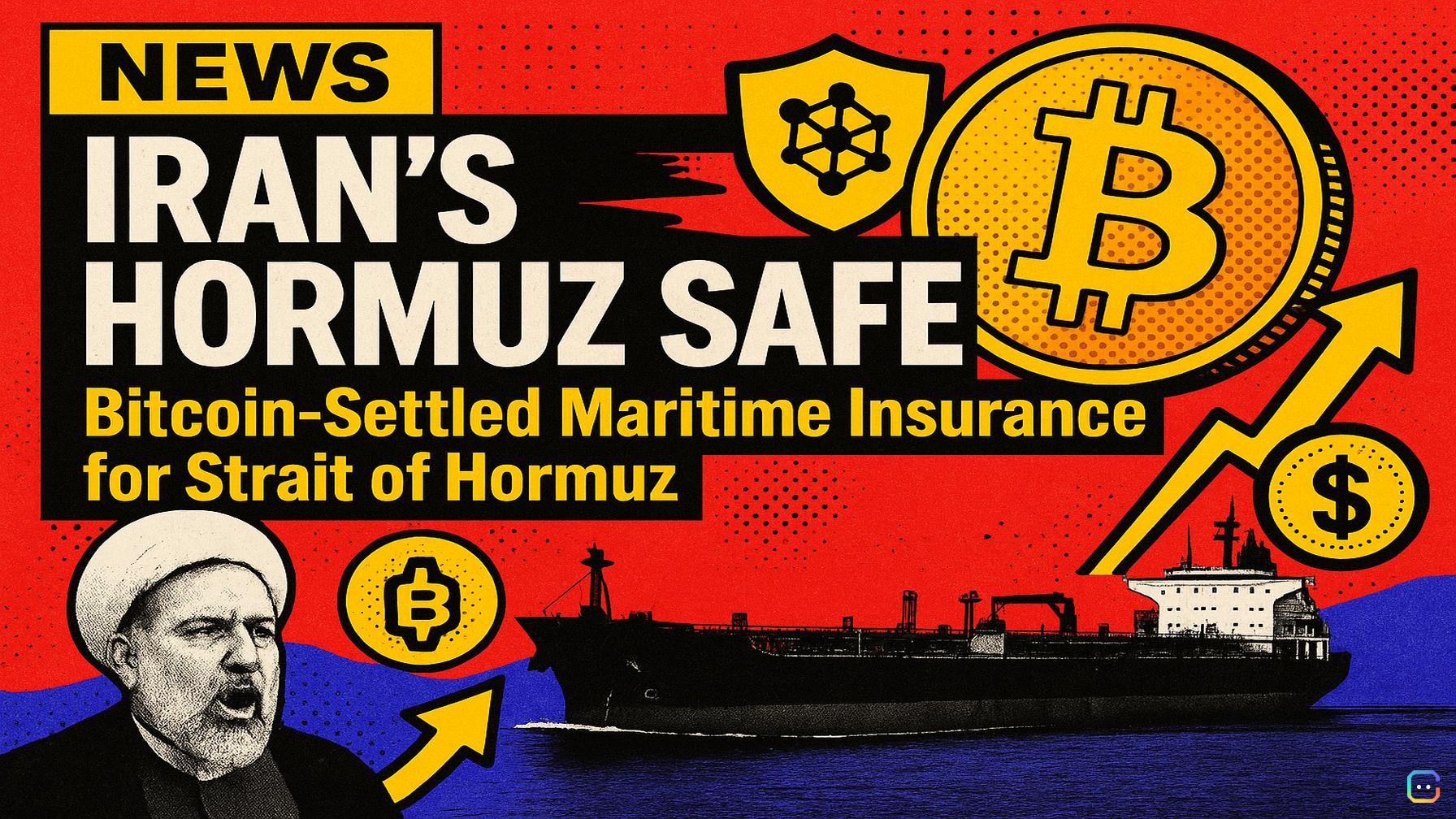
Iran has quietly rolled out a Bitcoin-settled maritime insurance platform aimed at cargo transiting the Strait of Hormuz, according to a report from semi-official Fars News Agency. The program — branded “Hormuz Safe” — places Bitcoin at the center of insurance infrastructure for one of the world’s most geopolitically sensitive shipping corridors.
What Fars says
- Hormuz Safe is now offering insurance for maritime cargo moving through the Persian Gulf, the Strait of Hormuz and adjacent waterways.
- A document obtained by Fars indicates Iran’s Ministry of Economic Affairs and Finance has been developing the plan since early Ordibehesht (the second month of the Iranian calendar, roughly April–May).
- The platform reportedly can issue maritime insurance policies and financial responsibility certificates, and Fars suggests the scheme could generate more than $10 billion in revenue for Iran.
- The report emphasizes the settlement layer: policy rules promise “fast, cryptographically verifiable” insurance and explicitly state “payments are settled with Bitcoin.” Coverage, Fars says, begins “from the moment of confirmation,” and shipowners receive a signed receipt.
Why it matters for crypto
This isn’t pitched as a consumer wallet or exchange product. Fars frames Hormuz Safe as operational infrastructure — an insurance and compliance engine for ships and cargo — that names Bitcoin directly as the payment medium rather than referring generically to “crypto” or blockchain rails. That makes the project notable to markets and regulators, since it brings a major on‑water trade corridor into direct contact with a permissionless settlement asset.
Geopolitical backdrop
The Strait of Hormuz links the Persian Gulf with the Gulf of Oman and the Arabian Sea and is consistently described as the world’s most critical oil chokepoint. The U.S. Energy Information Administration estimated that about 21 million barrels per day passed through Hormuz in 2022 — roughly 21% of global petroleum liquids consumption. Recent months have seen heightened tension in the corridor: Iran tightened transit following strikes at the end of February, allowed some Chinese vessels passage after an agreement on management protocols, and operations were further disrupted by a U.S. blockade on Iranian ports after an early-April ceasefire.
Unanswered technical and compliance questions
Fars did not disclose key operational details: whether payments are executed on-chain, routed through third-party custodians, handled via internal accounting, or converted immediately into local or foreign currency. The report also did not name counterparties, underwriters, wallet providers, or any external insurers tied to Hormuz Safe — leaving open questions about counterparty risk, custody, and regulatory compliance.
Bottom line
Hormuz Safe, as described, is a notable example of Bitcoin being positioned as an institutional settlement layer for real‑world commerce — specifically, maritime insurance tied to one of the planet’s most strategic and contested waterways. But with scant technical disclosure and no named partners, major questions remain about how the system will operate in practice and how it will interact with sanctions, insurance markets, and international maritime law.
At press time, BTC traded at $76,685. Source: Fars News Agency.
Read more AI-generated news on: undefined/news