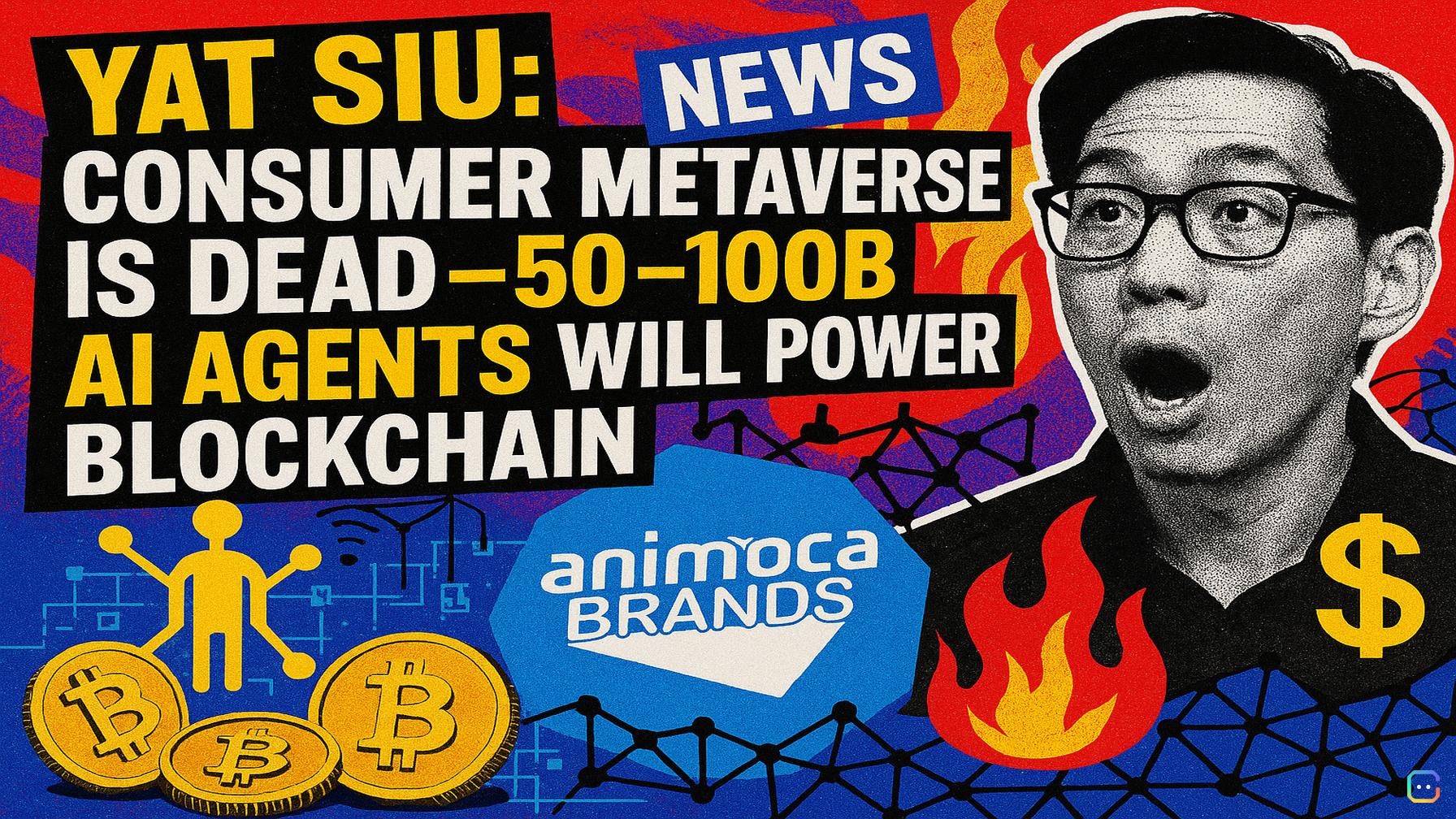
Headline: Animoca’s Yat Siu Declares the Consumer Metaverse Dead — Predicts 50–100B AI Agents Will Become Blockchain’s Main Users
At Consensus Miami 2026, Animoca Brands chairman Yat Siu delivered a stark reassessment of the industry’s pandemic-era metaverse dream: the immersive, human-centric metaverse the crypto world once chased is not the future. Instead, Siu argued, the real scaling opportunity for blockchain lies in autonomous AI agents — machines transacting and operating on-chain at massive scale.
“Where we’re landing is that the metaverse, the blockchain-based one, was really the proof of concept for agents,” Siu said, bluntly reframing the technology’s trajectory. “It was never really destined for humans as a prime consumer.” He added that humans were essentially “the guinea pigs,” used to test and validate blockchain primitives now better suited to machine actors.
A pivot from the pandemic metaverse narrative
Animoca was a prominent proponent of the pandemic-era vision that people would increasingly live, work and socialize inside immersive virtual worlds. Siu blamed that optimism on the unique distortions of COVID lockdowns — a time when many assumed remote digital life would become permanent. “Everyone thought, ‘Oh, we’re going to be at home, and we’re never going to travel as much anymore,’” he said. “Which, of course, turned out to be quite the opposite.”
Why agents, not humans, are the next frontier
Siu’s core argument is practical: crypto has struggled to convert holders into active users because blockchain remains too complex for mainstream human consumers. Roughly 700–800 million people worldwide own some form of cryptocurrency, yet fewer than 70 million actively interact with blockchain apps — a gap driven largely by user experience, custody and onboarding friction.
Autonomous AI agents don’t face those barriers. They operate through code, can transact on-chain without conventional banking rails or manual UX, and can be programmed to perform continuous, granular economic activity. Based on simple population math — 10 to 20 agents per human — Siu estimates a future population of 70–140 billion agents, and he suggested a realistic working range of 50–100 billion agents ultimately operating across the internet.
“Blockchain technology is the ideal financial system for machines,” Siu said, describing a machine-native economy where smart contracts and tokenized value enable thousands of tiny, automated transactions between agents.
Animoca’s next move: funding agent-first development
Underlining the shift in strategy, Animoca announced a $10 million initiative to support developers building AI agent applications via its Animoca Minds platform. The fund positions agents as the company’s next major investment category now that the consumer metaverse era — at least as originally imagined — has closed.
What this means for crypto
If Siu is right, the industry should expect a migration of resources from human-facing virtual worlds and social experiences toward infrastructure, standards and tooling that enable autonomous agents: identity for machines, machine wallets, agent marketplaces, micropayment rails and governance models for agent behavior. The change reframes blockchain from a consumer product to a foundational machine economy layer, potentially unlocking new classes of on-chain activity and revenue that don’t rely on mainstream human UX.
Whether the forecasted billions of agents materialize remains to be seen, but Animoca’s public pivot and funding commitment signal that at least some major players are already placing their bets on a machine-first blockchain future.
Read more AI-generated news on: undefined/news