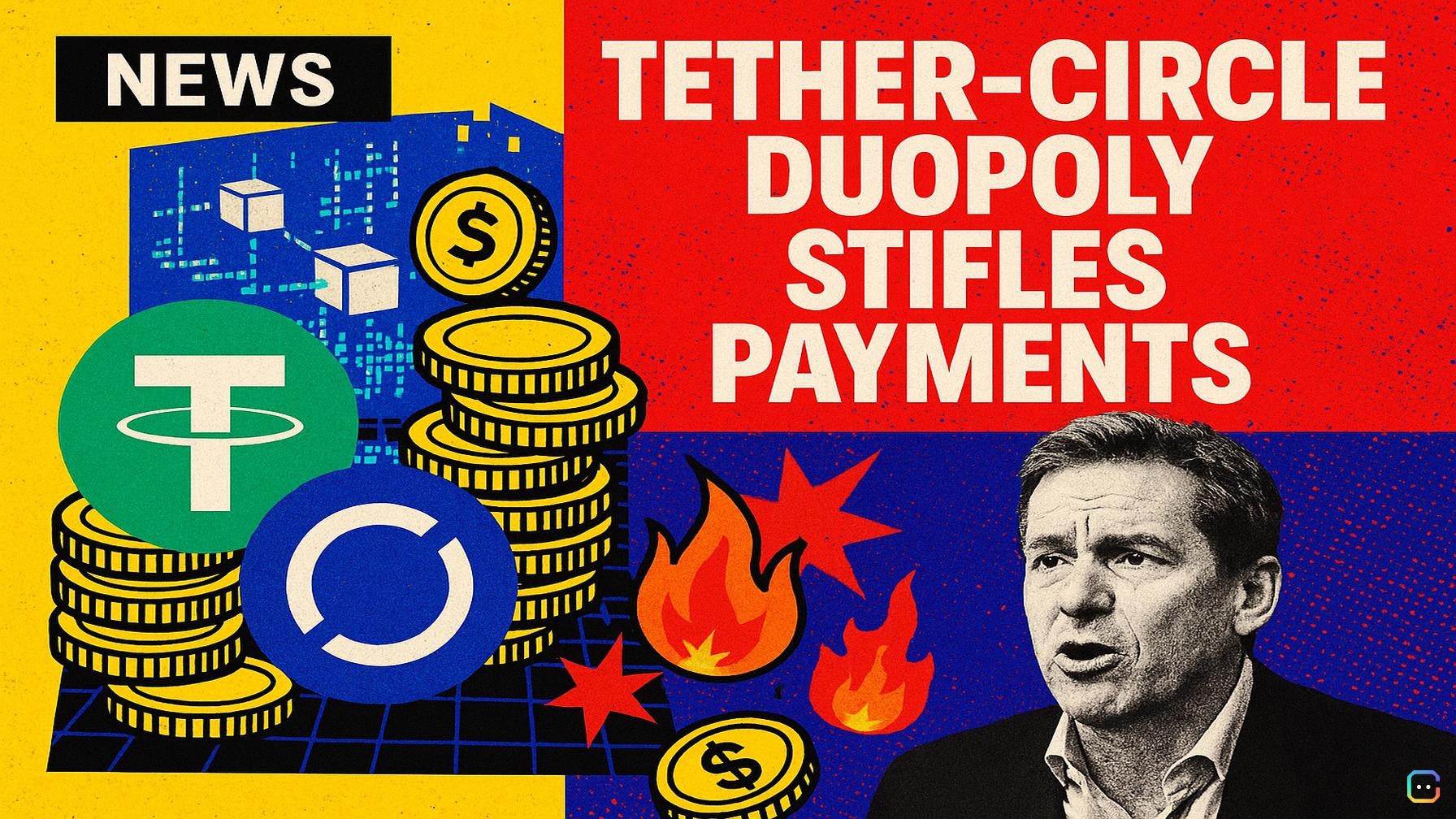
Ben O’Neill, head of money movement at Bridge, told a Consensus Miami panel that the stablecoin market’s duopoly — led by Tether and Circle — is stifling competition and leaving many real-world payments use cases underserved.
At the heart of O’Neill’s critique is how the two dominant dollar tokens have evolved differently and made design choices that don’t fit every need. Tether’s USDT, which traces its origins to 2014 when it launched as Realcoin, has grown into a roughly $189.5 billion behemoth and became widely used in overseas dollar flows outside the U.S. banking system. Circle’s USDC, launched in 2018 alongside Coinbase and now about $71 billion in market cap, positioned itself as a U.S.-friendly, regulated alternative and later became a major player in DeFi.
That split matters to payments firms, O’Neill said. Speaking from the perspective of Bridge (owned by Stripe), he argued neither model provides the certainty large payment processors require. Tether’s approach, he said, forces users to either accept costly on-chain “burn” fees — “we’ll burn for 10 bips, which is crazy expensive for a payments company” — or rely on market trades that introduce settlement uncertainty. Circle, by contrast, he described as increasingly focused on assets under management and raising redemption fees, which can make routine high-volume settlement expensive: “If I’m someone like Visa, and I want to do trillions of dollars of card settlement and stablecoins, I’m burning a bunch of USDC, and that’s gonna be a net bad.”
O’Neill called for a two-pronged remedy: more purpose-built stablecoins optimized for specific use cases, and infrastructure that makes swapping between stablecoins efficient — namely, clearing-house-style services that could ease liquidity and settlement frictions. He noted the latter is already an attractive idea for founders and VCs working in payments and crypto plumbing.
“If you don’t get more competition,” he warned, “they’re going to just keep upping the fees. They’re not gonna share the yield. They’re gonna disincentivize you from burning it. They’re gonna make it harder and harder to make it feel like money at each turn.”
The comments highlight a growing industry conversation: as stablecoins become central to on-chain commerce and off-chain settlement, design trade-offs and fee structures will shape who can actually use them at scale — and may prompt new entrants and infrastructure solutions to break the current duopoly.
Read more AI-generated news on: undefined/news