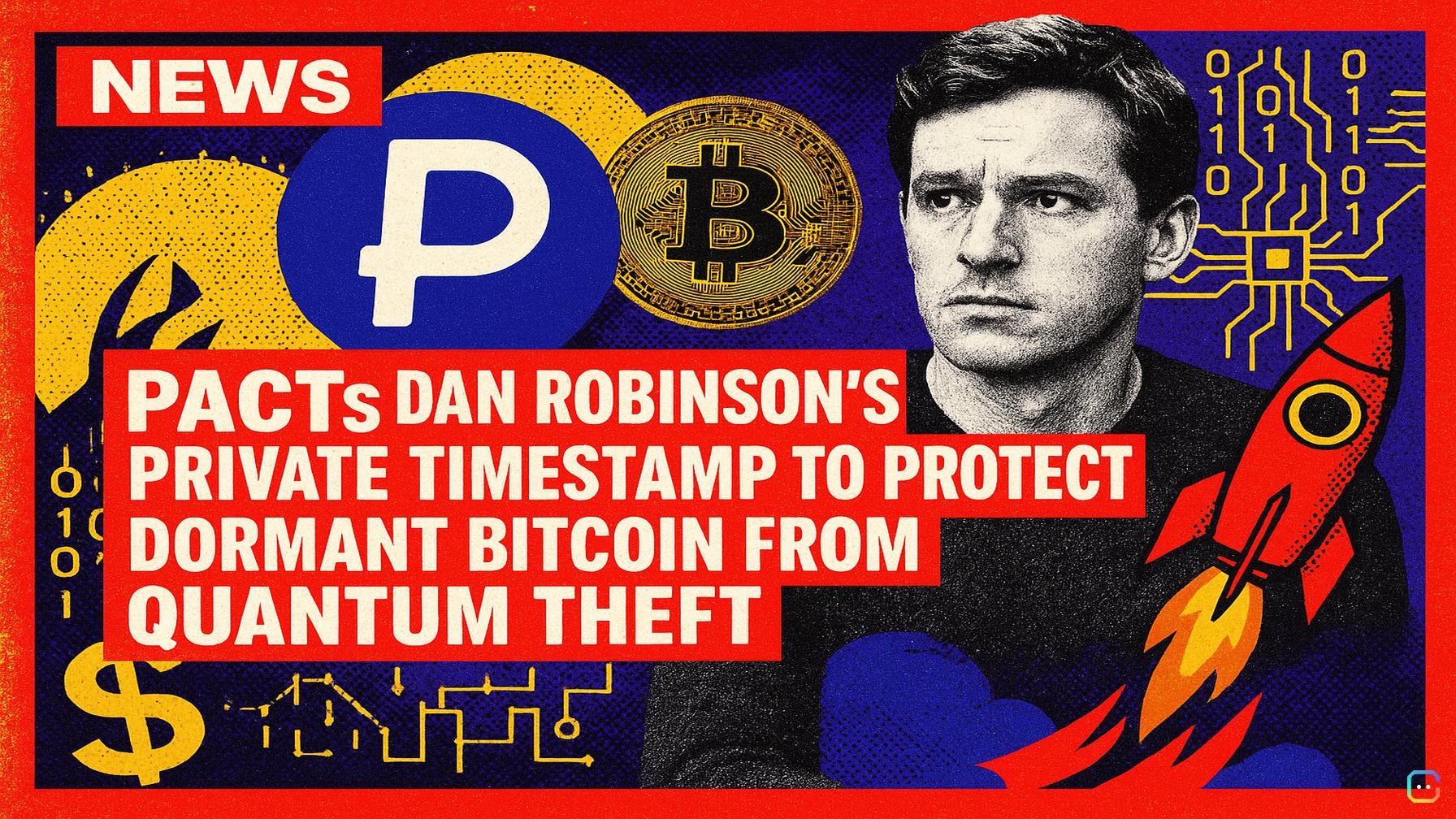
Paradigm Bitcoin partner Dan Robinson on May 1 unveiled a new quantum‑era contingency called PACTs — Provable Address‑Control Timestamps — designed to give dormant Bitcoin holders a private way to stake a claim on their coins before sufficiently powerful quantum computers arrive.
The idea targets what Robinson calls the “Satoshi Problem”: a worst‑case tradeoff in Bitcoin’s quantum debate. If quantum computers become capable of breaking current ECDSA public keys before the protocol adapts, coins in old, exposed address types could be stolen. If the network instead moves quickly to push a “quantum sunset” soft fork that freezes vulnerable addresses, owners of long‑dormant wallets would be forced into a public, often messy migration. PACTs offer a third route: a covert timestamp that proves control of a key today without requiring the wallet to move funds until — and if — a standardized rescue mechanism is ever activated.
Mechanically, PACTs let a keyholder create an auditable, time‑bound proof of address control that can be published quietly (Robinson suggests 2026 as a practical window). That proof would sit dormant until a community‑agreed recovery process is available, providing a potential rescue path for large, inactive holdings — including the caches associated with Satoshi Nakamoto, estimated at about 1.1 million BTC. More broadly, roughly 1.7 million BTC are currently stored in address types that expose public keys and would be vulnerable to future quantum attacks; some of those wallets are worth tens of billions of dollars.
Robinson frames PACTs as complementary to existing proposals such as BIP‑361, the phased migration plan authored by Casa CSO Jameson Lopp that would gradually move wallets away from legacy signatures and freeze unmigrated coins. PACTs aim to reduce the pressure for an immediate, network‑wide sunset by giving individual holders a way to preserve a verifiable claim without performing an on‑chain migration now.
He also cautions that PACTs aren’t a turnkey solution. Multisig setups, complex script types, and hardware wallet workflows will need further specification and tooling to integrate cleanly, and there’s always the possibility Bitcoin never adopts a formal quantum sunset or recovery process. The broader community debate has been heating up in 2026: Blockstream CEO Adam Back has argued for opt‑in, quantum‑resistant upgrades rather than forced freezes, and voices such as Naoris Protocol CEO David Carvalho have warned that dormant wallets will be “ripe for the picking” once quantum capability arrives — a breach that, he says, could trigger serious loss of trust in the asset.
PACTs are best read as a hedge — a low‑friction way for at‑risk holders to preserve proof of ownership now while the ecosystem debates and develops safe, standardized rescue tools. Whether the proposal gains traction will depend on standards work for complex wallet types, community appetite for coordinated recovery mechanisms, and how quickly quantum hardware advances. For now, PACTs add a pragmatic option to the ongoing conversation about how Bitcoin should defend itself against a future quantum threat.
Read more AI-generated news on: undefined/news