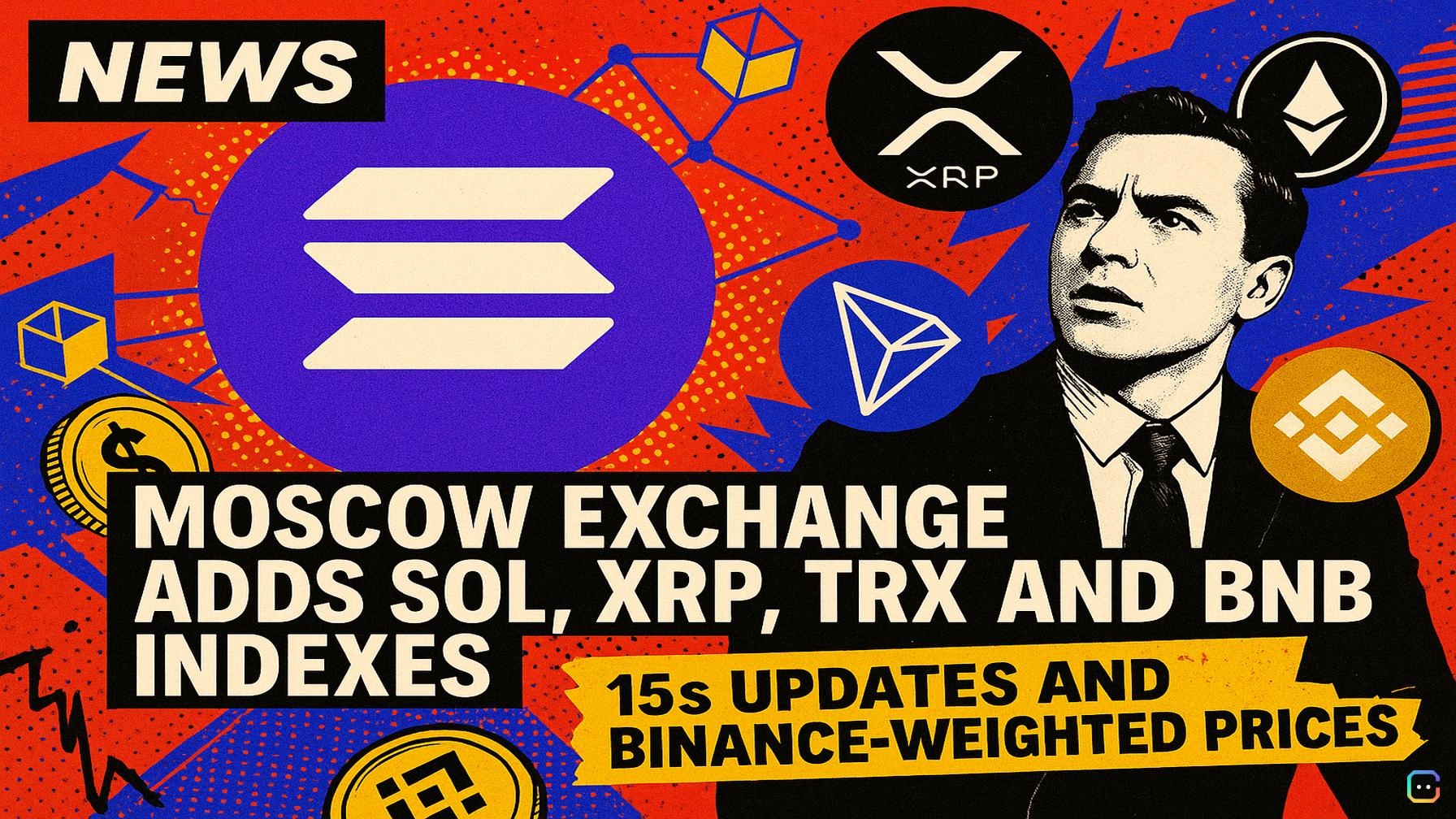
Moscow Exchange is expanding its crypto footprint: on May 13 it will add four new digital-asset indexes — tracking Solana, XRP, Tron and BNB under the tickers MOEXSOL, MOEXXRP, MOEXTRX and MOEXBNB — broadening its benchmark suite beyond Bitcoin and Ethereum.
Key details
- Data sources and weighting: index prices will be aggregated from Binance (50% weight), Bybit (20%), OKX (15%) and Bitget (15%).
- Faster updates: all MOEX crypto indexes, including existing MOEXBTC and MOEXETH, will refresh every 15 seconds during trading hours and in extra weekend sessions, improving their suitability for price-linked products.
- Tradability: the new altcoin indexes are not yet listed as tradable instruments. The exchange said they “could become” underlying assets for future products, but timing and terms remain open.
Why it matters
More frequent pricing and broader coverage make Moscow Exchange’s benchmarks more usable for derivative products, ETFs or structured instruments — if and when the exchange decides to turn them into tradable underlyings. The heavy 50% weighting for Binance in the price basket is notable and reflects market-share priorities in index construction.
Regulatory and market context
Moscow Exchange’s move fits Russia’s cautious, controlled pathway for crypto exposure:
- In June 2025 the exchange listed a Bitcoin futures contract linked to BlackRock’s IBIT product, but trading was limited to qualified investors, with trading set to begin June 4, 2025 and access restricted to that investor class.
- Authorities have favored channeling crypto activity into selected, supervised instruments rather than offering broad spot trading on regulated venues. A pilot trading program for top-tier investors has also been explored by the Finance Ministry and the Bank of Russia.
Policy momentum and market size
Russian officials are pushing more activity into regulated channels. Deputy Finance Minister Ivan Chebeskov estimated in February 2026 that crypto turnover in Russia is roughly 50 billion rubles per day — more than 10 trillion rubles a year — much of it “outside the regulated zone, outside our control.” The Bank of Russia has urged penalties for off‑rule transactions; Governor Elvira Nabiullina warned that “fraudsters are taking advantage of the gray market.”
Looking ahead
Moscow Exchange intends to expand its crypto benchmark list to ten assets. Candidates under review include Dogecoin, Cardano, Hyperliquid and Chainlink. The exchange has also discussed futures tied to its indexes — potentially including perpetuals on Bitcoin and Ethereum — while direct spot crypto trading remains a separate objective, currently slated for early 2027 on the exchange’s roadmap.
Bottom line
The new indexes mark a steady, incremental push to standardize crypto pricing in Russia’s regulated markets. Whether they become the foundation for wider retail access or remain tools for institutional and qualified investors will depend on regulatory choices and the exchange’s timing for product launches.
Read more AI-generated news on: undefined/news