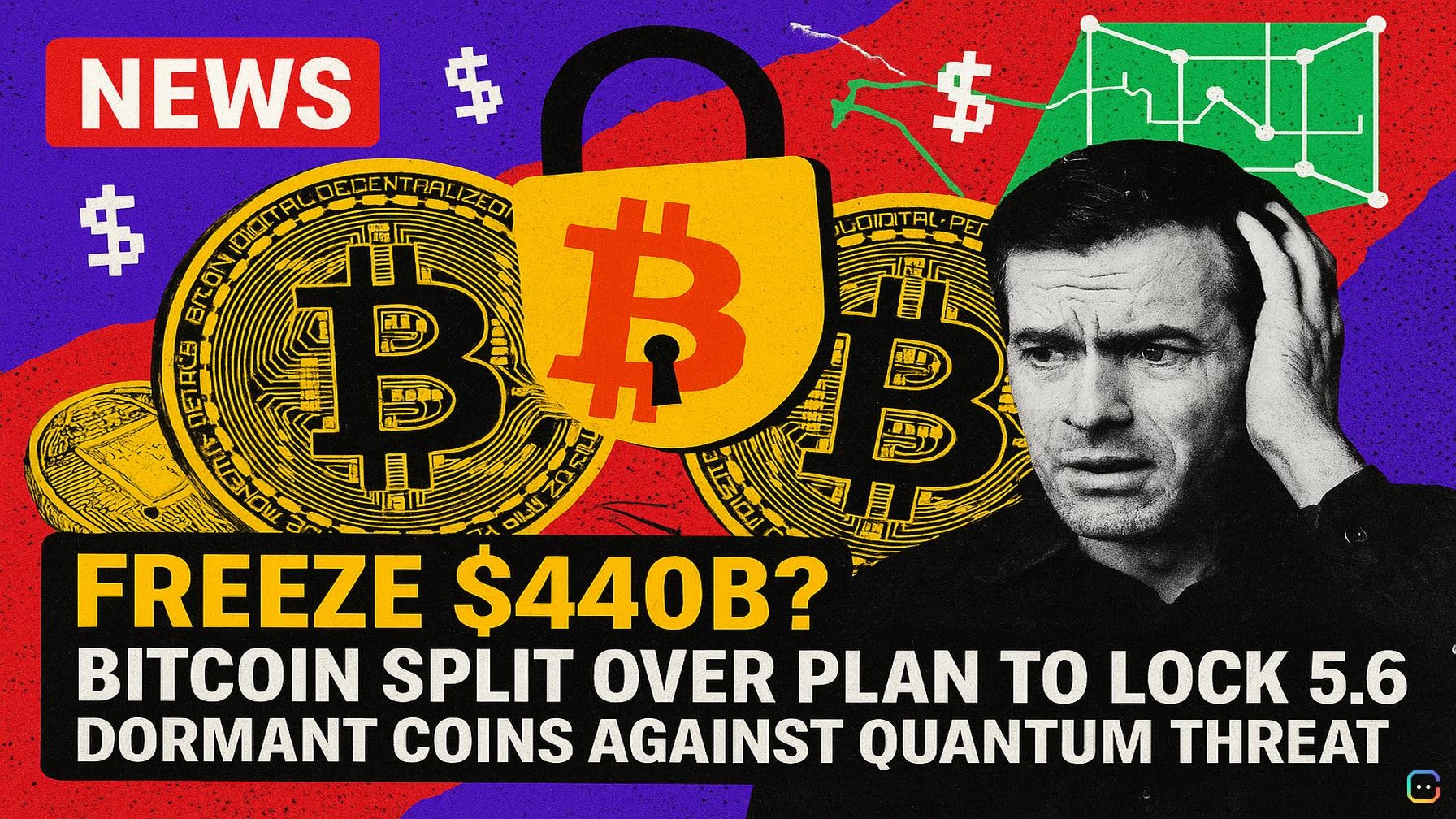
A brewing showdown over 5.6 million dormant bitcoins — roughly $440 billion of the supply — has reignited a heated debate in the Bitcoin community: should the network freeze old, at-risk coins to preempt theft by future quantum computers, or would that move destroy a core promise of the protocol?
Why this matters now
- About 5.6 million BTC sit in wallets that have been inactive for more than a decade and were created with older address types that haven’t been “upgraded.” That makes them, in theory, far more vulnerable if large-scale quantum computers ever arrive and break current cryptographic signatures.
- Freezing those coins would require a protocol-level change — a contentious hard fork — and proponents say it could be done to protect users from future quantum attacks. Opponents say any freeze undermines Bitcoin’s immutability and unconditional property rights.
What’s on the table
Core developers led by Jameson Lopp and others published Bitcoin Improvement Proposal 361 (BIP-361) this month, which contemplates phasing out legacy signature schemes and includes mechanisms that could freeze assets that don’t migrate. Lopp told CoinDesk he would rather see the dormant coins frozen by the network than left exposed to future quantum hackers, and already treats them as effectively lost.
The “instant repricing” argument
Samuel “Chad” Patt, founder of Op Net, warns freezing those coins would cause an immediate market repricing and “be the worst single day in bitcoin’s history” — not because of a hack but because it would prove Bitcoin’s ownership guarantees are negotiable. “Institutional risk desks do not care about the reason, they care about the precedent,” Patt said, arguing that treating currently circulating BTC as “conditionally owned” would force fund managers who bought Bitcoin for censorship resistance to unwind positions.
A spectrum of views among maximalists
The debate has split even staunch Bitcoin maximalists:
- Jason Fernandes (AdLunam) agrees precedent would trigger repricing but argues a successful quantum attack would be far worse — institutions would price whether the system itself could survive a breach of core assumptions.
- Mati Greenspan says if quantum ever compromises early wallets, it won’t lead to a rollback or freeze — it would be “the largest bug bounty in human history,” implying attackers would simply spend vulnerable coins.
- Kent Halliburton (SazMining) and Khushboo Khullar (Lightning Ventures) caution that freezing coins “breaks the core promise of inviolable property rights,” undermining immutability, permissionlessness and the network’s decentralized ethos. They favor voluntary migration and better tooling over a protocol-level contingency that looks like confiscation.
- Ken Kruger (Moon Technologies) calls the problem “extremely challenging” and argues some compromise may be necessary to prove Bitcoin’s resilience — “freeze funds or let them be stolen?” — and sees the debate as a potential defining moment for the protocol.
Existential risk vs. philosophical purity
Jason Fernandes frames the choice starkly: quantum risk is an existential threat, not just a philosophical debate. He notes Bitcoin has evolved via conservative upgrades like SegWit and Taproot, and suggests the risk of inaction could outweigh concerns about setting precedent. Others, like Greenspan, still prefer inaction: “doing nothing is better than doing something,” he said, arguing the community broadly views freezing as antithetical to Bitcoin’s core value proposition.
What’s next
No consensus has emerged. The options are painful:
- Implement a hard-fork contingency that freezes non-migrated funds and risks shattering the censorship-resistance narrative, possibly triggering sharp market repricing.
- Rely on voluntary migration, improved tooling and hope quantum computers arrive slower or less capable than feared.
- Accept the risk and prepare for a reactive response if a quantum attack ever occurs.
The debate captures a deeper tension in Bitcoin’s evolution: how to balance protocol conservatism and property rights against the need to adapt to genuinely existential technical threats. For now, the community continues to wrestle with whether protecting hundreds of billions in dormant BTC justifies a change that could itself reshape how the world views Bitcoin’s guarantees.
Read more AI-generated news on: undefined/news