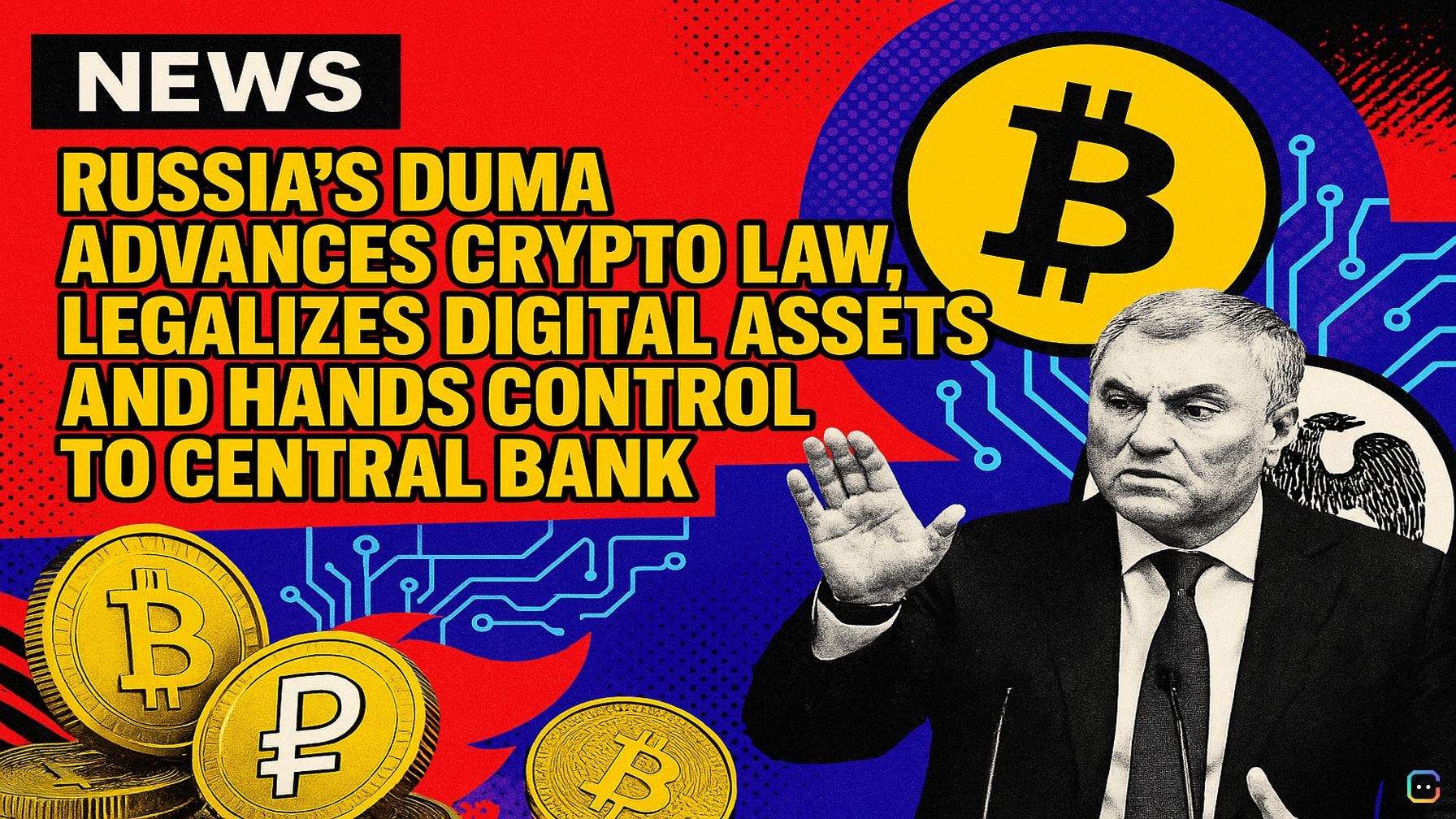
Russia’s lower house has taken a major step toward formally legalizing crypto, advancing a sweeping bill that would pull the country’s digital-asset market out of the gray zone and place it under the Central Bank’s supervision.
What happened
- On Tuesday the State Duma approved the draft law “On Digital Currency and Digital Rights” at its first reading, with 327 deputies voting in favor, TASS reported. The government first submitted the bill in December 2025 and aimed to have a regulatory framework in place by summer 2026.
- The bill must pass two more readings in the State Duma, then clear the Federation Council before reaching the president. If signed, most provisions will take effect on July 1, 2026 (some clauses may have different start dates).
Key provisions
- Legal recognition: Digital assets would be explicitly recognized as property. That legal status would allow crypto to be defended in court, included in bankruptcy estates, and considered in family law matters such as divorce.
- Central Bank control: The Central Bank of Russia (CBR) would gain licensing, regulatory and supervisory authority over the domestic crypto market. Only licensed, professional participants supervised by the CBR would be permitted to operate.
- Licensed market players: The bill names authorized facilitators — exchanges, brokers, trust managers and digital depositories — all of which must hold CBR licenses. Underground platforms and anonymous “black” brokers would be excluded and could face blocking and asset seizures, lawmakers warned.
- Eased entry for some players: Entities already operating under the CBR’s experimental legal regime would get a simplified path to authorization, and the bill offers streamlined procedures for banks and brokers that want to enter crypto.
- Mining rules: Crypto mining using Russian information infrastructure would be legal but regulated: miners must use Russian infrastructure and report both equipment and currency produced.
- Payments and cross-border use: The law would bar using cryptocurrencies for domestic payments for goods, services or labor (the ruble would remain the sole legal tender). However, it carves out an exception for cross-border settlements, enabling Russian companies to settle with foreign counterparties in crypto — a move lawmakers say could help circumvent sanctions restrictions.
- Investor protections: A tiered investor regime would limit access depending on classification. Non-qualified retail investors would be capped at buying 300,000 rubles (~$3,800) per year in the most liquid cryptocurrencies and must pass a knowledge test. Qualified investors who pass a risk-awareness test could buy unlimited amounts.
Lawmakers’ rationale
Deputy Kaplan Panesh, deputy chair of the State Duma Committee on Budget and Taxes, framed the bill as a necessary step to curb risks from years of regulatory ambiguity. “Now we are clearly defining: digital currency is property. This means it can be defended in court, included in the bankruptcy estate, and taken into account in divorce proceedings,” he said. Panesh also emphasized the government’s stance that the ruble remains Russia’s sole legal tender, while noting the cross-border exception would create “a legal instrument for cross-border settlements” that could help companies bypass sanctions.
Why it matters
- For users and holders: Formal property status and clearer regulation promise better legal protections and predictability for millions of Russians who already hold crypto.
- For market structure: Central Bank licensing and oversight would centralize control, likely favoring licensed domestic operators and making it harder for anonymous or offshore services to serve Russian customers without local approval.
- For miners: The requirement to use Russian infrastructure could push mining operations to localize hardware and reporting, potentially reshaping the domestic mining landscape.
- For international relations: The explicit allowance of crypto for cross-border settlements to evade sanctions could draw scrutiny from foreign governments and add a geopolitical dimension to the law’s implementation.
Next steps
The draft now moves through two more Duma readings and then to the Federation Council and the president. If the timeline holds, many provisions would come into force on July 1, 2026, setting a firm date for Russia’s transition from a gray market to a regulated domestic crypto ecosystem.
Read more AI-generated news on: undefined/news