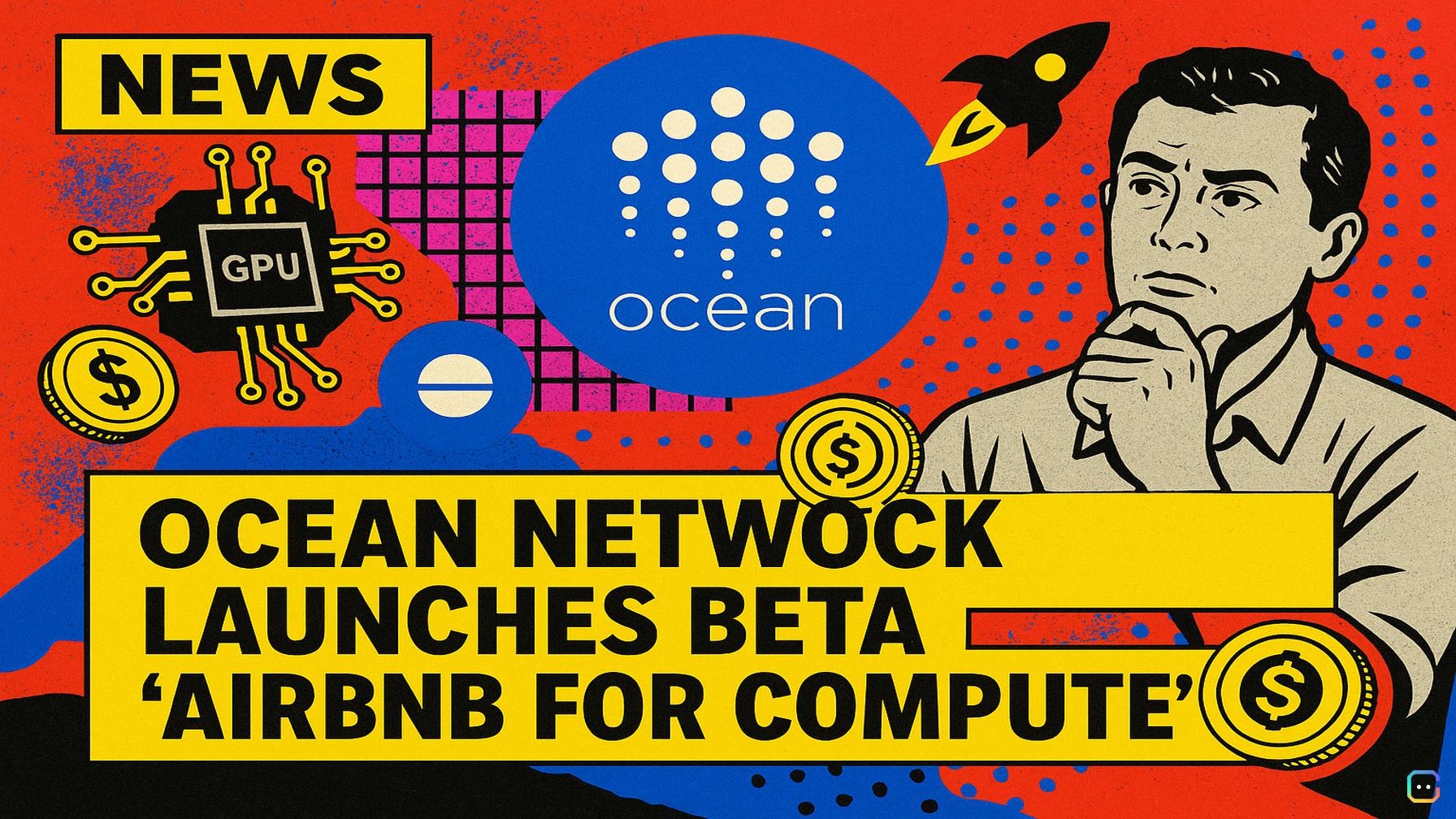
2026’s GPU crunch is forcing innovation: Ocean Network is rolling out what it describes as an “Airbnb for compute,” a decentralized peer-to-peer marketplace that lets people and organizations rent out idle GPUs and CPUs to handle external jobs.
Why it matters
- Demand for GPU compute is sky-high — driven by hyperscalers, AI firms and gamers — while supply remains tight and usage patterns swing wildly over hours and days. Ocean says a sharing model can smooth that volatility by turning underused consumer and enterprise GPUs into on-demand capacity.
How it works
- Users submit containerized jobs (Python, JavaScript, etc.) to an Ocean Node; the network runs the job and returns outputs without the user managing infrastructure. Jobs can be monitored live and results automatically pulled back to the user’s environment.
- Nodes are benchmarked continuously to confirm performance and reliability.
- Pricing is strictly pay-per-use: jobs are billed for actual resources consumed (time, hardware, memory, environment) rather than paying to reserve a machine. Escrow holds funds until a node completes a job and returns output.
Hardware choice and orchestration
- Users can filter and pick hardware — for example Nvidia H200, A100 or Tesla T4 — and set minimum CPU/RAM specs. High-demand jobs can be routed to top-tier GPUs; lighter workloads can run on gaming GPUs contributed by consumers.
- Ocean Orchestrator (formerly the Ocean VS Code Extension) coordinates nodes and plugs directly into popular dev platforms such as VS Code, Cursor, Windsurf and Antigravity, letting developers run remote jobs without leaving their IDE.
Privacy and security
- Ocean uses Compute-to-Data (C2D): algorithms run in isolated containers where the data lives, so raw data never leaves its environment and only computed outputs are returned.
- Identity and access controls are handled via wallet-based identity from Alchemy.
Payments and onboarding
- Settlements use Circle’s USDC on Coinbase’s Base (an Ethereum L2) for near-instant escrowed payments. Ocean also supports smart wallets managed via Alchemy, so users can authenticate with Google accounts, email or passkeys — no MetaMask setup required.
- Users can set spending caps (e.g., stop a node after 10 USDC). Ocean is also developing “card-to-compute” on-ramps to let people pay by credit card; the interface will automatically convert to USDC behind the scenes so no manual token bridges or exchange steps are needed.
Product rollout and incentives
- Ocean is inviting Web2 data scientists, analysts and Web3 builders to a beta, offering $100 in free credits to new users. The company has partnered with Aethir to guarantee initial supply of high-performance GPUs.
- The beta initially focuses on demand (running jobs); mid-April the platform will open for users to run their own nodes and monetize spare GPU/CPU capacity.
Bottom line
Ocean Network aims to relieve GPU shortages by monetizing spare compute across a decentralized network, combining developer-friendly tooling, privacy-preserving compute, escrowed USDC settlements, and easy onboarding. If the marketplace attracts both consistent demand and a diverse supply of reliable nodes, it could become a useful supplement to centralized cloud GPU offerings — especially for variable workloads and cost-conscious teams.
Source: Ocean Protocol announcement (tweeted March 16, 2026) and Ocean Network release.
Read more AI-generated news on: undefined/news