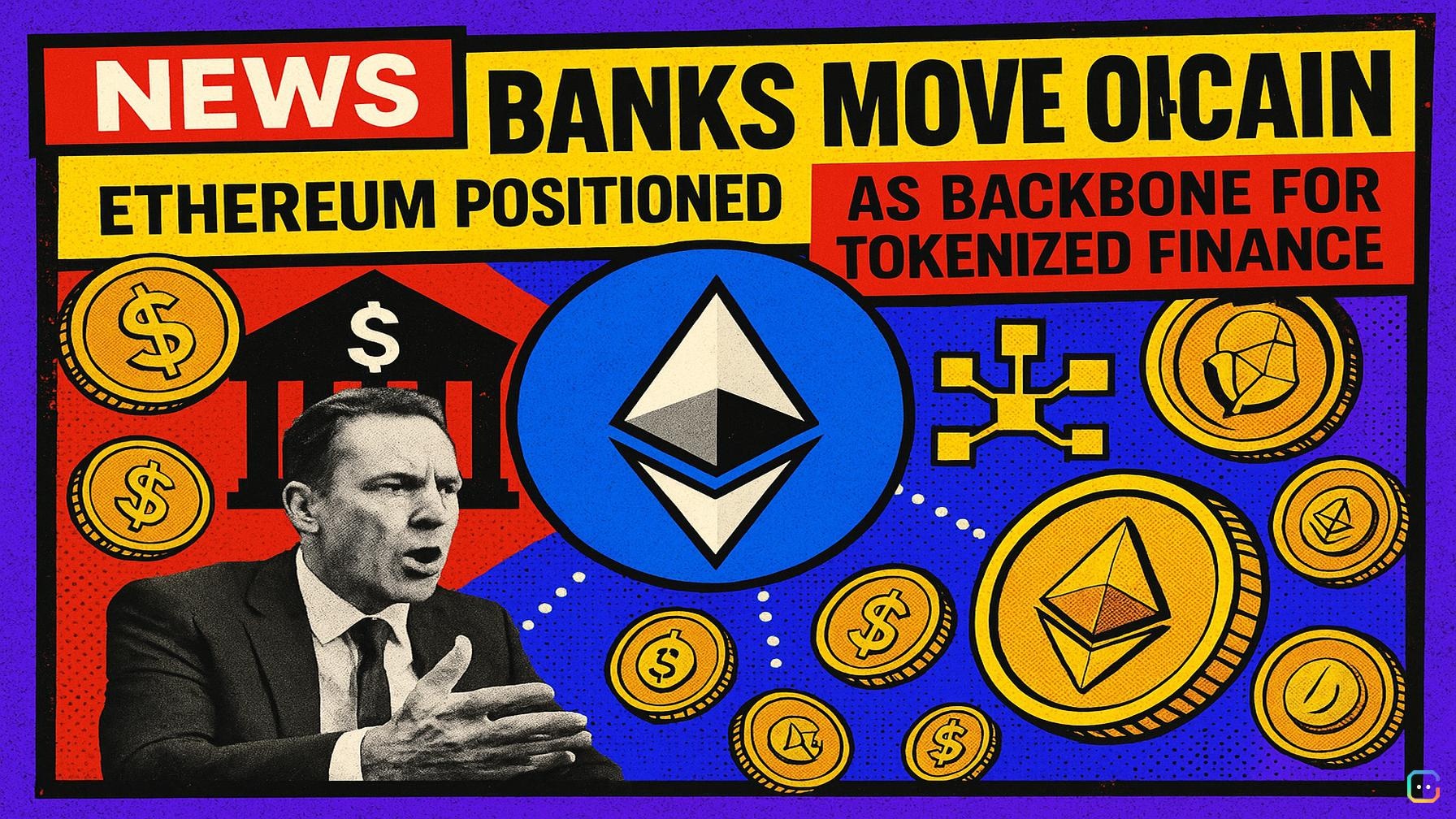
Headline: Banks are coming on‑chain — Ethereum positioned as the backbone for tokenization, say industry insiders
Ethereum is quietly gaining mainstream traction as the traditional financial sector prepares to migrate key services on‑chain. Raoul Paul, CEO of Real Vision, argues Ethereum is emerging as the natural infrastructure for the next phase of finance — tokenization and on‑chain banking — and that institutional adoption could accelerate soon.
In a wide‑ranging discussion with Danny Ryan and Vivek Raman, Paul laid out why banks may be closer to becoming “customers of decentralization” than many expect. He highlighted Ethereum’s decade‑long work on resilience, multiple client implementations and global distribution, saying these qualities map directly onto what institutional players prioritize: uptime, durability and systems that can’t be easily switched off. “You just have to translate the language to them,” Paul said, noting an important cultural dynamic: the conservative corporate impulse to pick proven platforms — “the ‘no one gets fired for picking Microsoft’ dynamic” — plays into Ethereum’s favor.
Paul framed Ethereum as “multichain” and “multicompliant,” positioning it as flexible enough to meet differing regulatory and operational needs while supporting the tokenization and programmability that modern finance demands. In plain terms: smart contracts and token standards allow assets — from deposits to securities — to be digitized, moved, and settled on‑chain with far more composability than legacy systems.
This thesis isn’t unique to Real Vision. Fundstrat’s Tom Lee and other market observers have long argued Ethereum is the most logical candidate to host tokenized Wall Street activity. Large institutions are already building on or experimenting with the ecosystem: BlackRock, JPMorgan and other major players have launched or explored Ethereum‑based products, signaling real interest in issuing stablecoins, tokenized securities and other on‑chain financial primitives.
Social voices in crypto echo the narrative. A recent post from BMNR Bullz described Ethereum as well positioned to power a blockchain economy — handling stablecoins, tokenization, and other building blocks — and suggested the network’s evolution is aligning with a broader institutional move on‑chain.
On the markets front, Paul also flagged a potential regime shift for ETH relative to Bitcoin. He said the idea that “everything bleeds against Bitcoin forever” is outdated: when the business cycle turns, ETH/BTC tends to move, and that rotation could be starting now — a signal traders and allocators will be watching closely.
What this means going forward: as regulators, custodians and banks test the space, Ethereum’s combination of smart contracts, composability and a growing Layer‑2 and institutional tooling ecosystem makes it a leading candidate to host tokenized finance. Whether adoption accelerates into large‑scale issuance and settlement will depend on continued maturity around compliance, custody and interoperability — but the narrative that Ethereum is readying itself as a backbone for tokenized finance is gaining credible champions.
Key takeaways
- Raoul Paul (Real Vision) sees banks as potential “customers of decentralization,” attracted to Ethereum’s resilience and uptime (as he described it).
- Ethereum’s smart contract and tokenization capabilities are cited as central to onboarding traditional finance on‑chain.
- Institutional interest is visible: firms like BlackRock and JPMorgan are building or experimenting with Ethereum‑based solutions.
- Market watchers note a possible ETH/BTC regime shift as institutional flows and tokenization narratives gather steam.
Read more AI-generated news on: undefined/news