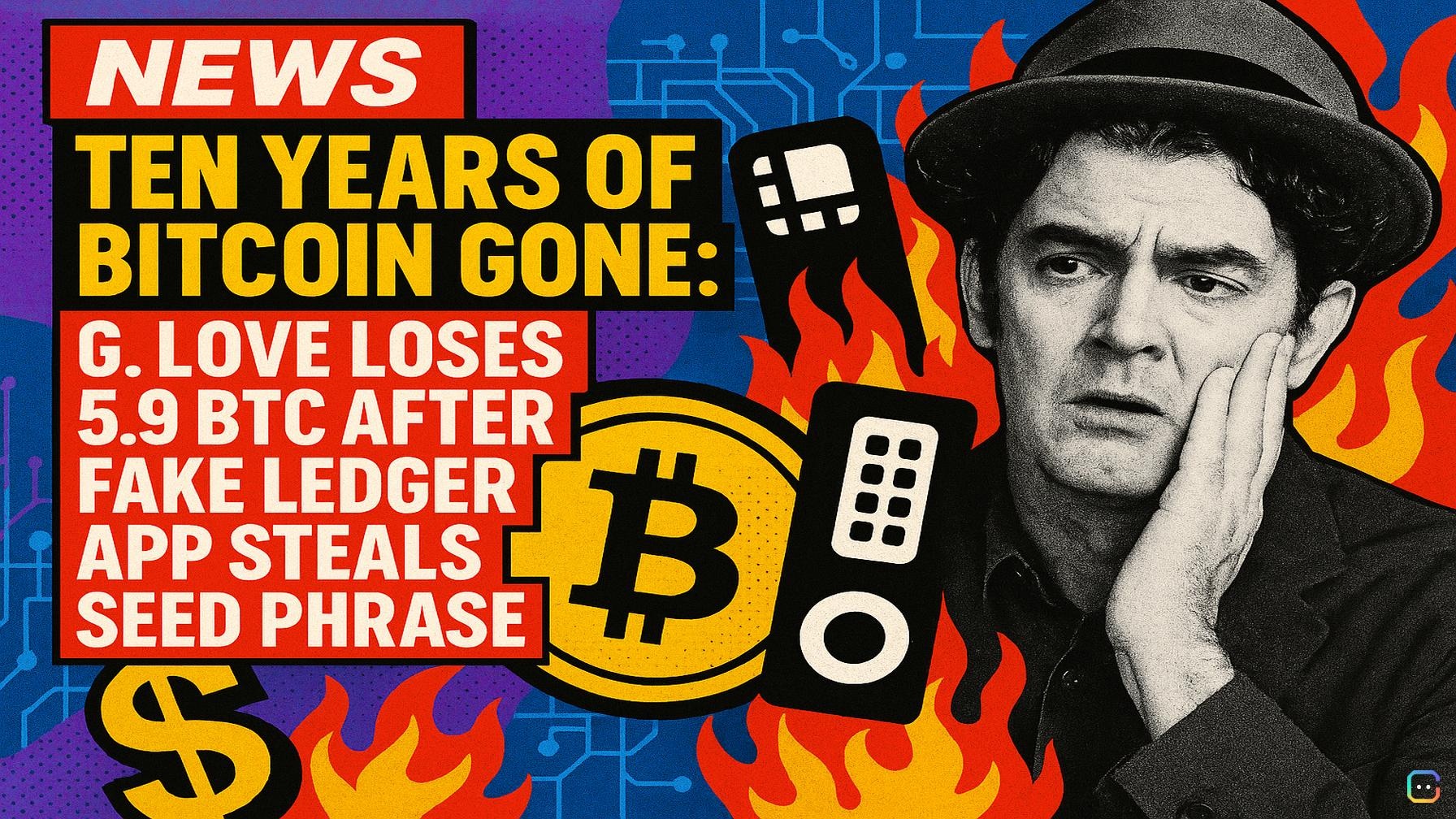
Ten years of Bitcoin savings wiped out in a single afternoon: that’s the loss suffered by American musician Garrett Dutton — better known as G. Love — after a fake crypto app tricked him into handing over his seed phrase.
What happened
- Dutton says he had been accumulating Bitcoin since 2017 as a long-term retirement fund. On April 11, 2026, he posted to X (formerly Twitter) that about 5.9 BTC — roughly $420,000 — vanished after he downloaded what looked like the Ledger Live desktop app from Apple’s App Store onto a new MacBook.
- The app was a counterfeit. It prompted him to enter his wallet’s seed phrase — the master key for self-custody wallets. He complied, and the funds were immediately drained.
Blockchain tracing and response
- Blockchain investigator ZachXBT quickly traced the theft. He found the coins split across nine transactions and moved into deposit addresses associated with crypto exchange KuCoin, sharing transaction evidence including a hash beginning 6f5c8eb6b0...
- KuCoin replied to ZachXBT’s post with a standard customer-facing statement. Dutton has not disclosed how he was led to the fraudulent download.
- Apple did not respond to requests for comment. The incident echoes a 2023 attack in which a fake Ledger Live app slipped through Microsoft’s app review and siphoned nearly $600,000; Microsoft later acknowledged that the malicious app bypassed its vetting process.
Bigger picture
- This is part of a wider trend: the FBI reported Americans lost more than $11 billion to crypto-related fraud in 2025, up from $9 billion the prior year.
- The core exploit here wasn’t a software bug but a social-engineering trap: convincing a user to reveal their seed phrase. No legitimate wallet or app will ever ask you to type your seed phrase into a program or website.
Practical takeaways
- Never enter your seed phrase into an app, website, or prompt. Treat it like the master key it is.
- Only download wallet software from official sources linked from the vendor’s website; verify developer identity and checksums where provided.
- Consider hardware wallets and follow vendor migration guides when switching devices.
- If you must use an online or mobile wallet, enable every available security layer (vendor-recommended PINs, passphrases, and 2FA) and keep only what you need on hot wallets.
- If funds are stolen, contact the exchange(s) implicated and file reports with law enforcement and platforms such as Chainalysis or trusted blockchain investigators — though recovery is often unlikely once seed phrases are exposed.
Dutton’s experience is a stark reminder that in self-custody crypto, user error can be as devastating as any exploit. Vigilance around downloads and an unshakable rule — never share your seed phrase — remain the first lines of defense.
Read more AI-generated news on: undefined/news