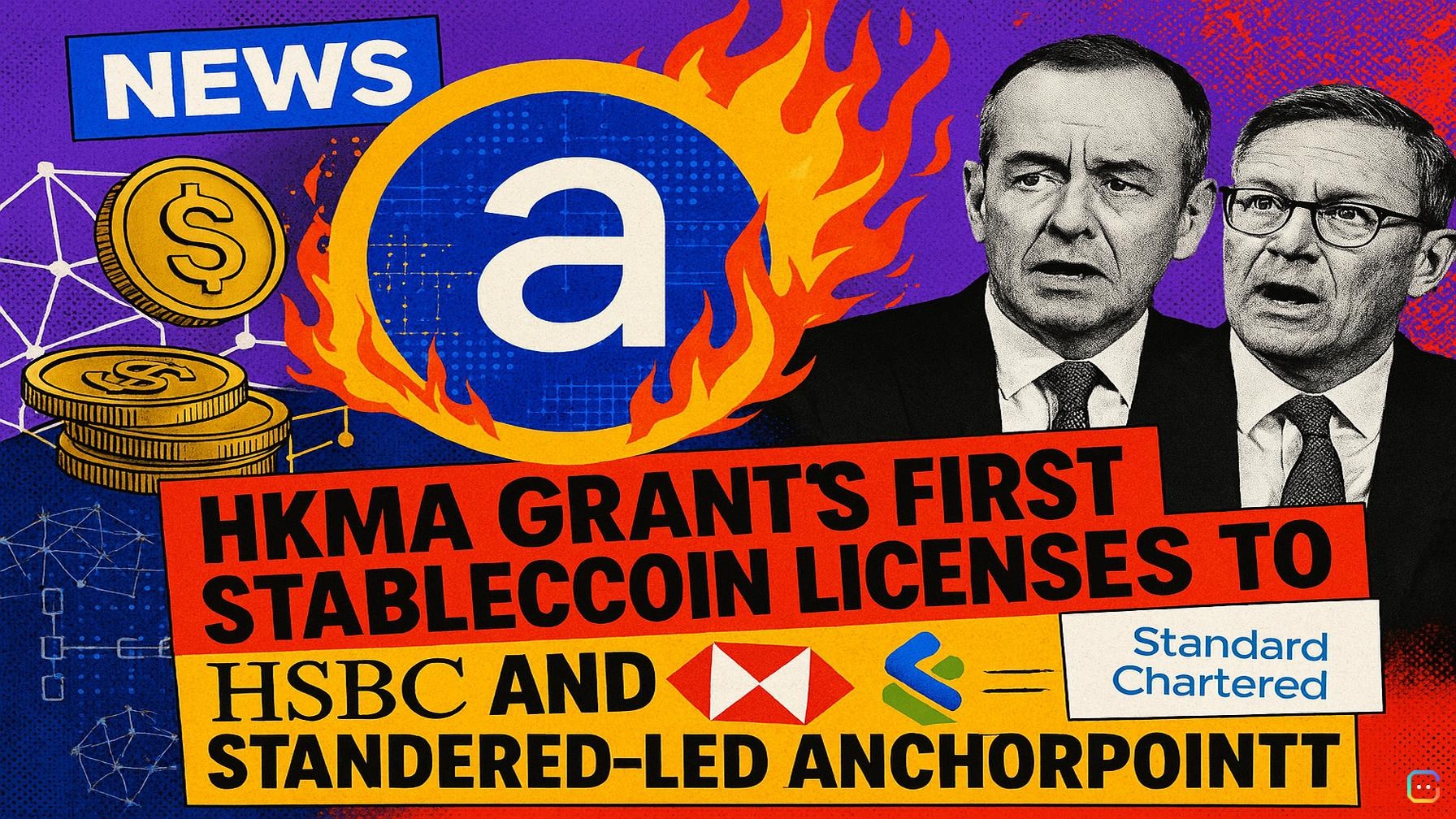
Hong Kong’s push into regulated digital money took a decisive step Friday as the Hong Kong Monetary Authority (HKMA) issued the city’s first two stablecoin issuer licenses — to HSBC and Anchorpoint Financial, a Standard Chartered–led joint venture that includes Animoca Brands. These approvals are the first under the Stablecoins Ordinance, which came into force in August 2025.
Why it matters
- The HKMA assessed 36 applications but made clear only a “small number” would be approved, prioritizing risk management, reserve quality and anti-money‑laundering controls. The regulator’s cautious rollout signals Hong Kong wants controlled, bank-backed adoption rather than open-market experimentation.
- HSBC and Standard Chartered were chosen first by design: they are two of only three commercial banks authorized to issue Hong Kong dollar banknotes — a historical role dating back to 1846. Today, those note-issuing banks back printed notes with U.S. dollar deposits in the government’s Exchange Fund at a fixed HK$7.80 per USD, a mechanism the HKMA likens to an on‑chain equivalent in concept.
Regulation and compliance
- The licenses come with one of the strictest KYC and AML frameworks for digital money globally. Under HKMA guidance, licensed stablecoins can only move to identity‑verified wallets. The travel rule applies to transfers above HK$8,000 (roughly US$1,000).
- Practically, this means HKD stablecoins will likely embed compliance into their smart contracts and maintain on‑chain whitelists of approved wallet addresses — a structural difference from freely transferable tokens such as USDT or USDC.
Policy context and the CBDC question
- The bank-led model reflects the HKMA’s decision to deprioritize a retail central bank digital currency (CBDC). An 11-group pilot completed in October found limited retail demand, and stablecoins emerged as a core focus at recent fintech events in place of CBDC debates.
- HKMA chief executive Eddie Yue framed regulated stablecoins as a way to “address pain points in financial and economic activities” and to “support the healthy development of digital assets in Hong Kong.”
Market implications
- Standard Chartered CEO Bill Winters has said regulated stablecoins and tokenized deposits could “lay the foundation for a new era of digital trade settlement,” positioning bank-issued tokens as a medium for cross-border commerce. Whether regional corporates and payment rails will embrace a non‑USD stablecoin remains an open question.
- Stablecoins are roughly a $310 billion asset class today, overwhelmingly dominated by USD-pegged tokens. Data from CoinGecko shows the largest stablecoins by market cap are dollar-denominated; no euro- or yen-pegged token has broken into the top ranks. Hong Kong is betting that tightly regulated, bank‑issued HKD stablecoins can develop the network effects needed for regional trade settlement.
What to watch next
- Rollout details from HSBC and Anchorpoint: timing, reserve arrangements and how compliance will be enforced on-chain.
- Whether corporate treasury and cross-border settlement use cases adopt HKD stablecoins over dominant USD alternatives.
- How the regulatory model influences other jurisdictions considering bank-led, highly regulated stablecoins.
UPDATE (April 10, 10:15 UTC): Amended description of Anchorpoint from consortium to joint venture.
Read more AI-generated news on: undefined/news