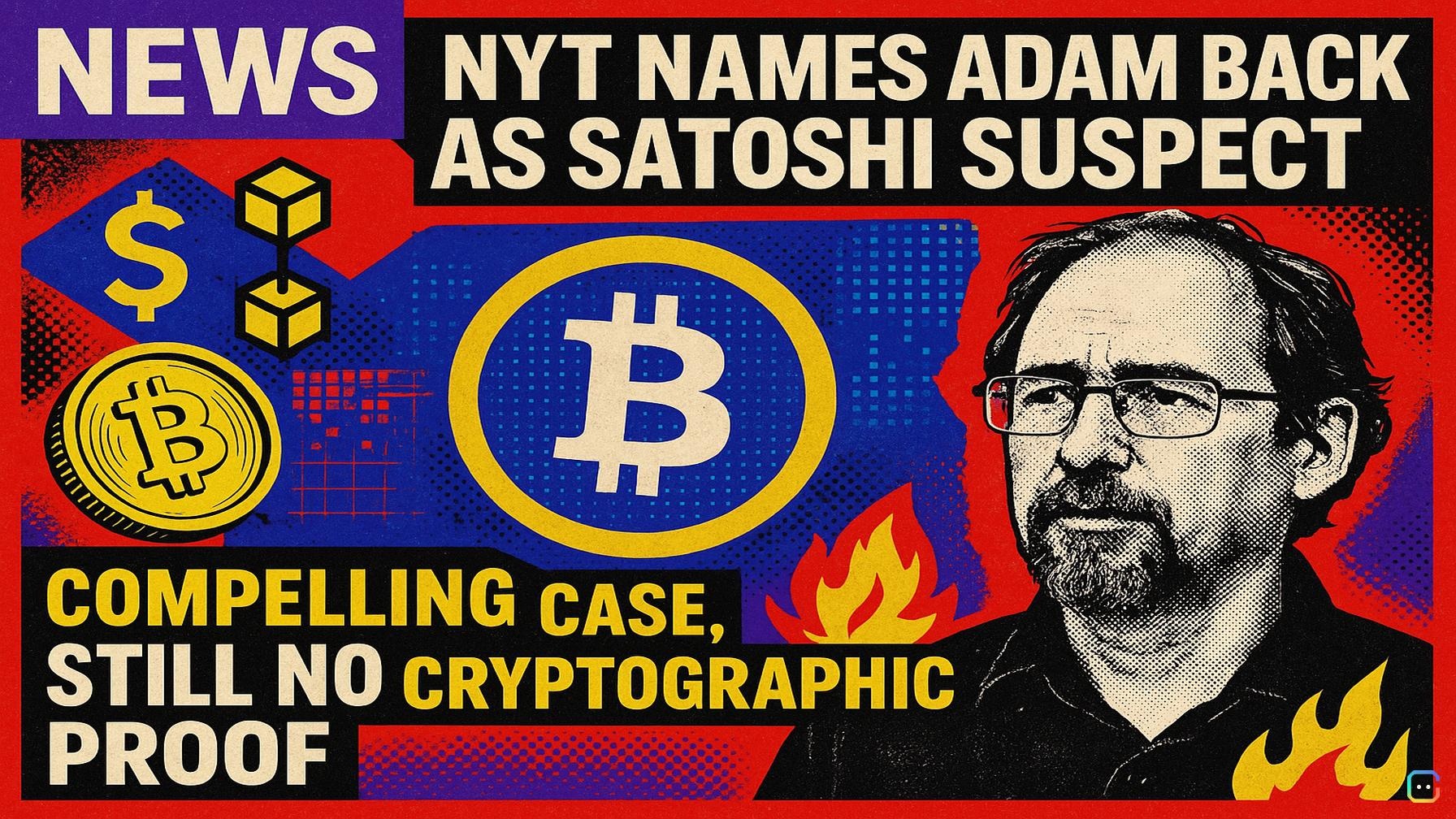
Headline: NYT names Adam Back as its Satoshi Nakamoto pick — strong circumstantial case, no cryptographic proof
A New York Times long-form investigation by Pulitzer-winning reporter John Carreyrou has for the first time a top U.S. legacy outlet directly naming a candidate for Satoshi Nakamoto: Adam Back, the 55‑year‑old British cryptographer best known as the creator of Hashcash and CEO of Blockstream. The piece pulls together technical, historical and linguistic threads to argue the overlap between Back’s work and Satoshi’s is too tight to be mere coincidence — but it stops short of the one thing the crypto world demands: cryptographic proof.
What the NYT lays out
- Motivation and author: Carreyrou, a two-time Pulitzer winner, says a year of reporting led him to focus on Back after watching the 2024 HBO documentary Money Electric: The Bitcoin Mystery and reviewing a large corpus of early Satoshi emails made public in the COPA v. Craig Wright litigation.
- Documentary clue: Carreyrou found how Back reacted in the HBO film — a visible tension when his name was floated — to be a prompt for deeper reporting.
- Email evidence: A large dump of early Satoshi correspondence surfaced in the Craig Wright case. Among them were exchanges between Back and the person using the Satoshi identity in 2008–2009. Those emails discuss Bitcoin’s design, cite Hashcash, and show Back recommending Wei Dai’s b‑money — despite historical oddities in the timeline and citations that Carreyrou flags as suspicious.
- Cypherpunks and precedent ideas: Back was active in 1990s Cypherpunk and Cryptography mailing lists, where he advocated decentralized electronic cash, independent nodes, censorship resistance and proof‑of‑work spam prevention years before Bitcoin’s launch. He proposed combining his Hashcash proof‑of‑work idea with b‑money-like systems — essentially the architecture Satoshi later used. Satoshi explicitly cited Back’s Hashcash paper in the 2008 whitepaper.
- Technical profile match: Back has a PhD in distributed systems, professional experience in network security and public‑key crypto, and used C++ — the same language used in early Bitcoin code. Carreyrou argues that the combination of ideological alignment, technical skillset and network position is striking.
- Stylometry by AI: Traditional stylometric tools were inconclusive, so NYT data reporter Dylan Freedman applied AI‑based analysis to thousands of cypherpunk posts, searching for British spelling, grammar tics and other patterns. That filtering reportedly reduced suspects to a small pool that included Back.
Why the case is persuasive — but not definitive
The NYT’s presentation strings together a lot of circumstantial evidence: historical posting behavior, technical blueprints predating Bitcoin, direct email exchanges, citation trails and linguistic patterns. Taken together, Carreyrou says the constellation of clues “stretches plausibility” if treated as coincidence.
Yet every serious Satoshi theory encounters the same hard hurdle: no one has produced cryptographic proof. Past contenders (Hal Finney, Nick Szabo, Dorian Nakamoto, Len Sassaman, Craig Wright) either denied authorship or were discredited by lack of signature or by contradictory evidence. Carreyrou himself confronted Back at a Bitcoin conference in El Salvador; Back again denied being Satoshi, and Carreyrou says his denial further narrowed his suspicions.
Why the crypto community cares
- Practical stakes: If Satoshi were credibly identified, regulators, litigants and courts might reinterpret Bitcoin’s origins, potentially revisiting questions about intent, control or securities-style arguments — a matter of concern to many in crypto.
- Market reaction: Without an on‑chain move from Satoshi-era addresses or a verifiable signature from early keys, markets will likely treat the NYT story as interesting but not market-moving. A genuine cryptographic proof, however, would be a material volatility event with uncertain consequences.
- Cultural values: Many Bitcoin proponents view Satoshi’s anonymity as a feature — it reinforces the “no founder, no CEO” narrative that underpins Bitcoin’s ethos.
Bottom line
Carreyrou’s NYT piece makes a serious and methodical circumstantial case pointing at Adam Back. It compiles historical posts, technical lineage and novel AI-based linguistic analysis to build a narrative few previous mainstream reports have attempted. But it’s not the same as cryptographic proof. Until Satoshi-era coins move or a verifiable signature from Satoshi’s early keys appears, the story will remain a compelling but unresolved chapter in Bitcoin’s long-running identity mystery — one with significant legal, market and cultural implications if ever conclusively settled.
Read more AI-generated news on: undefined/news