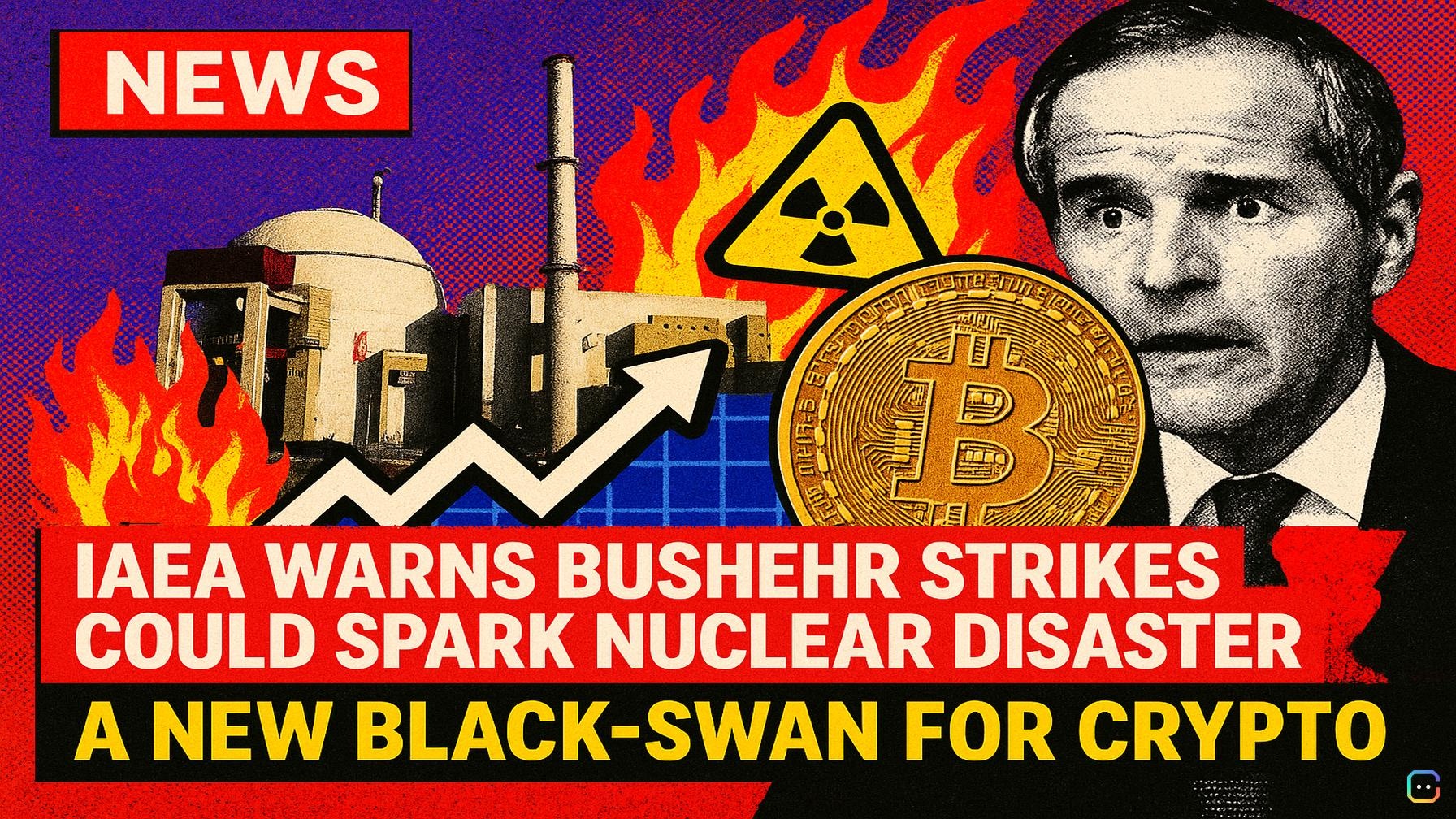
Headline: IAEA Warns Strikes Near Bushehr Could Trigger Cross‑Border Radiation Disaster — A New Black Swan for Crypto Markets
The world’s nuclear watchdog has issued a dire warning that elevates the conflict in the Middle East into a global safety emergency — and poses acute risks for financial markets, including crypto. IAEA Director‑General Rafael Grossi said strikes near Iran’s Bushehr nuclear power plant “create a very real danger to nuclear safety and must stop,” calling Bushehr the Iranian facility “where the consequences of an attack could be most serious.”
Key facts
- Iranian officials say Bushehr — the country’s only operational nuclear reactor — has been struck or targeted four times since the war began on February 28.
- IAEA satellite imagery confirmed at least one strike as close as 75 meters from the plant perimeter.
- One member of the plant’s physical protection staff was killed by projectile fragments in the most recent incident; a building on site was damaged by shockwaves. The IAEA reports no detected increase in radiation levels so far.
- Bushehr contains thousands of kilograms of nuclear material. A direct hit on the reactor core or spent fuel pools could release radioactive isotopes such as caesium‑137, which wind and water could carry across the Persian Gulf and into neighboring countries for years to come.
- Russia’s Rosatom, which built and jointly operates Bushehr, has evacuated its 198‑person staff from the site.
- Iran’s foreign minister, Ali Bagheri‑Kani (Araghchi), criticized Western governments on X, comparing the situation to Zaporizhzhia in Ukraine and warning that radioactive fallout could reach Gulf Cooperation Council capitals. He also formally alerted U.N. Secretary‑General António Guterres to the risks.
- The World Health Organization’s director‑general warned a strike could “trigger a nuclear accident, with health impacts that would devastate generations.”
Why this matters beyond the region
Grossi’s statement frames Bushehr not just as a regional flashpoint but as a potential trigger for transnational environmental and humanitarian consequences. Even without an immediate radiological release, attacks this close to an operating nuclear reactor dramatically raise the risk profile for the entire region — from public health to shipping lanes and energy infrastructure.
Why crypto markets should pay attention
A radiological event at Bushehr would be a genuine black‑swan for global markets, not merely another geopolitical development. Crypto assets have already shown acute sensitivity to escalations involving Iranian nuclear sites: previous strikes on Iranian nuclear infrastructure prompted sharp, rapid declines in Bitcoin and Ethereum, erasing over $60 billion in crypto market value in a single day last year.
How an incident at Bushehr could ripple into crypto:
- Risk‑off flows: A major nuclear accident would push investors into safe havens (gold, USD, government bonds), triggering broad sell‑offs in risk assets including crypto.
- Energy and inflation pressures: Disruption or threats to Gulf energy infrastructure could spike oil prices, fueling inflation concerns and uncertain monetary reactions that often unsettle crypto markets.
- Market liquidity and volatility: Sudden illiquidity in derivatives and spot markets can produce outsized swings in volatile assets like Bitcoin and altcoins.
- Regulatory and operational risk: Broader sanctions, shipping disruptions, or infrastructure attacks could affect exchanges, miners, and custodial services with exposure or operations in the region.
What traders and observers should watch now
- Official IAEA radiation readings and satellite updates.
- Oil prices and shipping disruptions near the Strait of Hormuz and Persian Gulf.
- Risk‑off indicators (Treasury yields, gold, USD index) and crypto spot/derivatives liquidity.
- Statements from Rosatom, Iran, and involved states that might signal escalation or de‑escalation.
Bottom line
The IAEA’s strongest warning to date has put nuclear safety squarely on the table as the conflict escalates. For crypto markets — already reactive to geopolitical shocks — Bushehr represents a unique systemic threat: a single radiological event could reshape energy markets, investor risk appetite, and market liquidity worldwide. Traders and crypto firms should monitor technical indicators and credible international updates closely while policymakers and international institutions press for protections around nuclear sites.
Read more AI-generated news on: undefined/news