Headline: Why the next three weeks in the US Senate could determine XRP’s 2026 trajectory
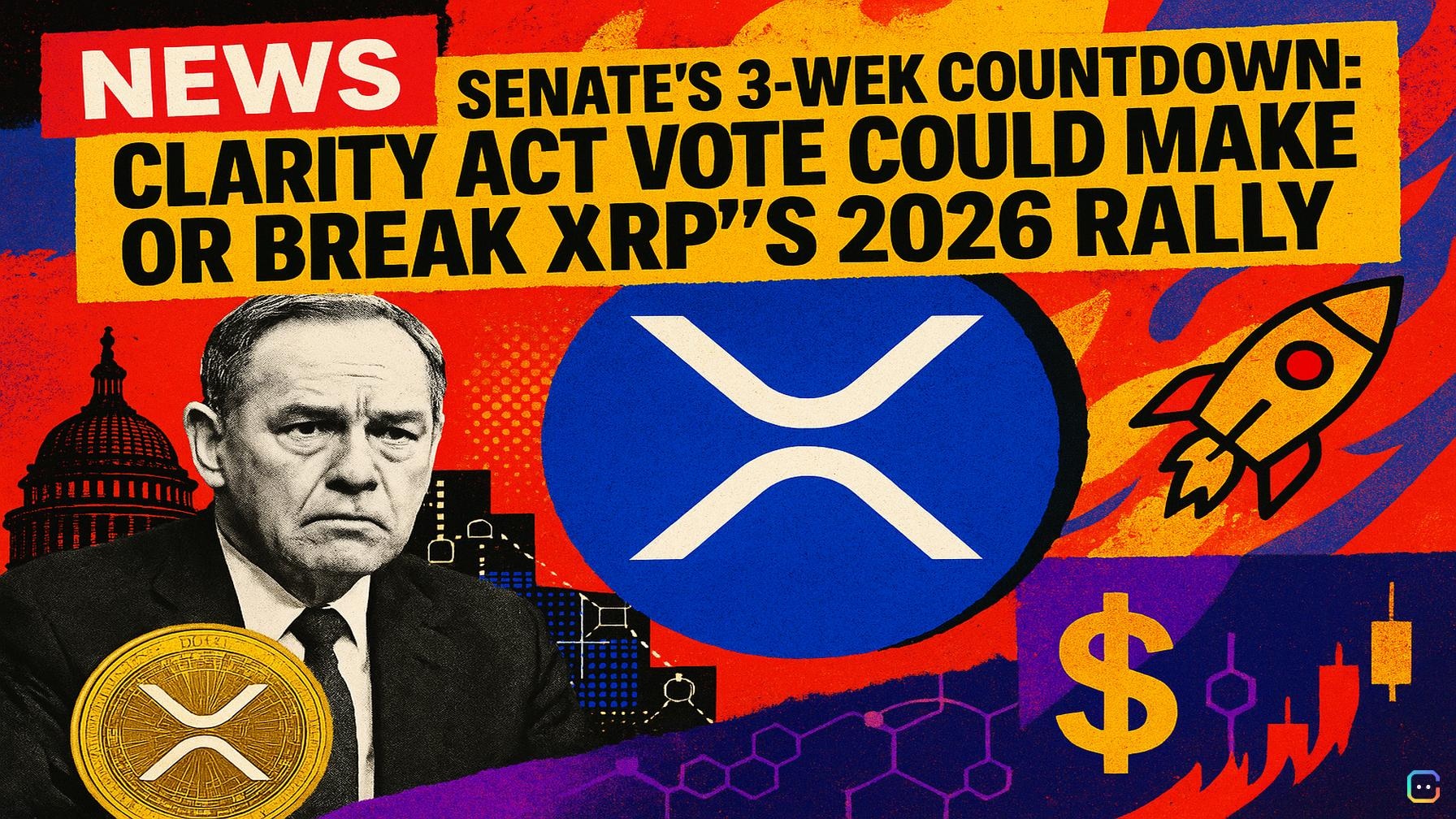
The clock is ticking for XRP. With the Senate Banking Committee eyeing a late-April markup of the CLARITY Act and Senator Bernie Moreno warning that missing a May floor vote would effectively doom the bill for 2026, the coming three weeks in Washington may be the most consequential stretch for XRP this year.
Where XRP stands now
- As of April 6 XRP traded around $1.34, up about 2.2% amid broader risk-on flows, but still more than 63% below its July 2025 peak of $3.65.
- Q1 2026 was especially brutal: 24/7 Wall St. reports it was XRP’s worst quarter in eight years, with market capitalization shrinking by nearly $29 billion — despite the SEC and CFTC jointly classifying XRP as a digital commodity on March 17.
Why the CLARITY Act matters
Analysts say the March regulatory interpretive guidance alone won’t convince big banks and asset managers to deploy capital at scale. The current classification is an interpretive release, not statute, and could be reversed by a future administration. That’s why passage of the CLARITY Act — federal law that would lock in legal certainty — is seen as the key step to trigger institutional flows.
The legislative timetable
- The Senate returns from Easter recess on April 13; the Banking Committee is targeting a markup in the second half of April. That window is now the focal point.
- Polymarket places the odds of the CLARITY Act being signed into law in 2026 at roughly 63–66%.
- Senator Moreno has publicly cautioned that if the bill doesn’t reach the Senate floor by May, midterm election dynamics will push it off the calendar for the year. Even Ripple CEO Brad Garlinghouse has adjusted his timeline, moving an expected passage from the end of April to the end of May.
Stablecoin compromise and other sticking points
One major sticking point appears to be the stablecoin yield debate. Senators Tillis and Alsobrooks reached an in-principle compromise on March 20 that would ban passive yields on stablecoin balances while permitting activity-based rewards tied to payments and platform use — a deal that, if preserved, clears a significant obstacle for broader crypto legislation.
Market implications if the bill advances
Standard Chartered analyst Geoffrey Kendrick estimates that a late-April advance by the Banking Committee could unlock $4–8 billion in additional inflows into US spot XRP ETFs. Seven US spot XRP ETFs already attracted $1.44 billion after launching between September and December 2025 — and those inflows occurred without the CLARITY Act being law. Enactment would give institutional capital “permanent legal cover,” likely locking hundreds of millions of XRP in custody, tightening circulating supply and, according to 24/7 Wall St., creating momentum that could push XRP above $1.60 and potentially toward its prior cycle high.
Downside if the bill stalls
If the CLARITY Act stalls past May, Standard Chartered has already pared back its 2026 XRP forecast to a best-case $2.80 (from an earlier $8 target). Without statutory clarity, XRP would likely mirror Bitcoin’s movements — and Bitcoin is currently range-bound between $65,000 and $73,000 amid expectations the Fed will keep rates steady through year-end. 24/7 Wall St. suggests a scenario where a CLARITY Act delay combined with BTC breaking below $60,000 could send XRP down toward $0.82.
The takeaway
April is shaping up as a narrow, high-stakes window for XRP. If the Banking Committee advances the CLARITY Act before May, Q2 could open with the legal certainty and institutional flows that Q1 lacked. If not, XRP’s outlook becomes far more dependent on broader crypto market trends and Bitcoin’s performance — and downside risks rise significantly.
Read more AI-generated news on: undefined/news